
Katanga murder trial: Defence seeks Molly’s acquittal at no-case stage
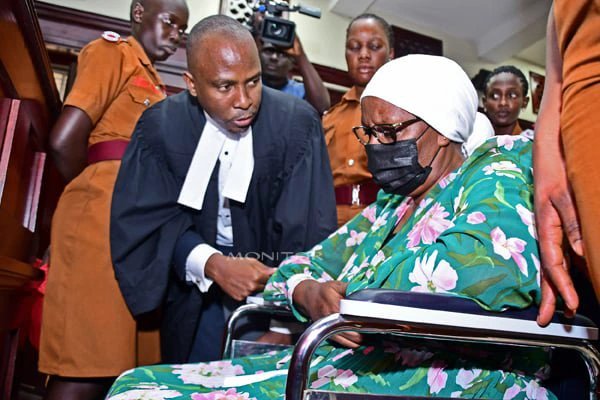

Ms. Molly Katanga (right), the key suspect in the murder of her husband Henry Katanga, speaks to one of her lawyers Bruce Musinguzi at the High Court in Kampala on July 2, 2024.
Defence lawyers in the murder trial of Molly Katanga have asked the High Court to acquit her at the no-case-to-answer stage, arguing that the prosecution failed to present credible evidence to justify putting her on defence.
In jointly filed 22-page written submissions, the law firms of Kampala Associated Advocates (KAA) and Tumusiime, Kabega & Co Advocates contended that the testimony of 25 prosecution witnesses collapsed under cross-examination and failed to establish the essential ingredients of murder.
“My Lord, the prosecution’s case has disintegrated. The ingredients of murder are not simply unproven; the evidence offered to prove them has been so thoroughly discredited that, applying the test in Bhatt v Republic, no reasonable tribunal could safely convict upon it,†the defence submitted on December 22.
They added: “This is not a case falling short of proof beyond a reasonable doubt; it is a case devoid of proof altogether. We therefore respectfully pray that this Honourable Court finds that accused one, Molly Katanga, has no case to answer and acquits her accordingly.â€
The defence urged trial judge Justice Rosette Comfort Kania to acquit Molly Katanga at this stage.
Molly Katanga is charged with the murder of her husband, businessman Henry Katanga, who died at their home in Kampala on November 2, 2023. Prosecutors allege she killed him and was aided by her daughters, Patricia Kakwanzi and Martha Nkwazi Katanga, family doctor Charles Otai, and a domestic worker, George Amanyire, in covering up the crime.
However, the defence argued that the prosecution proved only the fact of death and failed to link any of the accused to an unlawful killing. Counsel described the state’s case as relying on unreliable forensic evidence, contradictory testimony, and procedural irregularities.
On DNA evidence, the defence submitted that the prosecution’s own expert conceded that DNA findings could not establish who handled the pistol, when it was handled, or how the DNA was deposited. They further questioned the chain of custody of the swab allegedly taken from the firearm, noting that no physical exhibit was produced in court.
The defence also challenged the gunshot residue (GSR) evidence, pointing to discrepancies between the number of swabs allegedly taken from Molly Katanga and those analysed by forensic laboratories, which they said undermined the reliability of the results.
Counsel further relied on medical evidence showing that Molly Katanga sustained multiple injuries, including fractures and head wounds, arguing that this made it improbable that she could have fired a gun. They contrasted this with what they described as evidence consistent with suicide, including the trajectory of the fatal gunshot and the absence of defensive injuries on the deceased.
Regarding the co-accused, the defence argued that their actions after the incident did not amount to accessory or evidence-tampering offences, characterising their conduct as a response to an emergency rather than a criminal conspiracy.
The defence also criticised investigators for what they described as a premature and flawed investigation, noting that Molly Katanga was charged before key forensic reports had been completed.
According to timelines issued by the court on December 2, the prosecution—led by Assistant DPP Samali Wakooli and Jonathan Muwaganya—is expected to file its response to the defence submissions by January 28, 2026, with a rejoinder, if any, due by February 5, 2026.
Justice Kania is scheduled to deliver her ruling on whether there is a case to answer on February 19, 2026.
If the court finds the prosecution’s evidence insufficient, the accused will be acquitted. If not, they will be required to present their defence before judgment is delivered.
The ruling will be a key milestone in one of the country’s most closely watched criminal trials


 Government will not gazette Kijanangoma as King of Tooro for now - Attorney General insists
Ultimate Uganda
Government will not gazette Kijanangoma as King of Tooro for now - Attorney General insists
Ultimate Uganda
 King Oyo’s Body to Arrive Thursday
Ultimate Uganda
King Oyo’s Body to Arrive Thursday
Ultimate Uganda
 Besigye, Lukwago expected to meet Gen. Salim Saleh today at Kapeeke
Ultimate Uganda
Besigye, Lukwago expected to meet Gen. Salim Saleh today at Kapeeke
Ultimate Uganda
 Rwabwogo Advised to ‘Eat His Bishop’ As MK Prepares to Enter State H’se: PREZ MUSEVENI ON HIS WAY OUT
Ultimate Uganda
Rwabwogo Advised to ‘Eat His Bishop’ As MK Prepares to Enter State H’se: PREZ MUSEVENI ON HIS WAY OUT
Ultimate Uganda
0 Comments