
Uganda: Museveni Defends BVV Machines As Key to Credible Polls, Says Technology Closed Opposition's 'Cheating Lifeline'
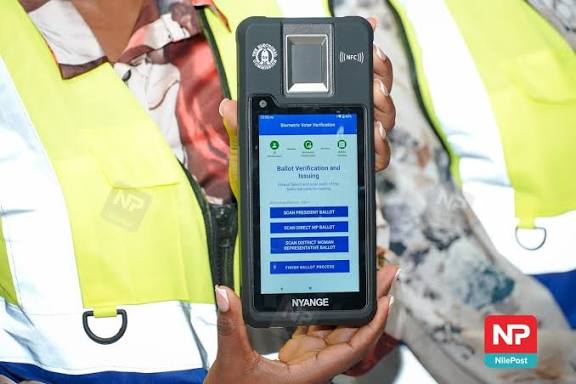

President Museveni has strongly defended the use of Biometric Voter Verification (BVV) machines in the recently concluded elections, arguing that the technology curtailed electoral fraud and strengthened transparency, while framing the broader vote within the National Resistance Movement's historical narrative of stability, economic recovery and mass-oriented reforms.
In his February 12, 2026 post-election statement--styled as a "condolence to the Opposition"--President Museveni placed unusual emphasis on the role of technology in protecting the integrity of the ballot.
He described the BVV machines as decisive in neutralising what he characterised as long-standing manipulation of the secret ballot system.
"The death-knell to the opposition were the BVV machines," Museveni said. "With the BVV machines, the Opposition's life-line of cheating, was gone."
Follow us on WhatsApp | LinkedIn for the latest headlines
He added: "I also affirm that the BVV machines work when properly handled, as reflected in the results from various districts."
The President extended his argument further, linking BVV performance directly to district-level outcomes. Citing Nebbi as an example, he said the machines functioned effectively where operators were properly trained.
"In Nebbi, they worked in all the 362 polling stations and NRM got 81%, NUP 15.4%," Museveni stated. "The BVV machines work if they are manned by people who know how to use them."
Minister of State for Energy and Mineral Development Phiona Nyamutoro reinforced the same position, noting: "In Nebbi, the BVV machines worked well in all the 362 polling stations and NRM scored 81%."
The President's message went beyond electoral technology. It served as a sweeping political reflection on the trajectory of Uganda under the National Resistance Movement (NRM), recounting what he described as the removal of "mikyeno" -- societal bottlenecks -- since 1986.
He revisited the end of extra-judicial killings, the defeat of insurgent groups, the restoration of industrial production, expansion of infrastructure, and mass immunisation campaigns launched in 1987 against six childhood killer diseases.
He also defended flagship anti-poverty interventions such as Entandikwa, Universal Primary Education (UPE), NAADS, Operation Wealth Creation (OWC) and the Parish Development Model (PDM), arguing that economic transformation had steadily expanded household participation in the money economy.
Museveni also addressed what he called internal weaknesses within the NRM, including poor supervision of mass programmes and "Najja-kulya" politics, which he said discouraged voter turnout among some party supporters.
But it was the electoral integrity debate that dominated the political undertone of his remarks. He alleged that past elections under the secret ballot system had been marred by ballot stuffing, multiple voting and result alteration, arguing that reforms were necessary to curb systemic abuse.
BVV machines in electoral framework
Biometric Voter Verification (BVV) machines are designed to confirm a voter's identity using fingerprint data captured during registration.
Before a ballot is issued, polling officials verify that the voter's biometric details match the national voters' register. This is intended to prevent multiple voting, impersonation and voting by unregistered individuals.
Uganda's Electoral Commission introduced biometric voter registration ahead of the 2016 general elections and progressively integrated biometric verification at polling stations.
By the 2021 elections, BVV kits were deployed nationwide, though there were reports in some areas of technical glitches and fallback to manual identification where devices failed.
In the 2026 elections, the technology was again central to voter authentication.
Electoral management experts generally agree that biometric systems, when properly deployed, can significantly reduce common forms of electoral malpractice such as duplicate voting and ghost voters.
However, their effectiveness depends on proper operator training, device reliability, power backup, and contingency protocols.
Museveni acknowledged operational challenges in his statement, noting that "many BVV machine operators did not learn how to use them properly," which he suggested created limited room for irregularities "here and there."
By pointing to districts such as Nebbi, Bulambuli and Namisindwa--where he cited detailed percentage outcomes--the President sought to demonstrate correlation between smooth BVV operation and strong NRM performance.
The BVV defence was embedded within a broader leadership narrative. Museveni reminded supporters that he addressed 143 rallies across 153 districts, standing "in the sun and rain" alongside crowds.
"Leadership means sharing both comfort and hardship with the people," he said.
He also called for "principled reconciliation" and urged Ugandans to "abandon any bad behaviour and act fairly to all, even opposition," even as he maintained that the opposition's electoral pathway had narrowed following tighter verification controls.
By tying BVV machines to credibility, and credibility to NRM dominance, Museveni positioned the technology not merely as an administrative tool but as a structural safeguard against what he describes as systemic fraud.
As post-election analysis continues, the role of biometric verification is likely to remain central in debates over transparency, trust and electoral reforms in Uganda.
For the President, however, the message was clear: when "properly handled," the BVV system works -- and in his view, it reshaped the balance of forces at the ballot box.


 Government will not gazette Kijanangoma as King of Tooro for now - Attorney General insists
Ultimate Uganda
Government will not gazette Kijanangoma as King of Tooro for now - Attorney General insists
Ultimate Uganda
 King Oyo’s Body to Arrive Thursday
Ultimate Uganda
King Oyo’s Body to Arrive Thursday
Ultimate Uganda
 Besigye, Lukwago expected to meet Gen. Salim Saleh today at Kapeeke
Ultimate Uganda
Besigye, Lukwago expected to meet Gen. Salim Saleh today at Kapeeke
Ultimate Uganda
 Rwabwogo Advised to ‘Eat His Bishop’ As MK Prepares to Enter State H’se: PREZ MUSEVENI ON HIS WAY OUT
Ultimate Uganda
Rwabwogo Advised to ‘Eat His Bishop’ As MK Prepares to Enter State H’se: PREZ MUSEVENI ON HIS WAY OUT
Ultimate Uganda
0 Comments