
Okello sentenced to death over Ggaba kindergarten killings
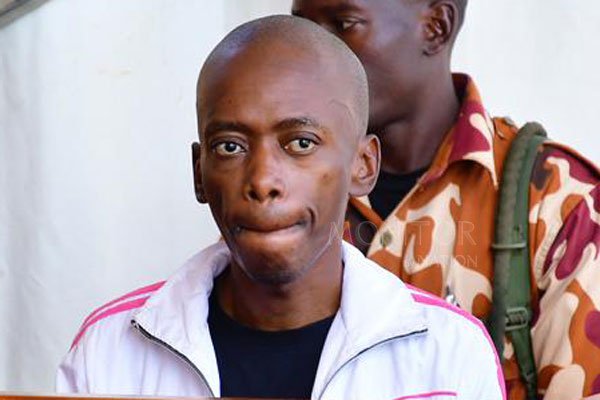

The suspect in the murder of four toddlers at Ggaba Kindergarten, Christopher Okello Onyum, in the dock during his trial and a public hearing at Ggaba Community Church, Kampala. PHOTO/ ABUBAKER LUBOWA
The High Court in Kampala has sentenced Christopher Okello Onyum to death for the brutal murder of four toddlers at Ggaba Early Childhood Development Centre, ending a case that stunned the nation.
In her sentencing, Justice Alice Komuhangi Khaukha said the offence fell within the “rarest of the rare†category, warranting the maximum penalty under Uganda’s sentencing guidelines.
The court noted that while the Sentencing Guidelines Practice Directions of 2013 provide a starting point of 35 years for murder, judges may increase or reduce the sentence depending on aggravating and mitigating factors.
Justice Khaukha agreed with the prosecution that the crime was exceptionally heinous. She highlighted that the killings were carried out in a cruel and calculated manner, targeting vulnerable children in what should have been a safe environment.
“The convict meticulously planned and executed this offence,†the judge said before adding that OIkello “attacked defenceless children who depended on adults for their protection and survival, and slaughtered them in broad daylight without regard for human life.â€
The judge further observed that Okello showed no remorse throughout the trial, including failing to apologise to the grieving families, some of whom were present in court during proceedings.
“I expected him to show remorse, to apologise to the families whose children he killed, but he did not,†she said.
The prosecution had urged court to impose the death sentence, arguing that the murders were committed with extreme brutality and premeditation. Prosecutors also contended that the nature of the killings pointed to possible ritual motives, a claim the judge said she found plausible based on evidence presented in court, including testimony from a psychiatric expert.
In mitigation, Okello declined to address the court. His defence lawyer instead offered condolences to the victims’ families and asked court to consider his troubled background, including coming from a dysfunctional family. However, the judge ruled that such factors could not justify the magnitude of the crime.
“I have considered that the convict comes from a broken family, but that is not a reason to slaughter innocent children,†Justice Komuhangi said.
She added that the sentence should serve as a deterrent to others who may engage in similar acts, particularly those driven by beliefs in ritual sacrifice.
“This sentence should send a strong message that such acts will be met with the full force of the law,†she ruled.
"I hereby sentence you to suffer death for the murder of Gideon Eteku in count one, Keisha Agenorwoth Otim in count two, Ignatius Sseruyange in count three and Ryan Odeke in count four in a manner authorised by law," the judge said.
According to the court, Okello has a right to appeal against his conviction and sentence within 14 days from the day of his sentence.
Outside the court, emotions ran high as members of the Ggaba community reacted to the verdict, with some residents breaking into song and dance, saying justice had finally been served for the slain children.
The case has drawn widespread public attention, with many Ugandans calling for stronger measures to protect children and curb violent crime.
A case like no other
What began as a gruesome crime that stunned the nation quickly transformed into one of the most extraordinary criminal trials Uganda has witnessed in recent years, blending raw public emotion, experimental justice, and a series of dramatic scenes that kept the country gripped for the better part of the month of April.
On April 2, a man allegedly walked into Ggaba Early Childhood Development Programme and, in a chilling sequence, stabbed four toddlers aged between one and two-and-a-half years to death using a kitchen knife.
The suspect, who was later identified as a 38-year-old Christopher Okello Onyum, was arrested at the scene, triggering nationwide outrage and calls for swift justice.
In response, President Museveni reportedly directed the Judiciary to deploy a newly introduced mobile court system, allowing proceedings to be held within the community where the killings occurred.
The aim was to deliver justice in full public view, an approach rarely seen in Uganda’s criminal justice system. Within days, the Judiciary set up a makeshift courtroom at Ggaba Community Church playgrounds next to Lake Victoria, erecting large tents to accommodate lawyers, journalists, and hundreds of residents eager to follow the proceedings.
What was initially expected to be a week-long trial instead stretched into three weeks after Okello pleaded not guilty to four counts of murder, compelling the prosecution to present its full case with a total of 18 witnesses.
But beyond the legal arguments, the trial became defined by a series of startling and, at times, chaotic scenes, some caused by Mother Nature.
On April 15, a prison van reversing toward the court venue failed to brake and ploughed into a group of journalists covering the proceedings.
Ronald Mukhwana, a reporter with an online television, was seriously injured after the van ran over him, sending shockwaves through the court. A week later, Mother Nature struck.
A sudden afternoon storm tore through the lakeside venue, ripping apart tents and forcing an abrupt suspension of court proceedings.
In a dramatic scene, strong winds dismantled the main structure sheltering the court, prompting security personnel to evacuate presiding judge Komuhangi as panicked attendees fled for safety.
Nearby worshippers responded with fervent prayers as the storm intensified. Religion became an unusual but consistent feature of the trial.
Each day began with prayers led by a local pastor, invited by the court to dedicate proceedings to divine guidance, an uncommon practice in criminal trials but one that underscored the gravity and emotional weight of the case.
Inside the courtroom, attention often shifted to the demeanour of the accused. Okello was occasionally seen laughing behind his face mask, a behaviour his lawyer, Mr Richard Kumbuga, would later cite as indicative of possible mental illness.
Public sentiment, however, remained sharply divided. While many demanded harsh treatment for the suspect, others were struck by the court’s adherence to constitutional principles.
Okello was provided with basic comforts, including bottled water, and was routinely greeted respectfully by the judge at the start of each session.
“Good morning, Mr Okello,†Justice Khaukha would say—a gesture that drew criticism from sections of the public who expected a more punitive tone.
Yet, legal experts noted that such conduct reflects the constitutional presumption of innocence until proven guilty.
As the marathon proceedings came to a close, the trial exposed tensions between public anger and judicial fairness, tested the practicality of mobile courts, and highlighted the unpredictable nature of administering justice in open community settings.


 Government will not gazette Kijanangoma as King of Tooro for now - Attorney General insists
Ultimate Uganda
Government will not gazette Kijanangoma as King of Tooro for now - Attorney General insists
Ultimate Uganda
 King Oyo’s Body to Arrive Thursday
Ultimate Uganda
King Oyo’s Body to Arrive Thursday
Ultimate Uganda
 Besigye, Lukwago expected to meet Gen. Salim Saleh today at Kapeeke
Ultimate Uganda
Besigye, Lukwago expected to meet Gen. Salim Saleh today at Kapeeke
Ultimate Uganda
 Rwabwogo Advised to ‘Eat His Bishop’ As MK Prepares to Enter State H’se: PREZ MUSEVENI ON HIS WAY OUT
Ultimate Uganda
Rwabwogo Advised to ‘Eat His Bishop’ As MK Prepares to Enter State H’se: PREZ MUSEVENI ON HIS WAY OUT
Ultimate Uganda
0 Comments