
Is this woman the worst UHRC chairperson in history? Bobi Wine thinks so
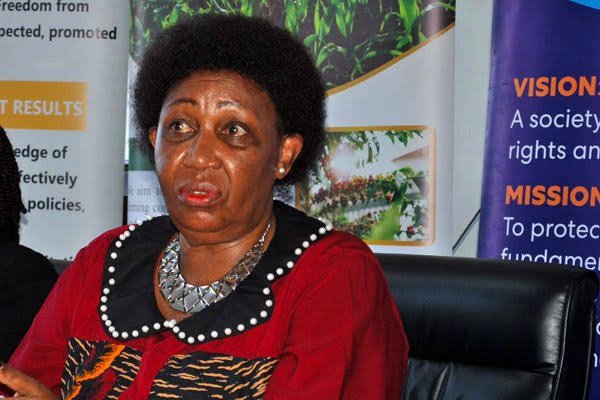

Mariam Wangadya resigned as UHRC chairperson
Mariam Wangadya, over the weekend, walked away from her job as chairperson of the Uganda Human Rights Commission (URHC), bringing to an end what some have called a disastrous cameo at a body meant to be the last line of defence for Ugandans whose rights have been violated.
In a limp resignation letter addressed to President Museveni, Wangadya thanked him “for the chance to serve Uganda in promoting and protecting human rightsâ€
Her resignation did not come out of nowhere and followed days after she had publicly accused Museveni of turning the commission into what she called a “dumping ground†for failed politicians.
Wangadya complained bitterly about the calibre of people Museveni was appointing as commissioners, singling out the former Kassanda South MP Simeo Nsubuga.
She said Nsubuga did not add any value to the commission and instead chose to engage in petty fights against her.
However, a couple of weeks before Wangadya resigned, there were reports that three commissioners had accused her of corruption and financial mismanagement.
In fact, some said the Inspector General of Government (IGG) had opened an inquiry into how she ran UHRC. Wangadya rejected the claims and challenged journalists to verify them with the IGG and the State House Anti-Corruption Unit.
She claimed the accusations had left her and her family without peace for months.
A stone in NUP’s shoes
Her departure has split opinion along Uganda’s political lines. Some people have praised her for finally speaking candidly about interference in the commission’s work, while others, particularly government-leaning voices, have accused her of “washing the institution’s dirty linen in public.â€
In fact, the Minister for Local Government, Balaam Barugahara, rebuked her for her statements.
For the opposition in Uganda, Wangadya was the worst thing that happened at UHRC.
Since her appointment in 2021, the National Unity Platform (NUP) has accused her of bias and of shielding the state from accountability rather than fighting for victims of rights abuses.
In November 2022, after NUP claimed thousands of its members had disappeared, Wangadya asked the party for details and received a list of just 25 names, a number she said surprised her given the scale of the party’s media claims.
She said she could not investigate the matter because only one of the 25 had a national identity card.
A few months later, Wangadya said seven of those on the list had been found and released, some having been charged with offences such as murder or damage to property and granted bail.
She later accused NUP of exploiting the issue for political gain, saying the party had done little to help trace the people it claimed were missing while spending its energy criticising her commission instead.
After Wangadya clashed severally with NUP over the issue of missing persons, Bobi Wine said she was unfit for her position.
In October 2023, she went further and shut the files altogether, arguing the commission’s resources had been wasted chasing people she considered not genuinely missing.
She said some of those on the list turned out to be living abroad or already free on bail for offences including terrorism and vandalising electricity infrastructure.
None of the next of kin she contacted, Wangadya said, seemed genuinely interested in pursuing the cases further.
NUP leader Robert Kyagulanyi, aka Bobi Wine, rejected that account outright and accused Wangadya of lying about relatives being uncooperative. Kyagulanyi said she was unfit for her position.
Some of the relatives of the missing NUP supporters who later spoke to journalists painted a very different picture.
One woman said she had never been contacted about her missing husband, and a brother of another missing man described searching prisons across the country without success.
At a tense tribunal hearing in 2024, Kyagulanyi accused the commission’s leadership of inaction against perpetrators and of effectively blaming the victims, before withdrawing his complaint and telling Wangadya she lacked the impartiality to hear it.
Clash with Muhoozi
Wangadya’s tenure was also marked by an uneasy relationship with the army. In May 2025, she wrote to the Chief of Defence Forces, Gen Muhoozi Kainerugaba, over the detention of NUP security aide Edward Ssebuufu, aka Eddie Mutwe, warning that continued non-compliance could leave him liable for contempt of the Constitution.
Muhoozi hit back on X, calling her letter “stupid†and demanding an apology, but Wangadya refused to back down.
At a press briefing ahead of Human Rights Day commemorations in December 2025, Wangadya admitted that fear had shaped how boldly she spoke out against abuses by security agencies.
Describing herself as “the most unpopular chairperson ever,†she conceded that her critics were partly right to say the commission went easier on security forces than on other perpetrators, and admitted that fear was the reason.
This was not the first time she had spoken publicly about threats to her safety. Back in February 2022, appearing before Parliament’s Committee on Human Rights, Wangadya told MPs plainly that her life was in danger.
She said she was being bullied by a section of Ugandans she declined to name, and that the harassment was too frightening for her to identify who exactly was behind it. She told the committee she had “a tough skin but was still human.â€
Wangadya studied Law at Makerere University before working as an advocate and later a partner at Dagira and Company Advocates in Mbale. At that time, she was also volunteering with the Uganda Association of Women Lawyers, FIDA Uganda.
In 1996, she became one of the founding commissioners of the newly created UHRC, serving alongside Margaret Sekaggya.
In 2013, she left to become deputy IGG, a post she held for eight years, before Museveni brought her back to UHRC as chairperson in 2021 after Medi Kaggwa’s sudden death.
Measured against her two predecessors, Wangadya’s tenure looks markedly different. Sekaggya, who led the commission from its birth in 1996 until 2008, is remembered as the institution’s founding mother.
Sekaggya’s first office was located in a nondescript building near Arua Park. She later oversaw the growth of UHRC built into a body with eleven regional offices and international standing.
She went on to become the first United Nations Special Rapporteur on human rights defenders, and admirers still call her the mother of Uganda’s human rights movement.
Kaggwa, who chaired the commission until his sudden death in 2019, was remembered for his outspokenness and his ability to work with both government and opposition figures. A human rights activist told Bbeg Media that Kaggwa was approachable and welcomed everyone irrespective of their political leaning.
As for Wangadya, many people believe her six years in charge have been a disaster for the commission’s credibility. They argue she has too often sided with the state and stayed silent when security forces were accused of human rights abuses.
Could she be the worst chairperson of the UHRC since it was formed in 1996?


 The women who have been in King Oyo’s life
Ultimate Uganda
The women who have been in King Oyo’s life
Ultimate Uganda
 Ex Kagame Guard Commander Tom Byabagamba Dies in Rwandan Prison After 12 Years
Ultimate Uganda
Ex Kagame Guard Commander Tom Byabagamba Dies in Rwandan Prison After 12 Years
Ultimate Uganda
 Government begins salary payments for public sector workers – Reform Committee
Ultimate Uganda
Government begins salary payments for public sector workers – Reform Committee
Ultimate Uganda
 Temangalo land: NSSF, Nzenyi reach agreement
Ultimate Uganda
Temangalo land: NSSF, Nzenyi reach agreement
Ultimate Uganda
0 Comments