
Minister Bahati Tasks Banks on Affordable Credit as Manufacturers Cry Foul
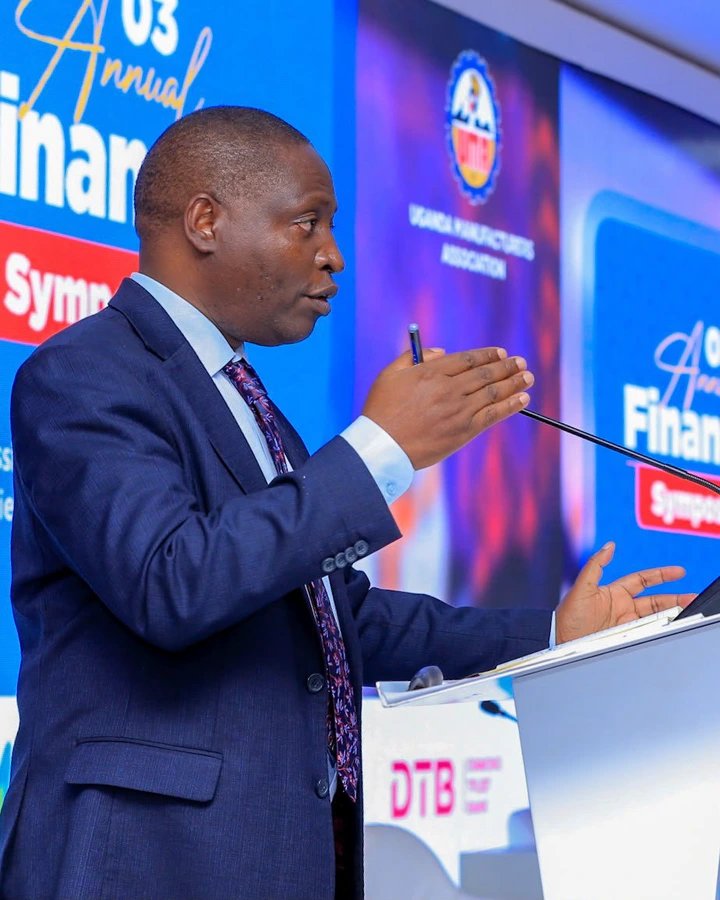

Minister Bahati Tasks Banks on Affordable Credit as Manufacturers Cry Foul
Minister David Bahati speaks durign the symposium
The Minister of State for Trade, Industry and Cooperatives, David Bahati, has challenged commercial banks to lower lending rates for manufacturers, saying the high cost of capital remains one of the biggest obstacles to Uganda’s industrial growth.
Speaking at the third annual Uganda Manufacturers Association (UMA) Financial Symposium held at Silver Springs Hotel in Bugoloobi, Kampala, Bahati said access to affordable financing is critical if Uganda is to accelerate industrialisation and achieve its economic transformation agenda.
He noted that while manufacturers generate significant returns for the economy, commercial lending rates remain far above the sector’s investment returns.
“The internal rate of return for manufacturers stands between eight percent and 12 percent, but the cost of capital remains much higher. On average, interest rates are between 18 percent and 24 percent,†Bahati said.
He argued that borrowing at such rates makes it difficult for manufacturers to break even and expand.
“Borrowing money for manufacturing at 18 percent or 20 percent and expecting to break even and make profits within five years is almost impossible,†he said.
Bahati urged banks to design financing products tailored to manufacturers, describing the sector as one of the most organised and bankable in the economy.
“I speak as a former banker and I want to tell you that manufacturers are among the most organised sectors. If somebody puts up a factory, you know where they are located and where to find them. They are not going to disappear,†he said.
The minister said affordable credit would benefit not only manufacturers but also financial institutions by stimulating job creation, increasing incomes and expanding the customer base for banking services.
“It is a cycle. Reduce interest rates, create more jobs, grow the economy and increase business opportunities,†he said.
He also urged banks to balance profitability with sustainable economic growth.
“There is also a moral responsibility. When banks announce huge profits after charging very high interest rates, one must ask whether those profits are sustainable when they come from squeezing businesses,†Bahati added.
The minister highlighted government interventions aimed at easing financing constraints, including investing more than Shs1 trillion in the Uganda Development Bank (UDB) to provide long-term industrial financing.
He also pointed to ongoing financial sector reforms, including the introduction of Islamic banking regulations and amendments to the Financial Institutions Act.
Manufacturers call for financial reforms
The Uganda Manufacturers Association Board Chairperson, Aga Sekalala Jr., said despite manufacturing contributing 16.5 percent of Uganda’s Gross Domestic Product and more than 30 percent of domestic tax revenue, the sector continues to grapple with expensive financing.
“Despite this progress, persistent structural barriers remain. High lending rates, short financing tenures and stringent collateral requirements continue to constrain growth, particularly among small and medium enterprises that form the backbone of industry,†Sekalala Jr. said.
He noted that only 22.9 percent of SMEs currently access formal financing, forcing many businesses to rely on retained earnings or informal lenders, limiting their capacity to expand, innovate and compete regionally.
The symposium, held under the theme "Harnessing Advanced Financial Models to Achieve 10-Fold Growth under the NDP IV Agenda," sought to promote innovative financing solutions through development finance, capital markets, green finance and blended financing models while strengthening trust between lenders and industry.
“We want inclusive financial systems that expand access to SMEs, de-risk industrial lending and foster dialogue that leads to actionable policy recommendations and institutional commitments from financing partners,†Sekalala Jr. said.
Banks Promise to Make Good
Responding to concerns raised by manufacturers, Diamond Trust Bank (DTB) Head of Business Banking, Douglas Damba, acknowledged that the cost of capital remains high but said banks are introducing financing solutions to improve affordability.
He explained that one of the biggest drivers of expensive lending is the high cost of funds, with commercial banks competing against government securities such as treasury bills and bonds that offer attractive returns to investors.
“Government securities provide alternative investment opportunities with attractive returns. This creates competition for available resources and can increase the cost of capital in the market,†Damba said.
He said DTB is expanding partnerships with development finance institutions and other international partners to provide blended financing, enabling manufacturers to access cheaper capital.
“Blended financing means that a partner is able to take up a portion of the transaction. Where the total financing requirement is large, they can provide more affordable financing for part of the investment, while banks finance the remaining portion,†he said.
According to Damba, the approach combines resources from commercial banks, development partners and government-backed programmes to lower borrowing costs.
He cited the Agriculture Credit Facility and the Special Business Fund, implemented in partnership with the Bank of Uganda and government, as examples of programmes that have enabled businesses, particularly SMEs, to access financing at rates as low as 10 percent.
DTB is also working with risk-sharing partners that provide guarantees to reduce collateral requirements and lower lending risks, making financing more accessible to manufacturers.
Damba acknowledged manufacturers' concerns over short repayment periods, noting that many industrial investments require six to seven years before generating meaningful returns.
“A period of five years is often not sufficient because many manufacturing projects only become economically viable after six or seven years,†he said.
He revealed that DTB has already extended repayment periods for some projects to as long as 10 years, depending on their nature and financing requirements.
EADB calls for stronger governance
The East African Development Bank (EADB) Country Manager, Francis Ogwang, said the institution remains committed to financing Uganda’s industrial sector but emphasised that manufacturers must meet governance and compliance standards.
“We mainly fund capital expenditure (CAPEX). We finance machinery and civil works. We do not fund ordinary working capital because we would like commercial banks, our partners, to come in with working capital financing,†Ogwang said.
He said manufacturers seeking financing must demonstrate strong corporate governance, sound reporting systems and compliance with Environmental, Social and Governance (ESG) standards.
“What do we ask from manufacturers? We ask for good governance. We ask for strong institutional support systems, proper reporting and compliance with ESG standards. We want stronger corporate governance, and this is very important,†he said.
Ogwang stressed that unlocking Uganda’s industrial potential will require more than access to funding, calling for integrity-driven financial systems built on trust, transparency and long-term partnerships between government, financial institutions and the private sector.


 NSSF sets September 24 for Annual Members Meeting as savers await interest rate declaration
Ultimate Uganda
NSSF sets September 24 for Annual Members Meeting as savers await interest rate declaration
Ultimate Uganda
 Boda boda riders launch e-commerce, digital loans platform
Ultimate Uganda
Boda boda riders launch e-commerce, digital loans platform
Ultimate Uganda
 Rwanda: We Cannot Sit and Watch As Illicit Alcohol Kills People - Kagame
Ultimate Uganda
Rwanda: We Cannot Sit and Watch As Illicit Alcohol Kills People - Kagame
Ultimate Uganda
 Local traders in Kansanga cry foul over refugee-owned businesses
Ultimate Uganda
Local traders in Kansanga cry foul over refugee-owned businesses
Ultimate Uganda
0 Comments