
Who loses when medical interns stay home?
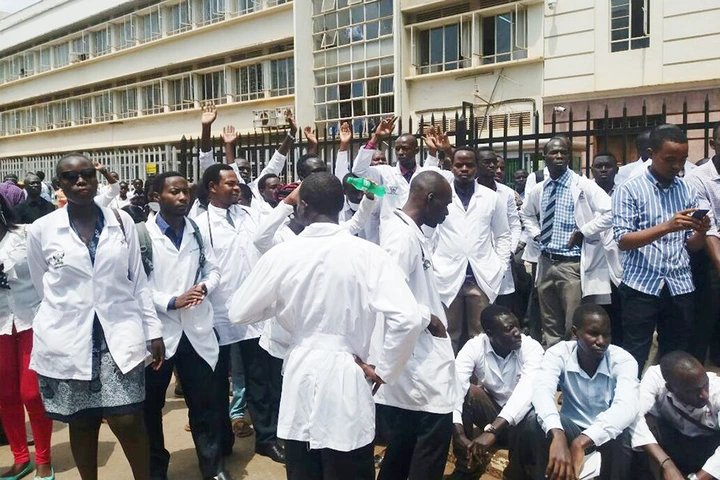

Who loses when medical interns stay home?
At a time when Uganda’s public hospitals are already struggling with too few health workers, more than 2,000 young doctors staying away from their designated internship facilities should worry a country whose health system has little room to absorb another staffing gap.
The Ministry of Health has deployed 2,417 medical interns for the 2026/27 internship year and instructed them to report to their designated facilities, but many have not done so, escalating a dispute that has been building for months over internship allowances, the National Education and Training for Health Policy and the broader working conditions of doctors.
The Uganda Medical Association has now given government a 14-day ultimatum, threatening industrial action if there is no satisfactory written commitment on the deployment and welfare of medical interns.
At the centre of the controversy is the government's decision under the new policy framework that private medical interns would no longer receive the monthly allowance they previously received, with internship being integrated into the formal university education system. Parliament has since said government would review the policy following the backlash.
But beyond the dispute between government and the medical profession is a more important question: who actually loses when medical interns are not in hospitals?
The answer is ultimately the patient.
Imagine a mother arriving at a public hospital with a sick child. She is not interested in resolutions of the Uganda Medical Association, Cabinet decisions or the National Education and Training for Health Policy; she simply wants someone to examine her child.
Now imagine the doctor who would ordinarily be reviewing patients in that ward is not there. Another doctor may take over, but that doctor was already handling dozens of patients. A senior doctor may step in, but there are only so many hours in a day. Nurses may carry more of the workload, yet they too are already stretched.
This is how a staffing crisis works. It does not always announce itself dramatically; it manifests through longer queues, delayed reviews, exhausted health workers, additional night shifts and, when the system is stretched beyond its limits, potentially much more serious consequences for patients.
That is why the internship dispute cannot simply be treated as a disagreement between young doctors and government. It is a health-system story because Uganda is not a country with doctors to spare.
The health system has for years grappled with shortages of health workers, uneven distribution of personnel and difficulties retaining specialists, particularly outside major urban centres. Even as the current dispute has unfolded, Uganda's doctor-to-patient ratio has been cited in public debate as evidence of the country's shortage, although the exact figures deserve careful scrutiny rather than being reduced to slogans.
The larger reality, however, is difficult to dispute: Uganda does not have enough doctors to comfortably lose thousands of young doctors from its hospitals.
If all 2,417 interns are deployed, they represent thousands of additional pairs of hands entering a health system that desperately needs capacity. If they remain away, somebody else has to absorb the work.
But it is equally important not to romanticise medical internship or suggest that a young doctor's professional calling should be enough to sustain them.
A medical intern still needs to eat, find somewhere to sleep, pay for transport and survive away from home while working long hours in hospitals and dealing with sick human beings. Government and medical professionals may disagree about the appropriate level of facilitation, and the Uganda Medical Association's demand for a monthly allowance of Shs4 million, equivalent to 75% of a medical officer's salary, will understandably be debated on grounds of affordability and sustainability.
Those are legitimate questions. Can government afford it? What should be the source of the money? Should every intern receive the same amount?
But there is another equally important question: can Uganda reasonably expect graduates to undertake a compulsory year of supervised clinical practice without a predictable means of sustaining themselves?
Calling someone a student does not make their rent disappear.
This is where Uganda's broader health financing problem enters the story.
Uganda has allocated Shs5.23 trillion to the health sector in the 2026/27 financial year, down from Shs5.87 trillion in the previous financial year, with the allocation expected to support priorities including maternal and child health, immunisation and prevention and treatment of non-communicable diseases.
This is not an argument that all this money should go to doctors. It is an argument about priorities and planning.
Every time Uganda trains a doctor, the country makes an investment. Taxpayers invest, parents invest, universities and teaching hospitals invest, while the student invests years of their life. Internship is a mandatory part of that journey, so it should not be the point at which the country suddenly discovers that it has not planned for the person it has spent years training.
Uganda knows how many students enter medical school, when they are expected to graduate, that internship is mandatory and that hospitals need doctors. It also knows that every year a new cohort will require internship placements.
Why, then, does internship financing repeatedly become a crisis?
We are treating a predictable problem as an emergency.
This is not an earthquake, a pandemic or an Ebola outbreak that appears without warning. The government knows the graduates are coming, the Ministry of Health knows hospitals need them, the Medical Council knows they require supervised practice and the Ministry of Finance knows the internship year comes around every year.
If a young doctor spends years studying medicine, graduates and then waits indefinitely for deployment or is unable to complete internship because of financing uncertainty, Uganda should not be surprised when some eventually look beyond its borders.
That is how the country's brain drain problem can begin.
Brain drain does not necessarily start when a doctor boards a plane. Sometimes it starts when a doctor concludes that their own health system has no clear plan for them.
Government, however, also faces a difficult balancing act. It would be unfair to pretend the solution is simply for the state to write a cheque. Uganda needs medicines, health workers, laboratories, ambulances, equipment, better maternity services, disease surveillance, infrastructure and adequate pay for those already employed in the health sector.
The health budget cannot stretch infinitely, and government therefore has a legitimate responsibility to ask what is affordable and sustainable.
But it also has a responsibility to explain its decisions. If the internship allowance is being changed, government should explain why. If internship is being integrated into university education, it should explain who bears the cost. If the previous arrangement is unaffordable, it should tell Ugandans what the alternative is, while any difference in treatment between private and government-sponsored medical graduates should also be clearly explained.
What cannot work is uncertainty.
A young doctor cannot plan their life around a policy that changes while they are standing at a hospital gate.
There is also a patient-safety question that cannot be ignored. Internship exists for a reason. Medical graduates are not sent into hospitals simply to fill vacancies; they are supposed to work under supervision and gain practical experience before practising independently.
Uganda therefore has two responsibilities: ensuring that interns are properly trained and supervised, and ensuring that hospitals have enough qualified personnel to provide safe care.
These responsibilities should not be placed in opposition. The country should not have to choose between protecting interns and protecting patients. It should be capable of doing both.
That is why the current standoff needs a solution that goes beyond an emergency meeting.
The Uganda Medical Association says doctors will begin industrial action after 14 days if government does not resolve the dispute, while emergency and essential life-saving services would remain available. That is a serious warning, but the 14 days should be treated as an opportunity for government and the medical profession to confront a problem that has been allowed to grow for too long, rather than simply as a countdown to a strike.
Once doctors down their tools, the argument will no longer be about internship allowances. It will be about patients, hospitals, emergency rooms, maternity wards and people who cannot afford private healthcare.
And that is where the politics of this dispute ends and the human cost begins.
The poorest Ugandan has the least room for this fight.
A wealthy Ugandan can walk into a private hospital. Someone with medical insurance may have alternatives. But the woman who has travelled from a village to a regional referral hospital may not have that luxury. The boda boda rider involved in a crash does not have that luxury. The mother whose child develops severe malaria does not have that luxury, nor does the patient facing a surgical emergency.
For these people, the public health system is not simply one option among many. It is the only system they have.
Every decision made in Kampala about health-worker welfare eventually travels to a hospital ward somewhere in Uganda. Patients should therefore not become collateral damage in a dispute they did not create.
The internship dispute ultimately exposes something much bigger than the question of allowances. Uganda needs a comprehensive health workforce plan that connects medical school admissions to the number of doctors the country needs, graduation to internship capacity, internship to employment, and remuneration to retention, while also addressing rural deployment and the conditions under which doctors can build sustainable careers in Uganda.
A doctor is not just a number on a government payroll. There is a human being behind every staffing figure, a family behind every intern and a patient behind every vacant hospital position.
So, who loses when interns stay home?
The interns lose a year of professional progression, government risks public confidence, hospitals lose manpower, senior doctors and other health workers inherit an even heavier workload, and Uganda risks worsening an already difficult health workforce crisis.
But ultimately, the patient loses the most.
That is why this should never have been allowed to become a 14-day ultimatum. The country should have had a plan long before the graduates arrived at the hospital gates.
Uganda does not have the luxury of fighting over whether doctors are needed in hospitals. We know they are.
The real question is whether the country is prepared to build and finance a health system capable of keeping them there.
Because when a medical intern stays home, the empty space is not just in the hospital. Eventually, that empty space appears between a sick Ugandan and the care they desperately need.


 Ex Kagame Guard Commander Tom Byabagamba Dies in Rwandan Prison After 12 Years
Ultimate Uganda
Ex Kagame Guard Commander Tom Byabagamba Dies in Rwandan Prison After 12 Years
Ultimate Uganda
 Government begins salary payments for public sector workers – Reform Committee
Ultimate Uganda
Government begins salary payments for public sector workers – Reform Committee
Ultimate Uganda
 Temangalo land: NSSF, Nzenyi reach agreement
Ultimate Uganda
Temangalo land: NSSF, Nzenyi reach agreement
Ultimate Uganda
 Susan Makula brings longtime rivals Nameere, Full Figure together
Ultimate Uganda
Susan Makula brings longtime rivals Nameere, Full Figure together
Ultimate Uganda
0 Comments