
Museveni gives China-Uganda Mbale Industrial Park thumbs up, second park planned
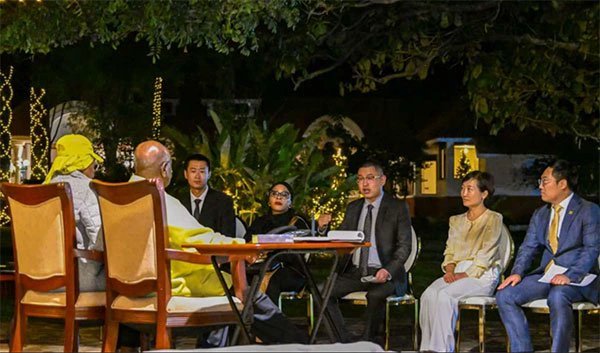

A team from the China-Uganda Mbale Industrial Park briefs President Museveni and First Lady Janet Museveni. Far right is Luke Wang, Managing Director, Tian Tang Group, and Lucy Zhang, Group CEO
RWAKITURA, Uganda | THE INDEPENDENT | President Yoweri Museveni has approved a proposal to establish a second industrial park in Uganda, following a briefing from developers of the China-Uganda Mbale Industrial Park.
President Museveni and First Lady Janet Museveni hosted a delegation led by Lucy Zhang, CEO of the park’s developer, at their country home in Rwakitura on Friday evening.
During the meeting, Zhang briefed the president on the latest developments at the Mbale facility and formally expressed her group’s intention to expand its footprint by establishing another industrial park at a new location.
The president welcomed the plan and assured investors of government support to ensure the success of the expansion.
“Tonight, a team from the Mbale Industrial Park led by Lucy Zhang called on Mama Janet and me at Rwakitura. They updated us on progress at the park and informed us of their intention to set up another industrial park. I welcome their plan and assure them of our support,†the president wrote on X (formerly Twitter).
The existing 619-acre park in Mbale City, located in eastern Uganda, has been a cornerstone of the government’s industrialization drive since it became operational in 2018.
By the end of 2025, the facility hosts approximately 75 factories and employs over 12,000 Ugandans.
Recent developments at the Mbale project include plans to launch four new factories in August 2025, specializing in steel, textiles, electronics, and paper production. The park has also seen major infrastructure investments, including a $2.5 million wastewater treatment system, as well as government initiatives to enhance power reliability and improve road networks to prevent flooding.
With a total investment of $2.5 billion, the park’s factories produce goods such as glass, detergents, mobile phones, LED bulbs, and baby diapers, using raw materials sourced from both Uganda and China. The park strives to implement the BUBU (Buy Uganda, Build Uganda) policy by maximizing the use of locally sourced Ugandan raw materials. Its products are sold in the Ugandan market and exported to neighboring countries, including Kenya, Tanzania, South Sudan, DR Congo, and Rwanda.
At an inauguration ceremony held in late August, Museveni emphasized that the national industrialization agenda relies on attracting investors who can create jobs.
“As a nation, we must focus on sectors that generate wealth and employment for our people. This will also address the need for import substitution, especially for consumer and commercial goods,†said Museveni.
Key among the new factories are Uganda United Steel Investment Co. Ltd. and Xinlong Textile & Garment Technology Co. Ltd. He also laid foundation stones for nine other projects, including Hercules Automobile Manufacturing Co. Ltd. and Changjiang Industry.
Museveni revealed that Chinese investors are seeking an additional 500 acres of land to expand the current park and urged local residents to cooperate with authorities to secure the land.
The push to build more industrial hubs aligns with Museveni’s vision of transforming Uganda from a trading economy into an industrialized nation.
He pledged to develop similar parks in the Masaka, Kyotera, and Kalungu regions to promote value addition and youth employment.


 Government will not gazette Kijanangoma as King of Tooro for now - Attorney General insists
Ultimate Uganda
Government will not gazette Kijanangoma as King of Tooro for now - Attorney General insists
Ultimate Uganda
 King Oyo’s Body to Arrive Thursday
Ultimate Uganda
King Oyo’s Body to Arrive Thursday
Ultimate Uganda
 Besigye, Lukwago expected to meet Gen. Salim Saleh today at Kapeeke
Ultimate Uganda
Besigye, Lukwago expected to meet Gen. Salim Saleh today at Kapeeke
Ultimate Uganda
 Rwabwogo Advised to ‘Eat His Bishop’ As MK Prepares to Enter State H’se: PREZ MUSEVENI ON HIS WAY OUT
Ultimate Uganda
Rwabwogo Advised to ‘Eat His Bishop’ As MK Prepares to Enter State H’se: PREZ MUSEVENI ON HIS WAY OUT
Ultimate Uganda
0 Comments