
Residents suffocate as Lake Victoria chokes on pollution
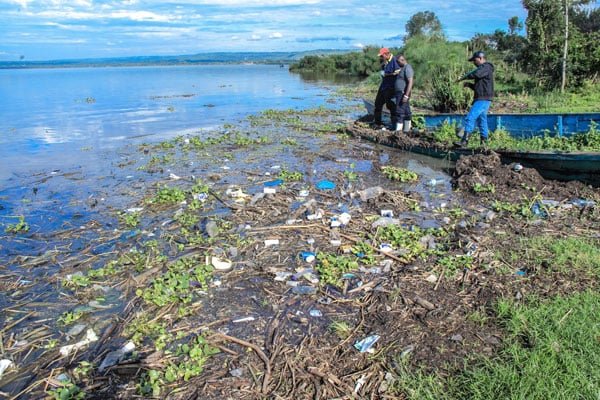

Research. Science professors conduct research on water pollution in Lake Victorian in October last year. Their findings indicated that the lake contained heavy metals, pesticides and other chemicals. PHOTO/FILE
At dawn, the cool breeze from Lake Victoria should carry freshness, the soft rustle of fishing nets being untangled and the low hum of boat engines warming up.
For generations, this was how the lake announced the morning to communities along its shores. Today, dawn arrives with a different sensation. Along the waterfronts of Luzira, Ggaba, Port Bell and Entebbe, an inescapable, choking stench now hangs in the air. It drifts through open markets, seeps into homes, settles in bedrooms and clings to clothes long after sunrise. For many lakefront residents, the smell has become so familiar that they now mark time by when it intensifies and when it finally fades.
At Luzira Market, traders say the smell does not announce itself politely; it invades. It grows worse at night, thickening as temperatures drop. Customers abandon meals halfway, and vendors hurriedly cover their food, unsure whether it makes any difference. Some traders now close early; others endure, with little choice. Nearby, tenants living close to the lake speak of sleepless nights, headaches and nausea. Some have packed up and left. “For landlords, they can wait, but tenants are moving out; it has become unbearable,†Mr Usama Manana, the chairperson of Wavu Village, said.
What is happening to the lake?
Barely a kilometre away, officials at the Ministry of Water and Environment say what residents are experiencing is a visible sign that Lake Victoria is under ecological siege. Dr Callist Tindimugaya, the Commissioner for Water Planning and Regulation, said the stench is the result of a dangerous combination of pollution and rising temperatures. “When pollution enters the lake, it introduces nutrients that cause excessive growth of algae; when temperatures rise, the algae die, decompose and release a putrid smell,†he explained.
This process, known as eutrophication, cuts oxygen levels in the water. As algae rot, they release gases such as hydrogen sulphide and ammonia, both notorious for their offensive odours. “These are the gases people are smelling, and high temperatures have accelerated the process,†Dr Tindimugaya said. What residents see as greenish water, floating scum and dark patches along the shoreline are not harmless weeds, he added, but warning signs of severe ecological distress.
Lake Victoria receives industrial effluent from factories, untreated sewage from Kampala and surrounding suburbs, and agricultural runoff rich in fertilisers. During heavy rains, plastic waste, garbage and human waste are washed directly into the lake.
The Inner Murchison Bay at Luzira, one of the most heavily used sections of the lake in Uganda, is especially vulnerable. Its shallow waters make it a natural collection point for pollutants. Studies by the ministry and its partners show persistently high concentrations of nitrogen and phosphorus in the bay, the perfect conditions for algal blooms. In a February 3 statement, the ministry said prolonged dry conditions and high temperatures had created ideal conditions for the blooms witnessed recently.
“In simple terms, the lake is being overfed and is suffocating,†the statement noted. At Ggaba Landing Site, fishermen say the lake has changed in colour, smell and character. “We cannot stay near the water for long anymore;we have had this smell since December,†Mr William Ssemasamba, a fishermen’s leader, said.
He blamed unchecked waste dumping and weak enforcement. “Companies and wealthy individuals dump waste here with little treatment. Even the water hyacinth, which helped trap dirt, was removed,†he said.
Once viewed solely as a nuisance, water hyacinth also absorbed pollutants. Removing it without addressing pollution upstream, fishermen say, has exposed the lake to even greater contamination. For small business owners along the lake, the stench has become an invisible enemy. At Ggaba Beach, chapatti vendor Catherine Aturinda says customers hesitate before ordering. “Some ask if the food is safe. Others just walk away; all I can do is keep everything extra clean,†she said.
Restaurant operators report losses as foot traffic declines. Prime lakeside locations have become undesirable spaces. At Luzira Railway Quarters, village chairperson Elizabeth Barungi has urged calm, assuring residents the smell will pass, but patience is wearing thin. The current stench, experts say, is merely the most noticeable symptom of a deeper crisis. The Ministry of Water and Environment says measures are underway to protect and restore the lake. These include restoring degraded wetlands, which act as natural filters, and enforcing a 200-metre buffer zone along the shoreline to curb encroachment.
Industries are being encouraged to adopt cleaner production methods, recycle wastewater and reduce effluent discharge. But officials warn that treatment alone will not solve the problem. “Stop garbage and waste from entering the water; once waste continues flowing into the lake, algae will keep growing. Prevention is the first priority,†Dr Tindimugaya said.


 Government will not gazette Kijanangoma as King of Tooro for now - Attorney General insists
Ultimate Uganda
Government will not gazette Kijanangoma as King of Tooro for now - Attorney General insists
Ultimate Uganda
 King Oyo’s Body to Arrive Thursday
Ultimate Uganda
King Oyo’s Body to Arrive Thursday
Ultimate Uganda
 Besigye, Lukwago expected to meet Gen. Salim Saleh today at Kapeeke
Ultimate Uganda
Besigye, Lukwago expected to meet Gen. Salim Saleh today at Kapeeke
Ultimate Uganda
 Rwabwogo Advised to ‘Eat His Bishop’ As MK Prepares to Enter State H’se: PREZ MUSEVENI ON HIS WAY OUT
Ultimate Uganda
Rwabwogo Advised to ‘Eat His Bishop’ As MK Prepares to Enter State H’se: PREZ MUSEVENI ON HIS WAY OUT
Ultimate Uganda
0 Comments