
NARO Courts Agro-Industrialists to Accelerate Value Addition and Boost Farmer Incomes
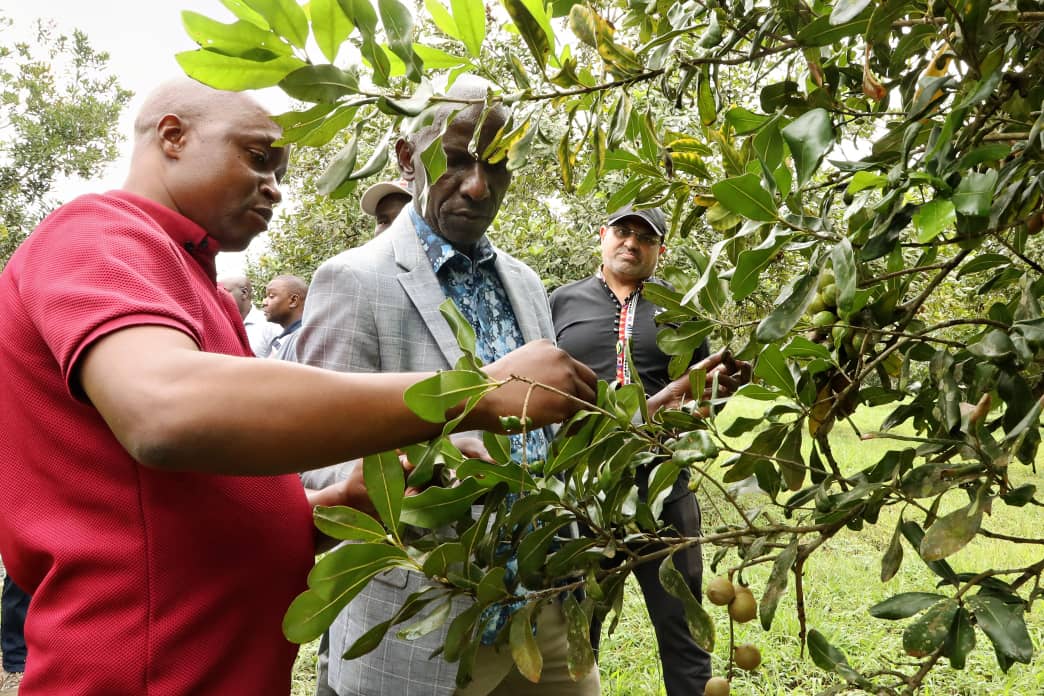

The National Agricultural Research Organisation (NARO) has intensified engagement with agro-industrial investors to fast-track agro-industrialisation, deepen value addition, and raise farmer incomes, positioning research and innovation as central drivers of productivity, inclusive growth, and stronger agricultural value chains.
NARO’s renewed push is anchored in strategic partnerships with private sector players through Memoranda of Understanding, aimed at translating research into practical solutions that address production bottlenecks, improve yields, and expand value addition across priority commodities.
The commitment was underscored during a high-level business visit led by NARO Director General Yona Baguma to Amafh Farms in Mityana District, Clarke Farm, and Njojo Agro-based Industries in Kyenjojo District.
The three enterprises are leading investments in macadamia nuts, coffee, and Hass avocado and maize production, respectively.
At Amafh Farms in Nambaale, Mityana District, the NARO team was hosted by Managing Director Morvi Asim.
Established in 2003, the 1,200-acre enterprise is among Uganda’s pioneers in macadamia farming, with more than 700 acres currently under cultivation.
The company grows and processes premium macadamia nuts for domestic and international markets, integrating sustainable farming practices and modern processing technologies along the value chain.
“Our vision is to transform Uganda into a leading macadamia producer,†Asim said, noting that global demand far outstrips supply.
“If you have 100 tonnes, the market demands 1,000 tonnes. This crop is hugely undersupplied.â€
Five years ago, Amafh launched the Macadamia Outgrower Extension Project to support more than 250,000 smallholder farmers nationwide through the planting of 25 million macadamia trees.
The initiative has the potential to create over 2.5 million jobs.
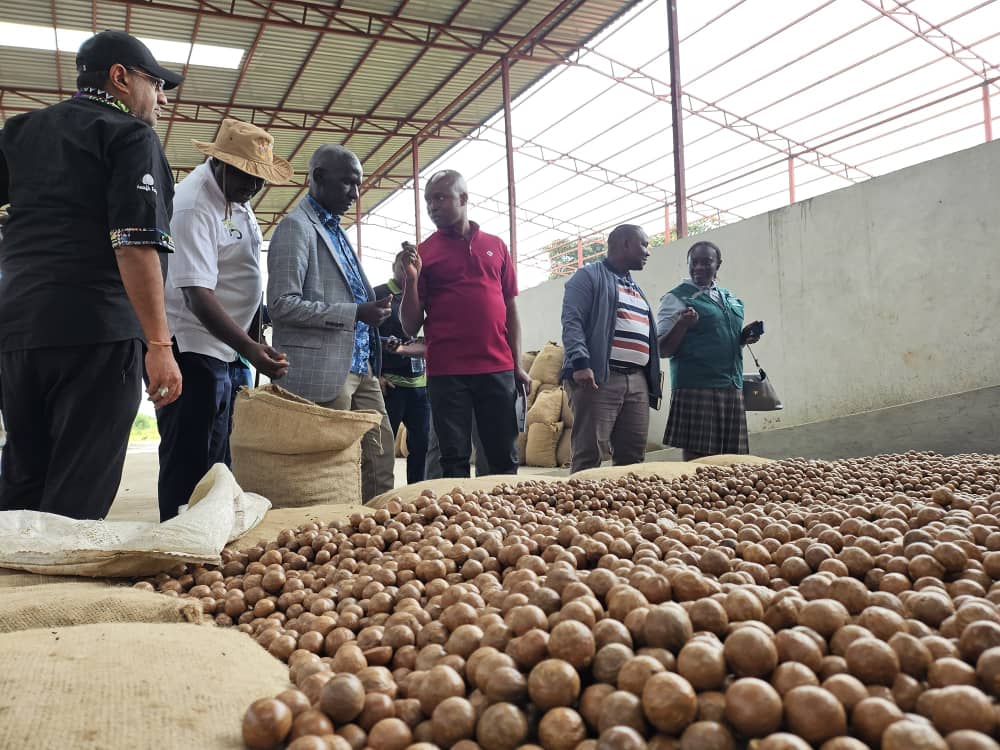
Currently, about 25,000 farmers are enrolled, receiving subsidised seedlings, technical training, and guaranteed market access through a buy-back arrangement.
Amafh is also investing heavily in value addition, with plans to produce up to 12 macadamia-based products, including cooking oil, briquettes for green energy, honey, and biofertilisers.
Integrated farming systems are promoted through beekeeping for pollination and honey production, while all processing waste is recycled into biofertiliser.
The company signed a Memorandum of Understanding with NARO in 2024, a partnership Asim described as critical to industrial growth.
He revealed that Amafh is establishing a nursery capable of producing between three and four million seedlings annually.
Addressing stakeholders, Baguma highlighted macadamia’s income potential for farmers.
“On one acre, a farmer can plant about 100 macadamia trees. With an average yield of 75 kilograms per tree and a farm-gate price of Shs3,000 per kilogram, a farmer can earn up to Shs 22 million annually,†he said.
“Given that a macadamia tree can live for over 100 years, this is a lifetime source of stable income.â€
He said NARO would work with Amafh to address challenges such as the absence of a national seed system, sub-optimal plant populations, and emerging pests and diseases.
Support for product diversification and value addition will be provided through NARO’s laboratories at the National Agricultural Research Laboratories in Kawanda.
Through the National Forestry Resources Research Institute, NARO plans to develop a breeding programme to adapt macadamia to diverse agro-ecological zones, including drought-prone regions such as Karamoja and West Nile.
“Macadamia thrives in sandy soils and can be intercropped, enhancing food security and incomes,†Baguma said, adding that the crop also presents opportunities for climate change adaptation.
In Kyenjojo District, the NARO delegation visited Clarke Farm in Katambale, Kyarusozi Sub-county. The 2,200-acre mixed farm has 750 acres under coffee, with plans to expand to 1,200 acres within four years.
Farm Manager Sylvester Kyendi described the engagement with NARO as timely, particularly in aligning production with market demands.
“One key area we agreed on is developing a lowland Arabica coffee variety that can thrive in non-traditional areas,†he said.
“Arabica attracts premium prices globally due to its superior cup quality, and our buyers specifically demand it.â€
Clarke Farm supplies coffee to markets in the United Kingdom, United Arab Emirates, Kampala, and other local outlets, while also providing planting materials and technical support to smallholder farmers.
Collaboration with NARO is expected to strengthen research on improved varieties, productivity, and climate resilience, supporting Uganda’s coffee export ambitions.
At Njojo Agro-based Industries, which specialises in Hass avocado and maize processing, Baguma said the visit followed a directive by President Museveni to harness innovation for socio-economic transformation.
The founder and managing director, retired Gen. Robert Rusoke, Uganda’s Head of Mission to Rwanda, said the engagement aligned with his vision of building agro-industrial value chains to transform livelihoods in the Rwenzori region.
He disclosed that Njojo is currently the only processor of virgin Hass avocado oil in Uganda.
NARO and Njojo agreed to collaborate on managing emerging pests and diseases and expanding the out-grower model to improve productivity and farmer incomes.
Through these engagements, NARO reaffirmed its commitment to working closely with the private sector to ensure research-driven agro-industrialisation becomes a cornerstone of Uganda’s economic transformation and poverty reduction agenda.


 Government will not gazette Kijanangoma as King of Tooro for now - Attorney General insists
Ultimate Uganda
Government will not gazette Kijanangoma as King of Tooro for now - Attorney General insists
Ultimate Uganda
 King Oyo’s Body to Arrive Thursday
Ultimate Uganda
King Oyo’s Body to Arrive Thursday
Ultimate Uganda
 Besigye, Lukwago expected to meet Gen. Salim Saleh today at Kapeeke
Ultimate Uganda
Besigye, Lukwago expected to meet Gen. Salim Saleh today at Kapeeke
Ultimate Uganda
 Rwabwogo Advised to ‘Eat His Bishop’ As MK Prepares to Enter State H’se: PREZ MUSEVENI ON HIS WAY OUT
Ultimate Uganda
Rwabwogo Advised to ‘Eat His Bishop’ As MK Prepares to Enter State H’se: PREZ MUSEVENI ON HIS WAY OUT
Ultimate Uganda
0 Comments