
M7 EXPLODES @ KISOZI! Secrets why top Water Ministry, NEMA officials could soon be jobless
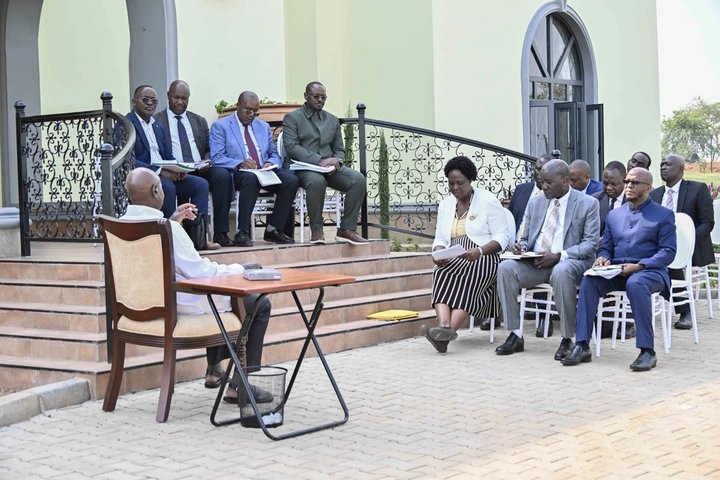

When President Yoweri Museveni summoned officials from the Ministry of Water and Environment and the National Environmental Management Authority (NEMA) to his Kisozi farm in Gomba recently, the mood was anything but routine. According to sources familiar with the meeting, the President was deeply dissatisfied with what he described as a failed war against wetland encroachment, despite years of policies, task forces, and public declarations.
What angered the President most, insiders say, is that the failures are now backed by hard numbers from the Auditor General’s report on Climate Change, Natural Resources, Environment and Water Management — a report that paints a bleak picture of weak enforcement, missed targets, and institutions struggling to control the very resources they were created to protect.
Uganda’s total wetland cover stands at 33,762.6 square kilometres, yet the Auditor General estimates that degraded wetlands now account for 6.3 percent of the country’s total land area. This degradation has not happened quietly or accidentally. The report documents extensive encroachment on at least 14 major water bodies, involving activities that are explicitly illegal under existing laws—but officials at NEMA and Water Ministry are in slumberland.
These include the construction of apartments and hotels, sand mining, sugarcane plantations, rice and palm cultivation, brick-making, quarrying, livestock grazing, informal markets, washing bays, wastewater discharge, charcoal production, illegal logging, wetland drainage and unregulated water abstraction. Many of these activities are commercial, permanent, and highly visible — raising uncomfortable questions about enforcement failure rather than ignorance.
The law itself is clear. The National Environment Act and the Wetlands, Riverbanks and Lakeshores Management Regulations require protected buffer zones of 100 metres from rivers and 200 metres from lakes, as well as mandatory updates of the national wetland inventory every five years. Yet the Auditor General found that these legal safeguards are routinely ignored, while inventories remain outdated.
Perhaps most damaging to institutional credibility is the failure of restoration efforts. Over a three-year period, the Ministry of Water and Environment planned to demarcate 4,150 square kilometres of wetlands using clear physical markers. Instead, it managed only 739.34 square kilometres, representing just 18 percent of the target. The result is vast stretches of wetlands that remain unmapped, unmarked and vulnerable to encroachers.
NEMA’s enforcement record offers little comfort. During the 2024/25 financial year, the authority issued 319 wetland restoration orders. However, only 146 of those orders — about 46 percent — were complied with. The remaining 173 orders, accounting for 54 percent, were not acted upon at all. The Auditor General notes that the lack of formal appeals regulations and irregular sittings of the appeals committee further weakened enforcement, effectively allowing violators to continue operating with minimal resistance.
Even more alarming is the scale of enforcement capacity. Uganda has 8,614 gazetted wetlands covering approximately 37,346 square kilometres across 146 districts and 11 cities. Yet there are only 45 environmental police officers assigned to protect them. The dilemma now is that those concerned at the Ministry of Water and Environment are still sleeping instead of advising the government to assign them more officers. More so, because the bosses there are not providing efficient advice and leadership, they don’t even exercise command and control over these officers, leaving enforcement fragmented and poorly coordinated.
Despite the ministry receiving over Sh600m for this task, officials have cited funding constraints—but sources say the President’s frustration goes beyond that. At Kisozi, he reportedly questioned why leadership failed to prioritise coordination, enforcement discipline, and accountability even within the limited resources available.
The consequences of these failures are already visible. The report links wetland encroachment to increased flooding, sedimentation, algal blooms, rising water levels, declining water quality, and higher water treatment costs. Aquatic biodiversity is under threat, ecosystem services are compromised, and public health risks are rising — particularly in urban and low-lying communities.
It is this combination of legal non-compliance, weak enforcement, missed targets, and visible national impact that has placed Water Ministry and NEMA leadership under intense scrutiny. Insiders say, in the eyes of the president, these institutions are now viewed as liabilities rather than performers, especially in an administration that has publicly committed to climate resilience and environmental protection.
As one source close to the discussions put it, “The President is no longer asking what the problem is. He is asking who failed to fix it.â€
Whether that frustration translates into dismissals remains to be seen. But after Kisozi — and with the Auditor General’s numbers now in the public domain — the message is clear: the era of excuses at Water and NEMA may be coming to an end and some bosses will likely pay the price—read job loss.


 Government will not gazette Kijanangoma as King of Tooro for now - Attorney General insists
Ultimate Uganda
Government will not gazette Kijanangoma as King of Tooro for now - Attorney General insists
Ultimate Uganda
 King Oyo’s Body to Arrive Thursday
Ultimate Uganda
King Oyo’s Body to Arrive Thursday
Ultimate Uganda
 Besigye, Lukwago expected to meet Gen. Salim Saleh today at Kapeeke
Ultimate Uganda
Besigye, Lukwago expected to meet Gen. Salim Saleh today at Kapeeke
Ultimate Uganda
 Rwabwogo Advised to ‘Eat His Bishop’ As MK Prepares to Enter State H’se: PREZ MUSEVENI ON HIS WAY OUT
Ultimate Uganda
Rwabwogo Advised to ‘Eat His Bishop’ As MK Prepares to Enter State H’se: PREZ MUSEVENI ON HIS WAY OUT
Ultimate Uganda
0 Comments