
Inside the battle for House Speakership
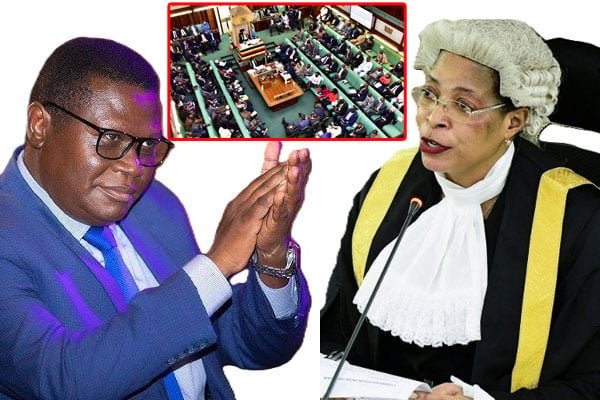

The race for the Speakership in the 12th Parliament moved up a gear this week, with the two leading candidates ripping along at a cracking pace. Following Mr Norbert Mao’s opening gambit, in which the president-general of Uganda’s oldest party—the Democratic Party (DP)—made clear that “the thirst [for the Speakership] is there,†Ms Anita Among, the Speaker of the 11th Parliament, reached for her gearshift and found the appropriate gear to make a huge statement of her own.
After Mr Mao—in a thinly veiled verbal attack—spoke on Tuesday about coming “in direct conflict with people who believe in ring-fencing positions,†Ms Among, who was re-elected to the 12th Parliament unopposed and cleared by the ruling National Resistance Movement (NRM) party’s top organ to remain House Speaker, achieved a victory few thought possible. On Thursday, she was endorsed by two high-profile lawmakers in Mr Mao’s native sub-region, including Mr Anthony Akol—the chairperson of the Acholi Parliamentary Group.
Keen to make it intensely and almost frighteningly personal, Ms Among aggressively moved the pieces on the chessboard. One observer told Saturday Monitor that the moves are intended to show, in the starkest terms possible, that Mr Mao cannot rally support in his own backyard. “We saw a united Parliament irrespective of our political party affiliations,†Mr Mapenduzi Ojara, the Bardege-Layibi lawmaker, widely seen as pawn in the game of power politics, said of Ms Among’s Speakership in the 11th Parliament. He added in an endorsement video: “It’s been a people-centred Parliament. We saw the Parliament getting out to the people, serving the interests of the citizens.â€
Yet despite disclosing that the changes in the political landscape of Acholi caught him unawares during the Laroo-Pece parliamentary race, Mr Mao this week described himself as a “pragmatic nationalist†with “unique skillsâ€. This as he cunningly used all means at his disposal to rationalise the formal cooperation agreement the DP entered with the NRM en route to becoming the Justice and Constitutional Affairs minister. “There is a hunger in the country for a more accountable Parliament,†Mr Mao told a media briefing this week. He added: “There is an outpouring of goodwill by people who want constitutional power as opposed to personal power.â€
A mere rubber stump?
The House speakership in Uganda matters a great deal. Occupying the Number Three position in the country’s National Order of Precedence, the head of the Legislative branch of the government plays—at least on paper—a crucial role in the formulaic separation-of-powers articulation. The counterbalancing influence the House plays in, most importantly, checking Executive authority is central to the soundness of democracy in a polity. Analysts say President Museveni has pushed the envelope in a bid to ensure the House’s oversight of the exercise of State power is blunted.
“It’s a clear signal that the Executive will continue to call the shots, reducing the Legislature to a mere rubber stamp. This will embolden the presidency to disregard checks and balances, further entrenching impunity and undermining democracy,†Mr Job Kiija, an associate director at Innovations for Democratic Engagement and Action (IDEA), told Saturday Monitor. Layered and networked in clientelistic weight, the legislative branch of the government stands accused of influencing, if not entrenching, regime resilience under President Museveni’s effective coercive power.
Mr Godber Tumushabe, a lawyer and policy analyst, noted that, since the adoption of the 1995 Constitution, institutional erosion has progressively loosened the doctrine of separation of powers. House Speakers owe their standing to President Museveni. Consequently, they always reflect the moral weight of the intentions that brought them into their presence. “You cannot expect the 12th Parliament to be good,†Mr Tumushabe said, adding, with an air of resignation, “[…] we already know how Parliament under Anita Among operates.â€
The policy analyst contends that seeing the dynamics of the Among-Mao battle through the lens of a democratic process misrecognises the richer picture of the pains that have been staked in tightening President Museveni’s grip on power. The battle, Mr Tumushabe added, speaks to the broader political trajectory of the country. On the one hand is Ms Among, who has styled herself as a vital cog in the team that helped President Museveni win a seventh elective term on the bounce. On the other hand is Mr Mao, whose national self-assertion is born from being “in the rooms that matter.â€
The Justice and Constitutional Affairs minister speaks, both overtly and covertly, about a “peaceful transition†that has approval from higher-ups, including Mr Museveni’s son, Gen Muhoozi Kainerugaba. “Museveni is a life president. As long as he is breathing, he will remain president. He cannot be preparing for his son,†Mr Tumushabe observed.
People power movement
With the 12th Parliament shorn of assertive figures like Mr Wilfred Niwagaba, Mr Theodore Ssekikubo, Mr Ibrahim Ssemujju, Mr Muhammad Muwanga Kivumbi, and Mr Jonathan Odur, the balance will be tipped, as it often does, in favour of the Executive. This is, added Mr Kiija, regardless of the outcome from the speakership race. “MPs [Members of Parliament] who dare challenge the Executive will face severe backlash, including intimidation, bribery, or worse. The only realistic mechanism for accountability will be through people’s power and civil society pressure—not through the toothless mechanisms of this compromised Parliament.â€
The tight corners of draconian legislations such as the Public Order Management Act (POMA) and the Computer Misuse Act, however, shrink the possibility of conceptual resources such as people power. This is perhaps why, as the Among-Mao battle rages on intensively but inconclusively, Mr Timothy Chemonges chooses to strike an optimistic tone. Solutions could yet still come from the House, he contends. The executive director of the Centre for Policy Analysis (CEPA), however, emphasised that realistic parliamentary oversight will depend largely on committees, issue-based coalitions, and the courage of individual MPs—particularly Independents and reform-minded members within the ruling party.
However, without leadership support, oversight on budgets, security, and corruption will encounter significant political resistance. In such an environment, oversight is possible but will likely be selective, constrained, and heavily contested rather than systematic. Mr Chemonges noted that, in principle, a speaker endorsed by the ruling party can still act independently. In practice, however, the manner of endorsement matters. When leadership emerges through party structures rather than a visibly independent parliamentary process, it undermines the credibility of claims that Parliament will not serve as a rubber stamp.
Independence, he stressed, is demonstrated through actions rather than assurances, and the starting conditions already raise legitimate doubts. “The endorsement of Anita Among by the NRM Central Executive Committee strongly signals executive influence over Parliament’s leadership. When the ruling party’s top organ effectively determines who leads Parliament, it blurs the separation between the Executive and the Legislature. This makes it more difficult for Parliament to act as an independent check on presidential authority, especially on politically sensitive matters where leadership neutrality is essential,†Mr Chemonges told Saturday Monitor.
Independence of the House
All of this is a recipe for one thing—regime survivability under Mr Museveni. It further frays any straight narrative line that contests the long-term power calculus of Uganda’s ninth President. Dr Juma Kakuba Sultan, a political scientist at Kyambogo University, said Uganda should dispense with any pretence of laying claim to be a democratising polity. “The Executive has too much power in this country,†he noted, adding, “You have seen the Speaker [Ms Among] openly campaign for President Museveni, and afterward the CEC gave her the green light. That means it will be very difficult for Parliament to question the Executive.â€
Burdened by the absence of independence, the House has found itself caught in the vortex of public outrage. While Mr Ojara opined that it is only Ms Among who can guarantee “a parliament that cares about the plights of the common man and woman,†Mr Mao is convinced that a durable need to improve exists. “I’m not the one to blame for citizens saying Mao should be speaker,†the DP president-general said on Tuesday. “A speaker must belong to parliament; not to anyone else. That’s why they say a Speaker of Parliament.â€
Analysts are sufficiently concerned about the issues Mr Mao raised. For one, Mr Chemonges underscored the importance of the speakership in shaping parliament’s independence. “The Speaker controls debate, committee direction, and the extent to which Parliament can challenge the Executive. Where the Speaker aligns closely with Executive interests, even a numerically diverse Parliament becomes constrained. Uganda needs a Speaker who is procedurally firm, institutionally confident, and willing to protect Parliament’s autonomy—especially when oversight challenges Executive power,†he said.
To avoid being perceived as a rubber stamp, Mr Chemonges advised that the 12th Parliament must strengthen committee independence, enforce attendance and accountability, and ensure committee findings lead to concrete action. Given the high turnover of MPs reflected in the data, the House must also invest in institutional memory and technical capacity. Without strong leadership backing committee work, oversight risks, he warned, remaining symbolic rather than effective.
As the 12th Parliament takes shape, Ugandans will be watching closely—not just to see who occupies the speaker’s chair, but whether the House chooses to defend the Constitution, protect public resources, and hold power to account.


 Government will not gazette Kijanangoma as King of Tooro for now - Attorney General insists
Ultimate Uganda
Government will not gazette Kijanangoma as King of Tooro for now - Attorney General insists
Ultimate Uganda
 King Oyo’s Body to Arrive Thursday
Ultimate Uganda
King Oyo’s Body to Arrive Thursday
Ultimate Uganda
 Besigye, Lukwago expected to meet Gen. Salim Saleh today at Kapeeke
Ultimate Uganda
Besigye, Lukwago expected to meet Gen. Salim Saleh today at Kapeeke
Ultimate Uganda
 Rwabwogo Advised to ‘Eat His Bishop’ As MK Prepares to Enter State H’se: PREZ MUSEVENI ON HIS WAY OUT
Ultimate Uganda
Rwabwogo Advised to ‘Eat His Bishop’ As MK Prepares to Enter State H’se: PREZ MUSEVENI ON HIS WAY OUT
Ultimate Uganda
0 Comments