
DNA on Gun, Washed Blood and Head Shot Evidence: Why Court Ordered Molly Katanga to Defend Murder Charge
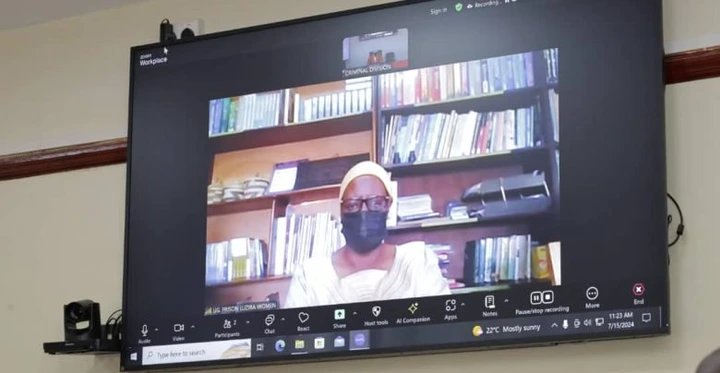

Justice Kania ruled that it was unlikely that Henry Katanga, a right handed person intending to commit suicide, would shoot himself on the left side of his head,†and that the alternative trajectory proposed by Molly's defence would require awkward positioning
Molly Katanga listening to the court proceedings from Luzira Prisons recently
KAMPALA — When prosecutors closed their case in the long-running trial over the shooting death of businessman Henry Katanga, the defence asked the High Court to end it there: no case to answer, they argued, because the state had not proved murder, nor shown that the scene at the Katanga home was unlawfully tampered with.
But in a tightly reasoned ruling, Lady Justice Rosette Comfort Kania said the threshold at this stage is not proof beyond reasonable doubt — it is whether the prosecution has shown a prima facie case: one on which “a reasonable tribunal… could convict the accused person if no explanation is offered by the defence,†as the court noted, quoting Ramanlal Trambaklal Bhatt v R (1957). And on that test, the judge ruled, the case must proceed.
Molly Katanga is indicted for murder under the Penal Code, accused of unlawfully causing her husband’s death on Nov. 2, 2023 at their home on Mbuya Chwa 2 Road in Kampala’s Nakawa Division.
Four other accused; Patricia Kakwanzi, Martha Katanga, Charles Otai and George Amanyire; are jointly indicted for destroying evidence and for being accessories after the fact of murder, accused of interfering with bloodstains, the body’s position, the gun and other items at the scene, and assisting Molly Katanga to evade justice.
The prosecution called 25 witnesses, ranging from pathologists and forensic analysts to police investigators and relatives.
After that, Justice Kania said the court had to decide whether the evidence “has succeeded in establishing a prima facie case against the accused persons.â€
On the murder count, the first issue, whether Henry Katanga is dead, was not in dispute for long.
The judge cited the postmortem evidence that the deceased “died of gunshot injuries,†and noted the defence conceded the fact of death.
Katanga and Molly at the wedding of their daughter at Mestil Hotel in 2023
Header advertisement
Gunshot
The fight, instead, turned to what the gunshot meant.
The defence urged a suicide narrative, even disputing where the bullet entered and exited the head.
The prosecution, for its part, leaned on medical evidence that the shot was fired at near-contact range and entered the head through the left temporal area, exiting via the right ear canal, and then piled on circumstantial material to argue the death was not self-inflicted.
The judge did not decide guilt.
But she found the suicide theory, on the evidence so far, raised questions that demanded an explanation, especially because, the court heard, only two people were in the room when the gun went off, and one of them is dead.
Right-handed
Justice Kania pointed to testimony that Henry Katanga was right-handed and trained to use a firearm using his right hand.
She reasoned that, on the state’s version of the wounds, it was “unlikely that a right handed person intending to commit suicide would shoot himself on the left side of his head,†and that the alternative trajectory proposed by the defence would require awkward positioning.
“There is therefore need for Molly Katanga, who was the only other person in the room with the deceased person, to give an explanation on what happened in that room on 2nd November 2023,†the judge concluded, finding the prosecution had established a prima facie case requiring Molly Katanga to answer.
Targeted head
The court also found enough evidence, at this stage, to infer malice aforethought, citing the weapon and the targeted body part.
The judge noted the medical testimony describing catastrophic brain injury from the gunshot and observed that the head is a vulnerable part of the body, a classic factor courts use to infer malice.
Molly Katanga being interviewed by police personnel at IHK hospital (courtesy photos)
Then the ruling turned to participation — and here, Justice Kania underscored that the state had no eyewitness to the shooting, forcing it onto circumstantial ground.
The prosecution, she said, relied on a chain: the “last seen†doctrine; forensic evidence said to connect Molly Katanga to the gun; and post-incident conduct.
On “last seen,†the court cited evidence that the shooting occurred in the master bedroom shared by the deceased and Molly Katanga.
In a reconstruction narrative, George Amanyire said the couple were heard quarrelling, the door was locked before the blast, and the only person who later emerged was Molly Katanga.
The judge said the locked-door detail itself created a gap that only Molly Katanga could fill.
“The issue of how the door opened is a grey area. No evidence was adduced to show how the door opened,†Justice Kania said, adding that even the defence claim of incapacity raised its own questions, including whether an allegedly incapacitated person could open a locked door.
DNA on gun
The judge also pointed to the state’s forensic case.
On DNA, she cited testimony that swabs from gun components, including the trigger and trigger house, showed a mixed profile with Molly Katanga as the predominant contributor, while the deceased and Patricia Kakwanzi were minor contributors.
Even allowing for household contact, the judge said the location of the DNA required explanation: the “existence of Molly Katanga’s DNA predominantly on the parts of the gun used for loading and firing the gun requires an explanation from Molly Katanga.â€
Firearm discharge
On gunshot residue, the court cited expert evidence that chemicals associated with firearm discharge were detected on samples linked to Molly Katanga, finding it sufficient, at this stage, to connect her to firing in a way that demanded an answer.
And on injury, Justice Kania noted medical findings that the tip of Molly Katanga’s right small finger was gangrenous, later amputated, which the court said could corroborate testimony that a firearm can injure a handler during firing.
But the ruling also lingered on what happened after the gun went off.
Access denial
Justice Kania recounted evidence that police were repeatedly denied access to Molly Katanga for a statement, with claims she was too unwell, until the DPP involved the Ministry of Health and she eventually recorded a statement in January 2024.
The judge contrasted that with a medical form indicating she was conscious and oriented earlier, and highlighted Molly Katanga’s own words in her statement:
“…I am injured, but I will not say how I sustained the injuries. I will only say how I sustained the injuries in court…â€
Taken together, the judge held, the prosecution had built a chain strong enough to require a defence.
“I therefore find that the prosecution evidence establishes a prima facie case against Molly Katanga, requiring her to offer an explanation lest she runs the risk of being convicted,†Justice Kania ruled, placing Molly Katanga on her defence. She may testify on oath, testify unsworn, or remain silent.
The four co-accused, Patricia Kakwanzi, Martha Katanga, Charles Otai and George Amanyire, faced their own turning point in destroying evidence.
Their lawyers launched a legal attack on the charge itself, arguing section 89 of the Penal Code applies only to documentary-type items, not to things like blood, a body’s position, or a firearm.
Justice Kania rejected that narrow reading, holding that “things of any kind†is deliberately broad.
“It is inconceivable… that the act of breaking and burning of a gun used in a murder, would not come within the provisions of section 89… because the gun… is not a book or a document,†she said, overruling the objection.
Cleaning blood
On the facts, the judge pointed to testimony that, when police arrived, George Amanyire was allegedly cleaning blood from the house, while the body had been moved and wrapped and the gun and its components handled and displaced by people including Patricia Kakwanzi and Charles Otai, steps the court said could “undoubtedly affect investigation.â€
She found that, in the context of a sudden violent death, knowledge that the scene would be needed for investigations “arises naturally,†and that the alleged actions could amount to intentionally rendering evidence incapable of identification.
A forensic expert pinning Molly Katanga in the murder of Henry Katanga
Justice Kania ruled the prosecution had established a prima facie case against Patricia Kakwanzi, Martha Katanga, Charles Otai and George Amanyire on destroying evidence.
Accessory
Finally, the court found the co-accused also had a case to answer on accessory after the fact of murder, rejecting the push to dismiss the charge on technical grounds at this advanced stage and holding that the state’s evidence, including alleged clean-up, displacement of key items, and narratives said to divert investigators, was sufficient to require explanations.
She singled out George Amanyire, noting a reconstruction account in which he said he rescued Molly Katanga from the bathroom and carried her out, yet later claimed he called the deceased’s phone wondering why Henry Katanga had not come down for breakfast.
That sequence, the judge said, demanded clarification: George Amanyire must explain whether, passing through the bedroom, he did not see the deceased “lying motionless†in blood.
By the end, the ruling had one clear result: every accused person now must answer. Justice Kania put Molly Katanga on her defence for murder, and put Patricia Kakwanzi, Martha Katanga, Charles Otai and George Amanyire on their defence for destroying evidence and being accessories after the fact, each with the same three options the law allows: sworn evidence, unsworn evidence, or silence.


 Government will not gazette Kijanangoma as King of Tooro for now - Attorney General insists
Ultimate Uganda
Government will not gazette Kijanangoma as King of Tooro for now - Attorney General insists
Ultimate Uganda
 King Oyo’s Body to Arrive Thursday
Ultimate Uganda
King Oyo’s Body to Arrive Thursday
Ultimate Uganda
 Besigye, Lukwago expected to meet Gen. Salim Saleh today at Kapeeke
Ultimate Uganda
Besigye, Lukwago expected to meet Gen. Salim Saleh today at Kapeeke
Ultimate Uganda
 Rwabwogo Advised to ‘Eat His Bishop’ As MK Prepares to Enter State H’se: PREZ MUSEVENI ON HIS WAY OUT
Ultimate Uganda
Rwabwogo Advised to ‘Eat His Bishop’ As MK Prepares to Enter State H’se: PREZ MUSEVENI ON HIS WAY OUT
Ultimate Uganda
0 Comments