
MPs warn it could take 48 years to clear Uganda’s Shs8.4t domestic arrears
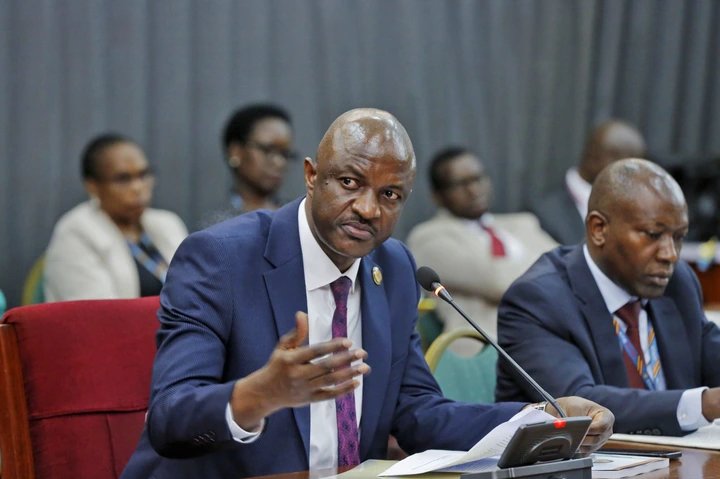

Appearing before Public Accounts Committee of Parliament, Ramathan Ggoobi, Permanent Secretary, Ministry of Finance, and Secretary to the Treasury.
Parliament has been told that at the current rate of funding allocated to settle government domestic arrears, it could take more than four decades to clear the outstanding debt currently estimated at Shs8.4 trillion.
The revelation emerged during a meeting between Parliament’s Public Accounts Committee (PAC) and officials from the Ministry of Finance while reviewing the December 2025 Auditor General’s report, which highlighted the growing burden of domestic arrears owed to suppliers and contractors.
During the session, Kashari North MP Basil Bataringaya calculated that if the government continues allocating Shs200 billion annually to clear arrears, it would take about 48 years to eliminate the current stock.
“I have computed, it is 48 years. For the Shs9.6 trillion, Shs200 billion per year is 48 years. The mid-term has a maximum of five years. But also remember there is a rate of growth of domestic arrears,†Bataringaya told the committee.
He warned that the debt is unlikely to remain static because new arrears continue to accumulate as government obligations increase.
“So the domestic arrears will be growing, it will not be static. But the current one, at the rate at which we have programmed to pay, we shall cover it in 48 years,â€he added.
The discussion followed concerns raised by PAC Vice Chairperson Gorreth Namugga, who questioned government’s commitment to settling debts owed to individuals and companies that supplied goods and services to government institutions but have remained unpaid for years.
Namugga argued that the UGX 200 billion allocation in the upcoming 2026/27 national budget is insufficient given the magnitude of the outstanding arrears.
“If you look at the trend of budgeting for domestic arrears over the previous five years, Shs200 billion has been your allocation most of the time. Yet the validated arrears stand at about Shs8 to Shs9 trillion,†Namugga said.
She added, “So if you really have a budget of Shs200 billion, which miracle are you going to perform to clear this debt? At the end of the day, you are seriously killing the private sector.â€
However, Secretary to the Treasury Ramathan Ggoobi defended the government’s approach, explaining that the Shs200 billion reflects the base funding currently available and that additional resources could be allocated if they become available.
“The Shs200 billion is the money we had in the base, and that is why I communicated it. If we manage to get new resources, it is an area of priority. When we fail, we shall definitely pay Shs200 billion. We can’t pay money we don’t have,†Ggoobi explained.
He also revealed that a verification exercise conducted by the Auditor General had uncovered irregularities in some of the claims.
“I requested the Auditor General to verify these arrears. The verifiers are finding that some claims had no concrete evidence that goods or services were supplied to government,â€Ggoobi said.
He added that once verification is completed, government will begin releasing funds to settle the legitimate claims.
“We are going to do very well in wiping out the portfolio that remains. Starting next quarter, we shall release money to pay those who have been certified as legitimate arrears,â€he said.
Ggoobi further clarified that the figure of Shs9.6 trillion cited during the committee meeting was inaccurate, noting that a revised figure will soon be announced by the Auditor General.
“That number you have is not correct. There is a new number coming and the Auditor General will announce it soon,â€he said.
Despite concerns about arrears, the Treasury Secretary told MPs that Uganda’s economy remains stable and continues to register strong performance across several indicators.
He revealed that the country earned $14.4 billion (about Shs53.6 trillion) in exports in 2025, the highest export earnings in Uganda’s history.
“Uganda has never in its history exported goods and services worth that magnitude. Our export performance reached $14.4 billion,†Ggoobi said.
According to him, the strong export performance has helped stabilize the Ugandan shilling, which has recently appreciated against major currencies including the US dollar.
“The shilling is stable and strong mainly because of the good performance of exports,†he explained.
Ggoobi also told the committee that inflation has remained under control despite Uganda entering an election period, which has historically triggered price instability.
“Usually, around election periods we see inflation rising, but this time prices of goods and services have remained stable,†he said.
He noted that Uganda’s economy is projected to grow between 6.5 and 7 percent this financial year, driven by expansion in agriculture, manufacturing, and the services sector.
“The GDP is continuing to grow, driven by all sectors of the economy. Agriculture, manufacturing and services are all growing,â€Ggoobi said.
He further revealed that Uganda recorded strong inflows in its financial account, amounting to US$5.6 billion, including $3.56 billion in Foreign Direct Investment and $1.7 billion from portfolio investors.
“As a result, our balance of payments registered a surplus of $2.37 billion, meaning Uganda received more money from international transactions than what went out, â€he said.
However, Ggoobi acknowledged that revenue collection remains a weak area, despite registering growth of about 16 percent, and said the government is working on measures to strengthen domestic revenue mobilisation.
“Revenue collection is still one of the areas of weakness, and we are working to address it in the coming budgets, â€he said.
He assured MPs that despite global and domestic economic pressures, Uganda’s economy remains resilient.
“The state of the economy is quite good, and we hope it will remain stable despite geopolitical challenges around the world,†Ggoobi said.


 Government will not gazette Kijanangoma as King of Tooro for now - Attorney General insists
Ultimate Uganda
Government will not gazette Kijanangoma as King of Tooro for now - Attorney General insists
Ultimate Uganda
 King Oyo’s Body to Arrive Thursday
Ultimate Uganda
King Oyo’s Body to Arrive Thursday
Ultimate Uganda
 Besigye, Lukwago expected to meet Gen. Salim Saleh today at Kapeeke
Ultimate Uganda
Besigye, Lukwago expected to meet Gen. Salim Saleh today at Kapeeke
Ultimate Uganda
 Rwabwogo Advised to ‘Eat His Bishop’ As MK Prepares to Enter State H’se: PREZ MUSEVENI ON HIS WAY OUT
Ultimate Uganda
Rwabwogo Advised to ‘Eat His Bishop’ As MK Prepares to Enter State H’se: PREZ MUSEVENI ON HIS WAY OUT
Ultimate Uganda
0 Comments