
Investigation: Kabale–Mgahinga Road: Shs.16bn Paid to Briefcase Firm, 2 years Later no Works on Ground
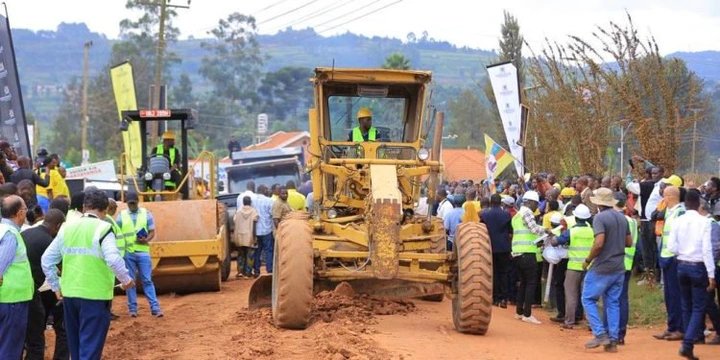

So far shs 16 billion has been paid to a brief case firm in Kabale- Mgahinga Road upgrade
When the government launched the Shs112 billion Kabale–Lake Bunyonyi and Kisoro–Mgahinga road project, it was marketed as a transformative infrastructure investment expected to unlock tourism potential in southwestern Uganda.
The roads were meant to improve access to key tourism destinations around Lake Bunyonyi and Mgahinga Gorilla National Park, attracting more visitors and boosting local economies.
However, emerging details surrounding the project are raising serious questions about its implementation and whether Uganda could be witnessing another infrastructure scandal similar to the notorious Katosi road saga.
The project was formally contracted on 19 September 2023 when the Uganda National Roads Authority entered into an agreement worth shs 112,028,918,319 with Samcrete Egypt Engineers and Contractors, an Egyptian construction firm tasked with upgrading the Kabale–Lake Bunyonyi and Kisoro–Mgahinga roads.
During the procurement process, Samuel Okurut was listed as the company’s country representative in Uganda.
However, months after the contract was signed, the structure of the project began to change. On 31 January 2024, Samcrete subcontracted the execution of the works to Sarick Construction Limited, effectively transferring the responsibility for completing the entire project to the local firm.
Sarick Construction is directed by Samuel Okurut together with Gorret Nabattu creating a situation where the same individual who appeared as the country representative for the main contractor became directly involved in the company tasked with executing the works.
The arrangement became even more complex in May 2024 when Sarick Construction entered into a joint venture with Vet Co. (U) Limited. Under this arrangement, Vet Co. was expected to execute about 30 percent of the project while also helping secure advance payment guarantees required for accessing project funds.
What initially appeared to be a normal subcontracting arrangement has since raised suspicions that the joint venture may have primarily been used as a mechanism to unlock advance payments rather than accelerate actual construction works.
Soon after these arrangements were finalized, the project received an advance payment shs 16,804,337,747, funds released under the financing structure of the project supported by the African Development Bank.
Advance payments are standard practice in large infrastructure projects to enable contractors mobilize equipment and begin works. However, the progress on the Kabale–Mgahinga project has raised questions about how the funds were utilized.
Nearly two years after the contract was executed, visible activity on the ground remains minimal.
Observers familiar with the project say the only notable activity seen during the early stages was the ceremonial appearance of a grader during the official launch.
Beyond that symbolic display, construction activity has been limited, with estimates indicating that only about 20 percent of the work has been done.
The slow progress and unusual contracting structure have drawn comparisons with the infamous Mukono–Katosi road scandal that rocked Uganda’s roads sector several years ago.
In that case, a contractor secured a lucrative government contract using questionable credentials and quickly obtained a massive advance payment before meaningful work had begun.
The scandal later exposed serious gaps in oversight and verification within the country’s infrastructure procurement systems.
The emerging details around the Kabale–Mgahinga road project appear to mirror several elements that defined the Katosi scandal.
A foreign contractor won the tender before the works were effectively transferred to another entity through subcontracting arrangements. Advance payments were subsequently released, yet progress on the ground remains far below expectations.
Such similarities are raising concern among observers who believe the situation could represent a repeat of past procurement failures that cost the country billions of shillings.
ADB didn’t conduct due diligence?
The fact that the project is financed under a framework involving the African Development Bank also introduces another layer of scrutiny regarding the safeguards that were applied before the advance payment was released.
Questions are now being asked about the level of due diligence conducted before approving the release of the Shs16.8 billion advance payment. There is growing curiosity about whether the financing institution was aware of the subcontracting arrangements that effectively shifted execution of the project from the original contractor to another company.
Observers are also questioning whether sufficient monitoring mechanisms were put in place to ensure the funds were used strictly for project mobilization and construction.
The Kabale–Mgahinga road project was originally intended to strengthen tourism by opening up access to southwestern Uganda’s iconic natural attractions.
Instead, the project now risks becoming a troubling example of stalled infrastructure development and questionable procurement practices.
Unless the relevant authorities urgently investigate the contracting arrangements and the use of the advance payment funds, the project could evolve into another costly infrastructure controversy.
For communities that were expecting improved roads and economic opportunities from the tourism corridor, the growing uncertainty surrounding the project is particularly worrying.
What was once presented as a strategic investment to unlock regional tourism now risks being remembered as another unfinished promise if transparency and accountability are not urgently restored.


 Government will not gazette Kijanangoma as King of Tooro for now - Attorney General insists
Ultimate Uganda
Government will not gazette Kijanangoma as King of Tooro for now - Attorney General insists
Ultimate Uganda
 King Oyo’s Body to Arrive Thursday
Ultimate Uganda
King Oyo’s Body to Arrive Thursday
Ultimate Uganda
 Besigye, Lukwago expected to meet Gen. Salim Saleh today at Kapeeke
Ultimate Uganda
Besigye, Lukwago expected to meet Gen. Salim Saleh today at Kapeeke
Ultimate Uganda
 Rwabwogo Advised to ‘Eat His Bishop’ As MK Prepares to Enter State H’se: PREZ MUSEVENI ON HIS WAY OUT
Ultimate Uganda
Rwabwogo Advised to ‘Eat His Bishop’ As MK Prepares to Enter State H’se: PREZ MUSEVENI ON HIS WAY OUT
Ultimate Uganda
0 Comments