
Middle East War: Uganda Fuel Prices Stay Below Europe
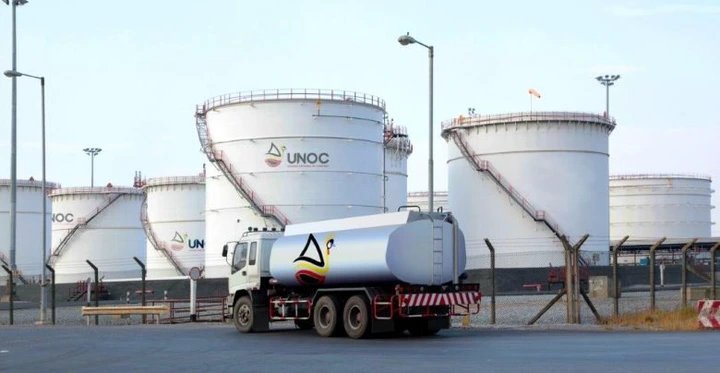

Kampala — Uganda’s fuel prices remain significantly lower than those in Europe despite rising geopolitical tensions affecting global oil markets, with officials attributing the stability to diversified supply arrangements through the Uganda National Oil Company (UNOC) and its international supplier Vitol.
As of March 10, petrol in Uganda is retailing between Shs4,900 and Shs5,200 per litre, while diesel ranges from Shs4,480 to above Shs5,000 per litre, depending on location and filling station.
Prices in cities such as Kampala, Soroti and Mbarara tend to fall toward the upper end of that range.
By contrast, motorists in the European Union are paying far higher prices.
The average price for Euro 95 petrol across the EU stands at €1.57–€1.58 per litre, equivalent to roughly Shs6,600–Shs6,700 at current exchange rates, according to fuel-prices.eu, an online platform that provides current and historical data on retail petrol and diesel prices across European Union member states.
In several European countries, prices are even higher.
Petrol costs about €2.07 per litre in the Netherlands (about Shs8,700), €1.95 per litre in Denmark (about Shs8,200), €1.84 per litre in France (around Shs7,700), and between €1.89 and €2.08 per litre in Germany (about Shs7,900–Shs8,700).
Even the lowest prices in the EU remain above Uganda’s levels, with Bulgaria averaging about €1.23 per litre (around Shs5,200) and Malta about €1.34 per litre (around Shs5,600).
Header advertisement
Tensions
Energy Minister Ruth Nankabirwa said Uganda’s supply chain remains stable despite tensions in the Middle East that have raised concerns about disruptions to shipments through the Strait of Hormuz, a waterway that carries about 20% of global oil supply.
“When UNOC comes out and says that we are able to supply you at the same cost I have been supplying you — the oil marketing company — I have not increased, why should you increase?†Nankabirwa said recently, warning distributors against raising prices without justification.
Uganda imports all refined petroleum products through regional ports in Kenya and Tanzania before transportation into the country.
Officials say the partnership between UNOC and Vitol has strengthened supply security because the global trader sources refined fuels from multiple refineries and trading hubs around the world, allowing Uganda to diversify supply routes even when specific regions face disruptions.
Vitol is the world’s largest independent energy trader, handling more than 7.3 million barrels of oil and petroleum products per day.
While primarily a trading firm, the company also owns and operates downstream assets, including seven refineries globally with a combined capacity of about 850,000 barrels per day, giving it the flexibility to source fuel from multiple markets.
These assets include the Sarroch refinery in Sardinia operated by Saras S.p.A., the Fujairah refinery in the United Arab Emirates, the Cressier refinery in Switzerland, the Geelong refinery in Australia through Viva Energy, and the Rotterdam condensate splitter in the Netherlands, among others, forming a diversified global refining network.
The decision to work with Vitol followed a competitive procurement process in which several global energy trading firms expressed interest in supplying Uganda’s petroleum imports.
Government officials say President Museveni personally reviewed and vetted the proposals from competing companies before the government selected Vitol as the strategic supplier under the centralized fuel importation framework.
Diversification
Officials familiar with the arrangement say the diversified sourcing strategy has helped shield Uganda from sharp price spikes seen in other markets.
In some European markets, diesel prices have recently approached the equivalent of Shs8,700 per litre, underscoring the value of diversified supply chains and centralized procurement.
The strategy has become particularly important amid security threats to shipping routes in the Middle East and attacks on energy infrastructure in the Gulf region.
Uganda consumes roughly 2.3 million litres of petroleum products daily, including petrol, diesel and aviation fuel, and maintains reserves equivalent to about three weeks of national consumption, alongside commercial stocks held by oil marketing companies.
Authorities say scheduled fuel cargo deliveries for March remain on course, helping shield the country from immediate price shocks as global crude prices hover around $84 per barrel.


 Government will not gazette Kijanangoma as King of Tooro for now - Attorney General insists
Ultimate Uganda
Government will not gazette Kijanangoma as King of Tooro for now - Attorney General insists
Ultimate Uganda
 King Oyo’s Body to Arrive Thursday
Ultimate Uganda
King Oyo’s Body to Arrive Thursday
Ultimate Uganda
 Besigye, Lukwago expected to meet Gen. Salim Saleh today at Kapeeke
Ultimate Uganda
Besigye, Lukwago expected to meet Gen. Salim Saleh today at Kapeeke
Ultimate Uganda
 Rwabwogo Advised to ‘Eat His Bishop’ As MK Prepares to Enter State H’se: PREZ MUSEVENI ON HIS WAY OUT
Ultimate Uganda
Rwabwogo Advised to ‘Eat His Bishop’ As MK Prepares to Enter State H’se: PREZ MUSEVENI ON HIS WAY OUT
Ultimate Uganda
0 Comments