
Museveni seeks funds for Ssenfuka drug
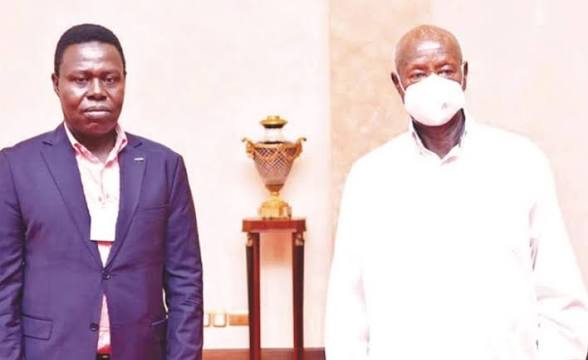

David Ssenfuka (L) and President Museveni
President Yoweri Kaguta Museveni has appealed to Members of Parliament to prioritise funding of critical areas in this year’s budget.
Speaking to members of the ruling National Resistance Movement parliamentary caucus recently, President Museveni among others listed the cancer and diabetes Medicine developed by David Ssenfuka as one of those projects that must be funded.
“In this year’s budget, there are a number of pressures that must be funded. There is Afcon; when this Afcon comes, there is a lot of money that we will earn than what we are spending on Afcon. Then we have got scientific innovation, Kira Motors, they will tell you the details, it is a big hit in Africa …then there are some of our young people who have discovered drugs…,there is a boy called Ssenfuka who has discovered medicines for diabetes and cancer. These must be funded,†Museveni told MPs and other NRM senior leaders.
Museveni also mentioned that government funding to people like Ssenfuka are a one-off expenditure that will not cost the country a lot of money in recurrent expenditures like it is with salaries.
Museveni’s public expression of the willingness to support Ssenfuka comes after years of effort to try and get partners to develop the medicine from its current herbal state to a drug internationally accepted. Speaking to sources who asked for anonymity to speak freely about privileged conversations, Museveni got to know about Ssenfuka through third parties about a year ago.
The president has subsequently met him a number of times and expressed his government’s willingness to help him. Ssenfuka, the source said, has also addressed cabinet a couple of times at the invitation of President Museveni to try and convince ministers on the need to fund his scientific discoveries.
Museveni, apparently told cabinet that the country stands to benefit immensely if Ssenfuka’s medicine is to ever be produced. He wondered why the government would spend money on what he called useless things, but fail to fund scientists to produce medicines that not only benefit Ugandans but also people elsewhere.
Non-communicable diseases, such as cancers, diabetes, cardiovascular disease and chronic respiratory diseases are on a rise in Uganda, estimated to contribute to 35 per cent of all deaths.
“Of course, it is one thing for the President to have a buy-in on something but it’s another for that thing to get government funding. That’s why he has to convince the bureaucracy; the Ministers and MPs so that they can support his vision,†a cabinet minister who attended one of the meetings in which Ssenfuka’s issue was discussed, said.
Another Minister, who also requested anonymity as he is not allowed to disclose cabinet affairs, said Ssenfuka’s case was helped by having a number of colleagues who had used his medicine to either treat themselves or their close relatives.
“A colleague stood up and said she had taken her diabetic mother to Ssenfuka’s place and her condition had improved tremendously. Another talked about her mother who had been to hospitals in America over cancer but wasn’t seeing any improvements. She said when she took her to Ssenfuka’s place, her condition improved greatly. These testimonies and others have greatly influenced the president’s position to help in the development of his medicines,†the source said.
The Observer has in the past interviewed very many prominent Ugandans who have testified to the efficacy of Ssenfuka’s medicine in the treatment of cancer and diabetes. Among them are former Chief Justice Samuel Wako Wambuzi, Justice John Baptist Katutsi, Justice Wilson Kwesiga, among others.
In a recent interview after learning about the decision of President Museveni to fund Ssenfuka’s medicine, former Chief Justice Wambuzi said it was long overdue. “I know that Ssenfuka has been trying to work on the project and I also know that in the long run, it is going to be very useful to this world because we are increasingly being bothered by diabetes and cancer.
These are the enemies of the entire world. Therefore, to know that one of us has discovered something that can be so useful is very good news,†Wambuzi said.
He thanked President Museveni for his foresightedness to support Ssenfuka and other Ugandans, to show that even Africa is capable of doing great things.
“Ssenfuka is little more than a herbal doctor, because on his staff, I know there are qualified doctors trying to assist in the development of this.
I think it’s very good news that the President has seen it fit to assist in the development of cancer and diabetes from our own local herbs. I don’t profess to have knowledge on everything, but I know quite many drugs have been developed from trees and vegetation of all sorts,†Wambuzi said.
Other people who have used Ssenfuka’s drugs and confess to its efficacy include Rev. Peter Mukirane of Kasese district. The 85-year-old Mukirane was diagnosed with Leukaemia in 2020 at Three Rivers hospital in Kampala.
He was recommended to start chemotherapy but his children declined because of his advanced age. “We knew it was going to be very rough on him. We looked at his body, we looked at his age, we said it will be brutal for him.
So, we decided we were going to just manage this thing from home. But then, a colleague whose father had prostate cancer told us about Ssenfuka. We decided to go there and enrolled him on the medicine. I can tell you, for five years now, the man’s health has improved a great deal.â€
Swizen Happy, the son of Peter Mukirane said. He thanked the government for accepting to help in the development of this medicine. For Ssalongo Muhigwa Erisania a 92-year-old retired cooperative officer in the Ministry of Trade and Industry, it is a miracle that he is still alive.
“Everybody thought I would be dead when they learnt that I had stage four cancer of the prostate. With God and Ssenfuka’s medicine, I have been given a new lease of life,†Muhigwa, speaking at his home in Kasese district, said.
Anna Nyangoma echoed her father’s words. “He was diagnosed with stage four prostate cancer after Dr Simon Baluku of Bwera Hospital ordered for tests which were done at the Cancer Institute in Kampala.
We declined the doctor’s suggestion for chemotherapy, because by that time he was 87 years old. This chemotherapy would have killed him before even the cancer. But we enrolled him on that herbal medicine of Ssenfuka. The guy is back on his feet. You might not even tell he is 93.
I really want to thank President Museveni for accepting to help Ssenfuka develop this medicine. I have no doubt about the efficacy of this medicine,†Nyangoma said.
For Hanifa Karubega who lost her leg to diabetes before being introduced to Ssenfuka while she faced the risk of losing the second leg, implored government to help diabetes victims like it helps those with HIV/Aids.
“The government has invested billions of shillings to treat people with HIV. I know diabetes is a non- communicable disease, but it is now affecting very many people. Therefore, there is need to help them too. That’s why I would like to thank the president very much for this gesture,†Karubega said.
It is people like these and many others whom we have profiled in the past, that have made Ssenfuka’s story irresistible. It is not yet known how much money government is going to invest in the project.
Speaking to The Observer, Ssenfuka said he is not in position to discuss the details of his conversation with the president. He, however, noted that his over 10 years’ effort is paying off.
“I have invested a lot of personal savings in this project. I have made some headway like subjecting the medicine to animal trials. The results were very positive. But singlehandedly there is very little I can do. That’s why I’m very grateful to the President for the great vision he has to support innovators like me,†Ssenfuka said.
If money is provided in this year’s budget, Ssenfuka is expected to commence more research on the medicine, particularly the human trials. It is also expected that a factory that will process the medicine into either syrup, injectables or tablets, will be set up. Ssenfuka would not comment on the timelines of when the medicine would be available on the market.


 Government will not gazette Kijanangoma as King of Tooro for now - Attorney General insists
Ultimate Uganda
Government will not gazette Kijanangoma as King of Tooro for now - Attorney General insists
Ultimate Uganda
 King Oyo’s Body to Arrive Thursday
Ultimate Uganda
King Oyo’s Body to Arrive Thursday
Ultimate Uganda
 Besigye, Lukwago expected to meet Gen. Salim Saleh today at Kapeeke
Ultimate Uganda
Besigye, Lukwago expected to meet Gen. Salim Saleh today at Kapeeke
Ultimate Uganda
 Rwabwogo Advised to ‘Eat His Bishop’ As MK Prepares to Enter State H’se: PREZ MUSEVENI ON HIS WAY OUT
Ultimate Uganda
Rwabwogo Advised to ‘Eat His Bishop’ As MK Prepares to Enter State H’se: PREZ MUSEVENI ON HIS WAY OUT
Ultimate Uganda
0 Comments