
Thrones wobble?
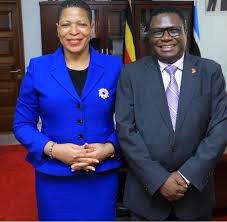

The once-seemingly impenetrable fortress surrounding Speaker Anita Among is showing its first visible cracks. The first signs emerged months ago when Norbert Mao, the Minister for Justice and Constitutional Affairs, officially declared his intention to vie for the Speakership.
Now, numerous Members of Parliament are openly vying for the Speaker’s position, much to Among’s chagrin. Among had worked hard to ensure she was the sole candidate for the Speakership in the ruling National Resistance Movement (NRM).
Even as Mao hobnobbed with powerful players such as the Chief of Defence Forces, Gen. Muhoozi Kainerugaba, to turbocharge his bid for the Speakership, Among still appeared to be comfortably cruising to victory ahead of the election of the 12th Parliament Speaker.
But that house of cards came crashing down on April 8 during a party retreat in Kyankwanzi, when Aringa South MP Alioni Yorke Odria, a legislator outspoken on issues of corruption, asked President Yoweri Museveni why the NRM was ringfencing the Speakership for Among.
“I am one of the four candidates contesting for the Speakership flagbearership of the NRM and we are calling for the rule of law, equity in the activities of CEC,†he said.
Odria also requested an appointment with the President to discuss the matter further. Museveni, with a wry smile, said that the Central Executive Committee (CEC)—the party’s top decision-making organ, which he chairs—had “recommended†the endorsement of Among, to the bemusement of NRM MPs packed into the National Leadership Institute (NALI), 150km from Kampala.
Museveni’s statement that the party would revisit the decision effectively blew the Speaker race wide open and pushed Among out of her comfort zone.
“This was our recommendation. It is not us who decide. When the time comes, we shall be able to discuss and explain why,†President Museveni told the MPs.
Last month, the NRM CEC endorsed Among and her deputy, Thomas Tayebwa, both former Forum for Democratic Change (FDCs) party members, for their positions. However, the decision did not go down well with some NRM MPs, who argued it was undemocratic. Leading the dissent were Odria, Mbale City Woman MP Lydia Wanyoto, Bukono County MP Persis Namuganza, and a few others who expressed their dissatisfaction more quietly.
The nine-day retreat at Kyankwanzi has become the stage where political plots unfold as the Speaker’s race heats up. For years, the institute has served as a stomping ground for party intrigue. Mao, a member of the opposition and president of the Democratic Party—the country’s oldest political party—has now joined the unfolding drama.
Mao remains the leading challenger to Among due to his prominence as a long-serving political figure. He is a Cabinet Minister and the newly elected MP for Laroo Pece Constituency in Gulu District.
The former Makerere University Guild President is returning to Parliament as an elected official after two decades and is making a strong bid for the Speakership.
On the day he departed for the Kyankwanzi retreat, Mao posted a well-choreographed video on his X (formerly Twitter) account showing him exiting his house in typical political fashion.
“The 12th parliament is a very very important parliament in the history of Uganda, he declared,†he declared while holding a coffee mug. “The purpose of this retreat is to ensure that members of the 12th parliament get a real sense of what their responsibility is…that they are the ones going to bridge so many gaps.â€
Mao was likely referring to Uganda’s anticipated but uncertain political transition as 81-year-old Museveni continues to hold onto power. Museveni’s son, Muhoozi, is increasingly seen as waiting in the wings as he accumulates influence as the country’s military chief.
Mao (left) in Kyankwanzi
Muhoozi detains generals, clashes with ministers, and decides who gets influential government jobs. When Mao was appointed to Cabinet a year after Museveni assembled his government, the new minister outlined his brief as helping to broker Uganda’s first peaceful transition. His presence in Kyankwanzi now appears to signal a broader interest in that transition process.
“I am excited to be meeting them,†the 59-year-old politician said. Mao was invited to the retreat by NRM Secretary General Richard Todwong in a March 27 letter, following a directive from NRM chairman President Museveni.
“The retreat is not about the Speakership but of course members of the 12th parliament are the electoral college,†he said.
Mao sounded philosophical in his video, perhaps aware that Among appears to command the numbers. The Speaker has cultivated strong support among MPs, including within the Opposition.
Bedroom drama
When Among addressed MPs at the retreat, she had no kind words for Mao’s challenge.
“We do cooperate with different political parties but the cooperation does not mean you come to my bedroom. You remain in the compound. The bedroom is the Speakership,†Among said.
Mao quickly responded: “This is not just bad politics. It is bad manners. Only the head of the family has the final word on who can access which room in the home. He doesn’t need lectures from a recently adopted child! Above all, when you insult your father’s visitors you’ve insulted your father.â€
In further remarks, Mao said Among’s “bedroom†comments were beneath the Office of the Speaker. His bid has energised other challengers who lack his national profile. The race has shaken Among’s grip on the House.
The Speaker, who commands staunch loyalty in Parliament, faced a stern test at the party retreat. The simmering discontent reached boiling point when Odria fired off his defiant question. There were murmurs from MPs when he raised the issue with the President—signals of growing unease within NRM ranks, even though the Speaker is traditionally chosen with Museveni’s decisive influence.
For Among, watching from the high table, the moment felt like a breach of protocol. Commentary on the exchange centred on how the NRM rank-and-file were no longer content with an anointed succession, transforming the retreat from a coronation into a battleground for political competition, much like party primaries.
Among has presided over the August House with firm authority, making the Speaker’s chair appear almost like a throne. But the Kyankwanzi atmosphere—combined with the presence of figures like Mao—shifted from reverence to a restless hum of ambition.
FILE PHOTO: Museveni welcomed by Speaker Among to Parliament’s session in Gulu. Museveni’s remarks in Kyankwanzi have shaken up the race for Speaker
Having cleared the field in her Bukedea Woman MP race and sailed through unopposed, Among had hoped for an uncontested return as Speaker. Instead, she now faces a possible primary election before confronting Mao for the third most powerful position in the country.
She must also contend with the reality that she is not only facing political rivals, but also quiet scrutiny from higher authorities unsettled by her rapid rise in Uganda’s power hierarchy.
Just seven years ago, Among was a backbencher in Parliament, barely known despite serving as deputy chair of a high-profile committee probing Bank of Uganda expenditures at the height of scandal. It was only when she contested for Deputy Speaker in 2021 and won decisively that she began to gain national attention.
Her elevation to Speaker of the 11th Parliament a year later, following the death of Jacob Oulanyah, propelled her to the apex of Ugandan politics, where she quickly built a strong power centre.
Her tenure, however, has been dogged by corruption allegations and perceptions of opulence amid widespread economic hardship. The Speaker built a cathedral-sized mansion in Bukedea, where she frequently hosts MPs.
She also owns luxury SUVs with personalised number plates, images of which often circulate on social media. An exposé by activist Agather Atuhaire detailed allegations of the Speaker’s involvement in the misuse of billions of shillings of public funds on personal items such as dresses, shoes, and household goods.
The exposé also revealed alleged transfers of funds to accounts of parliamentary subordinates, raising questions of financial impropriety that shocked the public even by Ugandan standards.
Among’s troubles peaked when she was sanctioned by both the U.S. and the U.K. over corruption allegations, including the infamous iron sheets scandal involving supplies meant for the people of Karamoja, which were distributed among Cabinet ministers.
Commentators argue that Among’s scandals and growing political clout have increasingly placed her at odds with the establishment. President Museveni appeared to tolerate the controversies, viewing Among as a Speaker willing to align Parliament more closely with the Executive.
With the exception of a few critical MPs, she has largely contained Parliament’s constitutional oversight role over the Executive.
This coincided with her rise to a more powerful Speakership than her predecessor, Rebecca Kadaga, whose influence was curtailed and who now serves as Deputy Prime Minister.
Among is currently in a similar position, having consolidated significant authority. Analysts point to the powerful Parliamentary Commission, which she chairs, as a key instrument of influence, controlling jobs and resources often used for patronage.
Parliament’s budget has also risen to over a trillion shillings, giving the Speaker considerable financial leverage to build a political base.
Some in the corridors of power suggest this explains the growing challenge to her bid for a second term as Speaker.
It is the first time a high-profile opposition figure like Mao has been invited to the NRM annual retreat. During the retreat, Museveni praised Mao while commenting on the Speaker’s race.
M7 praises Mao
“Regarding Hon. Mao, that’s a different logic,†Museveni said, pausing in his characteristic speech style. “Of course Mao has got his individual qualities as a leader which I have been watching for a long time but more importantly this is the fourth attempt by patriots to unite the people of Uganda politically.â€
Political commentators have interpreted Museveni’s remarks as a subtle endorsement of Mao, adding new intrigue to the Speakership race. Mao is widely regarded for his eloquence, wit, and intellectual depth—qualities that have strengthened his bid amid growing concerns about parliamentary leadership standards.
He has also reportedly received praise from Gen. Muhoozi Kainerugaba, who has emerged as a dominant political actor. The First Son is said to have held meetings with Mao, fuelling speculation about possible political alignments ahead of the Speakership contest.
Mao is also believed to have close ties with Gen. Salim Saleh, Museveni’s brother and a powerful behind-the-scenes figure. Saleh, who is based in Gulu, is reported to meet regularly with Mao, who hails from the same region.


 Government will not gazette Kijanangoma as King of Tooro for now - Attorney General insists
Ultimate Uganda
Government will not gazette Kijanangoma as King of Tooro for now - Attorney General insists
Ultimate Uganda
 King Oyo’s Body to Arrive Thursday
Ultimate Uganda
King Oyo’s Body to Arrive Thursday
Ultimate Uganda
 Besigye, Lukwago expected to meet Gen. Salim Saleh today at Kapeeke
Ultimate Uganda
Besigye, Lukwago expected to meet Gen. Salim Saleh today at Kapeeke
Ultimate Uganda
 Rwabwogo Advised to ‘Eat His Bishop’ As MK Prepares to Enter State H’se: PREZ MUSEVENI ON HIS WAY OUT
Ultimate Uganda
Rwabwogo Advised to ‘Eat His Bishop’ As MK Prepares to Enter State H’se: PREZ MUSEVENI ON HIS WAY OUT
Ultimate Uganda
0 Comments