
Justice Kiryabwire urges internal Auditors to ease court backlog
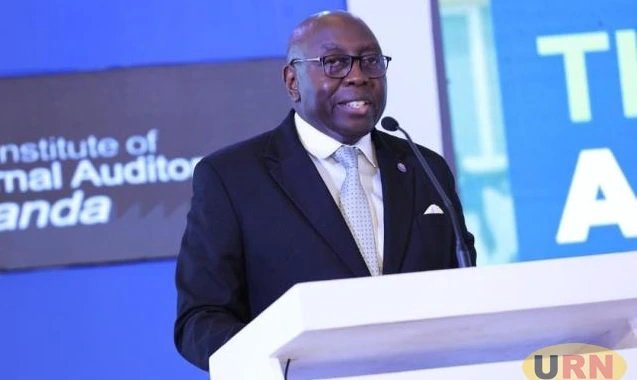

Kampala, Uganda | URN | Justice Geoffrey Kiryabwire of the Court of Appeal and Constitutional Court has urged internal auditors to play a more proactive role in reducing the growing backlog of court cases, warning that unresolved commercial disputes in y in the banking sector are tying up trillions of shillings and weakening financial stability.
He made the call in a presentation at the 20th Institute of Internal Auditors Conference held at Speke Resort Munyonyo under the theme “Ignite, Influence and Transform.â€
His paper was titled “The Internal Auditor And Case Backlog in Uganda: A Case for Proactive Early Warning Systems in Corporate Bodies.â€
Justice Kiryabwire revealed that on April 9, 2026, the Judiciary held a colloquium on Alternative Dispute Resolution (ADR) for commercial and banking cases, which revealed worrying trends in credit recovery and litigation.
He said the discussions showed that banks are increasingly “sinking†due to credit locked up in court cases, with significant financial exposure already tied up in unresolved disputes.
According to data presented during the engagement, there are 623 unresolved banking cases currently before the Commercial Court, involving disputed claims worth about 3.5 trillion Shillings.
The colloquium reportedly found that the value of contested credit was estimated at 7 trillion Shillings, with projections indicating that total credit could rise to 490 trillion Shillings by 2040.
However, concerns were raised that weak credit recovery mechanisms could trigger future financial instability.
Justice Kiryabwire warned that the current situation points to potential systemic risks, noting that reliance on litigation for credit recovery is inefficient and unsustainable.
He observed that many court cases are bogged down by legal technicalities, including disputes over spousal consent, poor-quality security documentation, and highly adversarial legal contests, all of which delay resolution and increase costs for both lenders and borrowers.
He emphasized that internal auditors have a critical role to play in reducing litigation risk by strengthening compliance systems, improving risk detection, and supporting early dispute resolution mechanisms.
He explained that effective internal audit functions can help prevent disputes from escalating into court cases by identifying weaknesses in credit processes, fraud risks, and governance gaps early enough for corrective action.
Regular audits, he said, also ensure compliance with laws, policies, and procedures, reducing exposure to lawsuits arising from regulatory breaches.
Internal audit systems further support administrative dispute resolution by enabling organisations to resolve grievances internally through reviews and appeals rather than litigation.
Justice Kiryabwire stressed that as internal audit practices evolve, there is a need for greater specialization. While auditors have traditionally been seen as “jack-of-all-trades,†he called for dedicated teams focusing on areas such as litigation risk, particularly in financial and commercial disputes.
He noted that such specialization would allow institutions to detect disputes early and ensure that courts are only used as a last resort, after all alternative dispute resolution mechanisms have been exhausted.
He further called for stronger auditor independence, improved professional competence, and firm management support to ensure audit recommendations are fully implemented.
Kiryabwire is one of the strong advocates for Alternative Dispute Resolution mechanisms such as mediation, conciliation, and arbitration, which are seen as faster and more cost-effective than court proceedings.
Justice Kiryabwire urged internal auditors to broaden their mandate to include litigation risk, adopt agile auditing approaches, and build capacity in emerging areas such as technology-related disputes, environmental, social, and governance (ESG) issues, and fraud.
He also recommended that ADR principles be extended beyond the public sector into the private and unregulated sectors to ease pressure on the judiciary and financial systems. Ultimately, he emphasized that a shift in knowledge, skills, and mindset among internal auditors is essential to transforming the profession into a central pillar of dispute prevention and resolution.
Meanwhile, the President of the Institute of Internal Auditors (IIA) Uganda, Ruth Doreen Mutebe, called on auditors to embrace transformation, saying the profession is undergoing significant change driven by new global standards, technology, and evolving governance expectations.
She said internal auditors must “ignite†professional courage, curiosity, and ethical leadership; “influence†decision-making through credibility and strategic insight; and ultimately “transform†institutions into stronger, more transparent, and resilient organisations.
Mutebe noted that the profession is being reshaped by the Internal Audit Vision 2035, the 2025 Global Internal Audit Standards, digital transformation, and Uganda’s national development frameworks, including Vision 2040 and the National Development Plan.
She emphasized that internal auditors must transition from compliance-focused roles to strategic advisors, risk navigators, and governance partners who add value in boardrooms and executive decision-making spaces.
According to her, transformation requires technology-enabled assurance, agile audit functions, stronger ethics, and forward-looking insights that go beyond retrospective findings.
Mutebe further highlighted ongoing efforts by IIA Uganda to strengthen the profession through expanded training and certification programs, adoption of global standards, partnerships with regulators and academia, and capacity-building initiatives for young auditors.
Conference Chair Ronald Kirungi also urged auditors to embrace technological change and expand their competencies to include big data analytics, digital systems, and emerging risk environments that are reshaping organisational operations.
He said modern internal auditors must go beyond assurance work to become trusted advisors who link audit findings to strategy, performance, and value creation, rather than simply reporting compliance gaps.
Kirungi stressed that auditors must uphold integrity, independence, professionalism, and public interest, noting that these values are essential for strengthening trust in the profession.
He encouraged delegates to fully engage in the conference and use the knowledge and networks gained to drive meaningful transformation in their institutions and across Uganda.
Kirungi added that the future of internal audit belongs to professionals who are willing to ignite courage, influence decisions, and transform organisations in a rapidly changing world.


 Government will not gazette Kijanangoma as King of Tooro for now - Attorney General insists
Ultimate Uganda
Government will not gazette Kijanangoma as King of Tooro for now - Attorney General insists
Ultimate Uganda
 King Oyo’s Body to Arrive Thursday
Ultimate Uganda
King Oyo’s Body to Arrive Thursday
Ultimate Uganda
 Besigye, Lukwago expected to meet Gen. Salim Saleh today at Kapeeke
Ultimate Uganda
Besigye, Lukwago expected to meet Gen. Salim Saleh today at Kapeeke
Ultimate Uganda
 Rwabwogo Advised to ‘Eat His Bishop’ As MK Prepares to Enter State H’se: PREZ MUSEVENI ON HIS WAY OUT
Ultimate Uganda
Rwabwogo Advised to ‘Eat His Bishop’ As MK Prepares to Enter State H’se: PREZ MUSEVENI ON HIS WAY OUT
Ultimate Uganda
0 Comments