
Chief Justice Zeija Demands Increased Judiciary Funding to Tackle Case Backlog
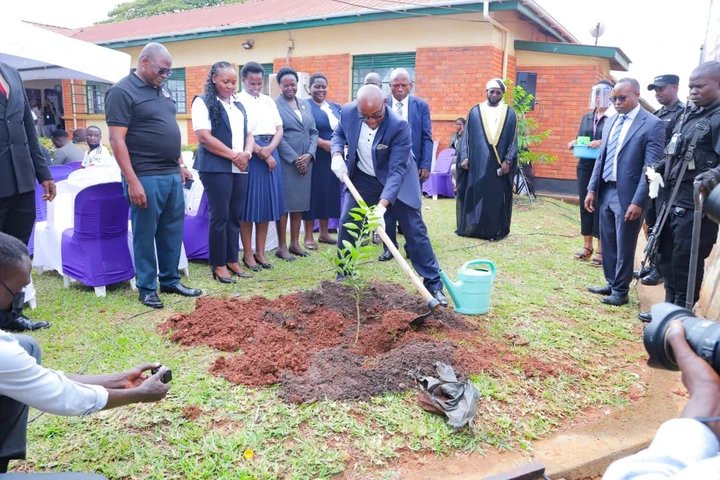

The Chief Justice of Uganda, Flavian Zeija, has called on government to increase funding to the Judiciary to address the growing backlog of cases and improve access to justice across the country.
Justice Zeija made the appeal during an Open Court Day held at Nabweru Court in Wakiso District, where members of the public voiced frustration over prolonged delays in the hearing and disposal of cases.
Residents from different parts of the country told judicial officers that many cases have remained pending for years due to a shortage of judges and magistrates, a situation they said has discouraged several people from seeking justice through the courts.
While addressing participants, Justice Zeija acknowledged the challenges facing the Judiciary, attributing the delays to inadequate budget allocations and limited manpower.
He revealed that the Judiciary currently has only 88 High Court judges out of the required 150, a gap he said continues to affect the timely trial of detainees and disposal of cases.
“We continue to operate under serious resource constraints which affect recruitment of judicial officers, expansion of court infrastructure and effective service delivery,†Justice Zeija said.
He appealed to government to increase the Judiciary budget to enable courts to handle cases faster and improve public confidence in the justice system.
The Open Court Day was organised to strengthen engagement between judicial officers and the public while addressing concerns affecting access to justice.
Meanwhile, the Judiciary has also reaffirmed its commitment to improving accountability, professionalism and efficiency through the rollout of the Performance Enhancement Tool (PET), a system aimed at strengthening performance management among judicial officers.
Speaking during the opening of a training session for magistrates on the use of the PET system, Musa Ssekaana, who represented Justice Mike Chibita, described the initiative as a major step towards improving service delivery and restoring public trust in the Judiciary.
Justice Ssekaana said the effectiveness of the Judiciary depends not only on laws and systems but also on the commitment and performance of judicial officers.
“The effectiveness of the Judiciary depends not only on the laws and systems in place, but also on the performance and dedication of its judicial and administrative personnel,†he said.
He explained that the PET system would streamline judicial workflows, promote accountability and support professional growth through objective assessment and continuous feedback.
Justice Ssekaana emphasized that the tool is not intended to punish judicial officers but rather to empower them to deliver justice more effectively and efficiently.
“This tool is not meant to be punitive, but rather designed to support and empower us as we work towards delivering justice more effectively and efficiently,†he noted.
According to Justice Ssekaana, the system will assess judicial performance using measurable indicators including case disposal rates, complexity of matters handled, time spent on cases and the number of witnesses involved.
“A judgment involving twenty witnesses cannot attract the same weight as a simple matter involving one witness. The system takes into account the complexity and effort involved in handling cases,†he explained.
Earlier, the Registrar High Court, Prossy Katushabe, speaking on behalf of the Chief Registrar, urged participants to ensure fairness and integrity during the appraisal process.
“This is not a time to settle scores, but to carry out a fair assessment of your bosses,†Katushabe cautioned.
Magistrates attending the training were also reminded that the success of the PET system will depend on the quality and accuracy of information entered into it.


 Government will not gazette Kijanangoma as King of Tooro for now - Attorney General insists
Ultimate Uganda
Government will not gazette Kijanangoma as King of Tooro for now - Attorney General insists
Ultimate Uganda
 King Oyo’s Body to Arrive Thursday
Ultimate Uganda
King Oyo’s Body to Arrive Thursday
Ultimate Uganda
 Besigye, Lukwago expected to meet Gen. Salim Saleh today at Kapeeke
Ultimate Uganda
Besigye, Lukwago expected to meet Gen. Salim Saleh today at Kapeeke
Ultimate Uganda
 Rwabwogo Advised to ‘Eat His Bishop’ As MK Prepares to Enter State H’se: PREZ MUSEVENI ON HIS WAY OUT
Ultimate Uganda
Rwabwogo Advised to ‘Eat His Bishop’ As MK Prepares to Enter State H’se: PREZ MUSEVENI ON HIS WAY OUT
Ultimate Uganda
0 Comments