
Uganda Cancer Institute, French Firm Sign Deal for New Oncology Centre in Western Uganda
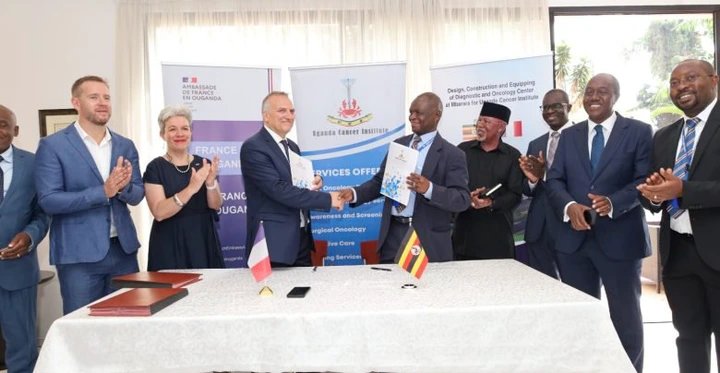

The Uganda Cancer Institute (UCI) and French healthcare company Tyllium SAS on Wednesday signed an agreement to design, construct and equip a modern Diagnostic and Oncology Centre in Mbarara, in a project backed by the French government aimed at expanding access to cancer care in Uganda.
The agreement, signed at the French Embassy in Kampala, marks a major step in Uganda’s efforts to decentralize oncology services and reduce pressure on existing treatment facilities, officials said.
The planned centre in western Uganda is expected to improve access to cancer diagnosis and treatment for patients in the region and neighboring countries, while reducing the burden of long-distance travel toKampala for specialized care.
Officials said the project would combine the Uganda Cancer Institute’s clinical expertise with Tyllium SAS’s experience in healthcare infrastructure development and medical technology integration.
“This project represents a transformative step in expanding equitable access to specialized oncology services,†said Dr. Jackson Orem, Executive Director of the Uganda Cancer Institute.
“By establishing a regional centre in Mbarara, we are strengthening early diagnosis, improving treatment outcomes, and ensuring that no Ugandan is left behind in the fight against cancer,†he added.
French Ambassador to Uganda H.E. Virginie Leroy said the partnership reflected growing cooperation between Uganda and France in strengthening healthcare systems.
“By setting a new oncology center in Mbarara, we will allow people from the western region and also from neighboring countries to come and be treated,†Leroy said.
She added that the project would include a partnership with Gustave Roussy, one of Europe’s leading cancer research institutes, to support access to advanced treatment and research.
“You know in cancerology things are moving very fast with very good progress on some treatments and this partnership will enable Uganda to not be left behind but to benefit from the latest research,†Leroy said.
Dr. Orem said Uganda currently records about 37,000 new cancer cases annually, warning that the figure likely represents only a fraction of the actual burden because many patients in rural areas remain undiagnosed or lack access to treatment.
“As we speak, the incidence of cancer stands at a staggering 37,000 new cases, and that is just the tip of the iceberg,†Orem said.
“Most of the affected Ugandans are in the countryside, they do not have access to care, and they cannot currently reach where care is being delivered.â€
He said the new facility was part of a broader strategy to take cancer services closer to communities across the country.
“What has been lacking is support for that type of plan for decentralization of our services, and that is exactly what this support is going to give us,†he said.
Once completed, the Mbarara Diagnostic and Oncology Centre is expected to ease congestion at existing facilities and strengthen cancer treatment capacity across Uganda and the wider East African region.


 The women who have been in King Oyo’s life
Ultimate Uganda
The women who have been in King Oyo’s life
Ultimate Uganda
 Ex Kagame Guard Commander Tom Byabagamba Dies in Rwandan Prison After 12 Years
Ultimate Uganda
Ex Kagame Guard Commander Tom Byabagamba Dies in Rwandan Prison After 12 Years
Ultimate Uganda
 Government begins salary payments for public sector workers – Reform Committee
Ultimate Uganda
Government begins salary payments for public sector workers – Reform Committee
Ultimate Uganda
 Temangalo land: NSSF, Nzenyi reach agreement
Ultimate Uganda
Temangalo land: NSSF, Nzenyi reach agreement
Ultimate Uganda
0 Comments