
Everything you need to know about jets in Kampala’s skies
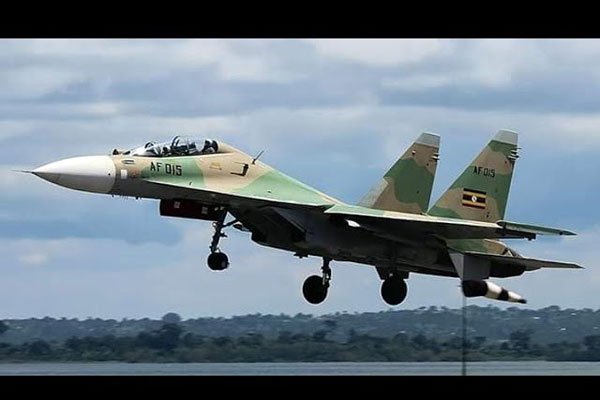

Is it a bird? Is it a plane? No, it’s not Superman. Over the past few days, the distinctive, high-pitched screech of Sukhois has become all too familiar to Kampala residents. While it was initially not immediately obvious why, the ostentatious displays by pilots of the fighter jets soon became a dead giveaway.
If Tuesday’s swearing-in ceremony of Mr Museveni ahead of a seventh straight elective term as president is to be glamorous, the Sukhois will have to be adequate vessels for entertainment.
How many Sukhois does Uganda have on its books?
It is believed that the Uganda People’s Defence Forces-Air Force (UPDF-AF) operates half a dozen Sukhoi Su-30MK2 fighter jets. The 4.5-generation jets can clock speeds of up to 2,100 km/h thanks to two AL-31F engines that provide specificity and power. The Sukhoi Su-30MK2s on the market were manufactured by KnAAPO or the Komsomolsk-on-Amur Aircraft Plant between 2000 and 2016. Uganda acquired its six Russian-made Sukhois in 2011. The cost set back the taxpayer $740m (Shs1.8 trillion approximate amount in 2011), with deliveries finalised in 2012. Since 2022, the fleet has been serviced by India's Hindustan Aeronautics Limited (HAL).
Are Sukhoi Su-30MK2s traditionally loud?
Indeed, much like other Sukhoi variants, the Su-30MK2s are known to produce a distinctive roaring, metallic wail. Over the past few days, the wailing of the UPDF-AF’s Su-30MK2s has cut into Kampala’s soul. Frighteningly, at times, if not most. The dangerous decibel levels owe much to the Su-30MK2’s heavy, twin-engine fighter. The twin-engine fighter is powered by two Saturn AL-31F afterburning turbofan engines. It is the latter that belches a signature, high-decibel wail.
What is the fuel consumption of the UPDF-AF’s Sukhois?
The UPDF-AF’s multirole combat aircrafts consume around 10,200 litres/hour. The fuel consumption spikes inexorably when using afterburners during either combat or rapid acceleration as expected during Tuesday’s swearing-in ceremony. The rapid acceleration will doubtless capture the imagination of the onlookers that are expected to descend on Kololo Ceremonial Grounds in Kampala on Tuesday. The fighter jets in question are, however, known to prioritise higher payload capacity over extreme manoeuvrability. So, if there is any safe bet, it is that onlookers should not expect anything fancy. Certainly a jaw-dropping display of slick trickery.
Why does fuel consumption matter a great deal now more than ever?
The 2026 Middle East conflict has precipitated a severe global jet fuel shortage. This is after the price of a barrel of jet fuel doubled to anywhere between $150 (Shs562,000) and $200 (Shs750,000). As of April 20, Uganda’s jet fuel stability translated to 53 days of cover. That’s 32 million litres of jet fuel. To further strengthen the supply chain, 23 million litres of jet fuel are expected between May and June. Notwithstanding, President Museveni still acknowledged the need to judiciously use aviation fuel in a bid to support the tourism sector and the country’s exports. The comments were made during the Africa We Build Summit that took place in neighbouring Kenya last month.
From May 1, domestic airlines in the country brought in a surcharge of anywhere between $25 (Shs94,000) to $50 (Shs187,000) per flight. The surcharge is expected to take the winds out of the sails of high-end tourism, a main driver of local air travel in Uganda. Could the aviation fuel being burned by the Sukhois have been redirected to ease the pain?


 Government will not gazette Kijanangoma as King of Tooro for now - Attorney General insists
Ultimate Uganda
Government will not gazette Kijanangoma as King of Tooro for now - Attorney General insists
Ultimate Uganda
 King Oyo’s Body to Arrive Thursday
Ultimate Uganda
King Oyo’s Body to Arrive Thursday
Ultimate Uganda
 Besigye, Lukwago expected to meet Gen. Salim Saleh today at Kapeeke
Ultimate Uganda
Besigye, Lukwago expected to meet Gen. Salim Saleh today at Kapeeke
Ultimate Uganda
 Rwabwogo Advised to ‘Eat His Bishop’ As MK Prepares to Enter State H’se: PREZ MUSEVENI ON HIS WAY OUT
Ultimate Uganda
Rwabwogo Advised to ‘Eat His Bishop’ As MK Prepares to Enter State H’se: PREZ MUSEVENI ON HIS WAY OUT
Ultimate Uganda
0 Comments