
From Saul to Paul! Journalist Mwenda concedes he was wrong after meeting Dei BioPharma Founder Dr. Magoola
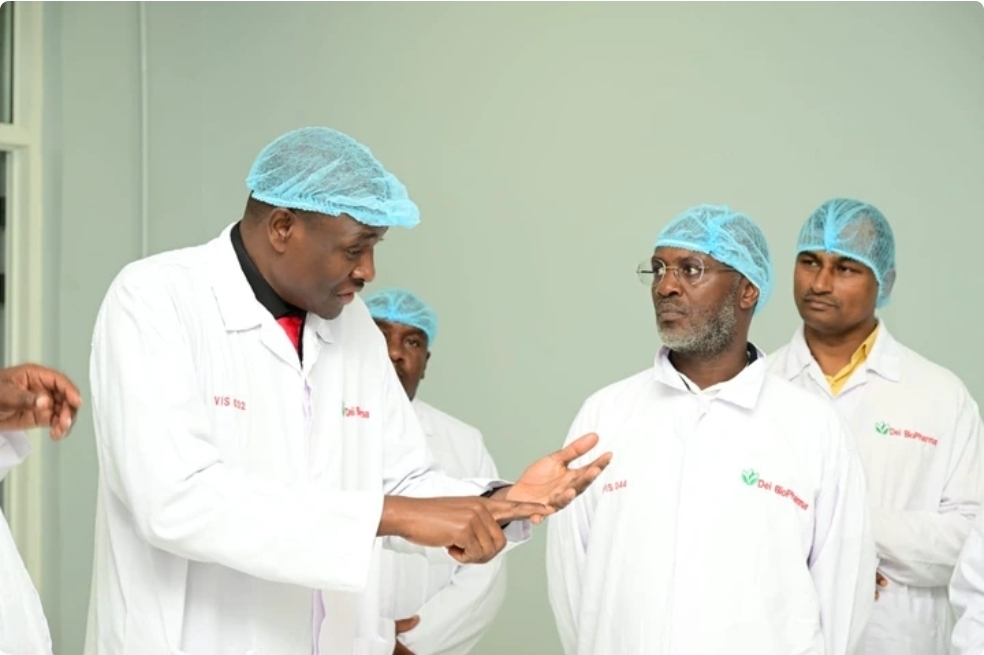

MATUGGA, Uganda — Veteran journalist and commentator Andrew Mwenda, whose written attacks on Dr. Matthias Magoola provoked a public scolding from President Yoweri Museveni, apologized to Magoola’s face, said he had been wrong to call him a conman without ever speaking to him, and asked for forgiveness.It was a remarkable about-turn for one of Uganda’s most combative commentators. Weeks earlier, Mwenda had written that Museveni was throwing public money at fraudulent schemes run by people he likened to con artists, and suggested the president’s judgment might be slipping with age. In a public letter, Museveni told Mwenda bluntly that a journalist who had never visited the factories he was condemning, or interviewed the men he was calling crooks, had no business writing about them at all.
“You are supposed to be a journalist,†Museveni wrote. “Why do you not interview these ‘conmen’ such as Magoola, Senfuka, etc.? They are here in Uganda. They are where you can reach them and even the assets they have put on the ground. Visit Magoola’s factories in Matugga and Kamuli.â€
Mwenda took the hit. Writing back, he conceded that he had broken the most basic rules of his own profession — truth, accuracy, fairness and balance — by spending thousands of words attacking Magoola without giving him a single line in his own defense.
“I felt embarrassed that the president had to remind me of my professional responsibilities because I had not yet visited the plant or spoken with the founder, Matthias Magoola,†he wrote, promising that as soon as he returned from China he would go to the plant, apologize to Magoola in person, and judge the project for himself rather than from his desk in Kampala.
On Friday, he made good on that promise.
“Beyond being a journalist, I also believe in the principles of natural justice, which dictate that you should not act as a judge and prosecutor in the same case, nor judge someone without listening to them,†Mwenda told reporters at Matugga. “I came here to watch, observe, listen, learn and understand.â€
What he found, by his own account, left him struggling to square it with what he had written.
“Everything I have seen here is impressive,†he said. “What Magoola is doing looks great, and the facility is highly equipped.â€
He said he had spent time with Magoola’s staff — “including a young pharmacist with a doctorate, and the chief executive officer†— and come away convinced.
“They are highly educated and gave me convincing explanations of their operations. I am inclined to believe that investing in a project like this can be beneficial for the country,†he said.
Of Magoola himself, he said: “He speaks with passion and conviction, and he knows his industry well.â€
When Magoola told him the company could one day be worth $300 billion or even $500 billion, Mwenda said he chose to listen rather than scoff. That choice, he said, forced him to confront something uncomfortable in himself.
“Africans sometimes suffer from what I call epistemic violence,†he said. “We have been conditioned to doubt our own competencies.â€
He said he had told Magoola, in the boardroom, that the same story coming from a white founder with a white staff would have been believed without a fight — and that his own instinct to disbelieve a Ugandan from Kamuli may have been nothing more than a colonized mind at work.
“I questioned whether my initial skepticism was a symptom of a colonized mindset that struggles to accept that a black man can start a company destined to become worth billions of dollars,†he said.
He invoked Elon Musk and Bill Gates as men who also started with nothing and were taken at their word, and concluded: “I am willing to give Magoola the benefit of the doubt. I am inclined to disregard instincts that stem from a history of mental conditioning.â€
He went further still on the subject of Magoola’s patents in HIV and cancer vaccines, describing his own reflex of disbelief in unsparing terms.
“I initially wondered how it could be that after 100 years of global scientific research, it is Magoola from Busoga, from Kamuli, who is inventing this,†he admitted. “As I was about to ask him what felt like a stupid question, I stopped myself. I realized that I was undermining and underestimating him simply because he is a Ugandan, a black man from Kamuli.â€
He said the moment exposed something he had not wanted to see in himself.
“Deep inside my subconscious, I have been raised to believe in the capabilities of white people and to doubt black men. If a black person says they are going to achieve something great, the immediate reaction from society is often to call them a liar, a cheat or a con man. In fact, that is essentially what I had implied about him,†he said.
Mwenda reached for South Korea to make his point about what Uganda stood to lose by doubting its own. He recalled living in a Samsung-owned apartment in Seoul in 2000, surrounded by Samsung appliances, and discovering that the single conglomerate produced about 40 percent of the country’s exports and roughly 36 percent of its gross domestic product.
“Building national companies that can become national champions is critical for our development, and we need to believe in our people,†he said.
He also revisited a long-standing argument from his conversations with Microsoft co-founder Bill Gates, who told him that African governments have no choice but to act as venture capitalists themselves, since the continent lacks the private risk-capital industry that underwrites entrepreneurship elsewhere. Mwenda noted that even by Silicon Valley’s own standards, failure is the norm rather than the exception: a venture capitalist friend once told him a 20 percent success rate — two wins out of 10 bets — counts as miraculous, with the real industry average closer to one in 13.
Measured against that bar, he said, Uganda’s gamble on Magoola looked far less reckless than his earlier columns had suggested. He said he had gone as far as pulling Dei BioPharma’s filings with the U.S. Patent and Trademark Office, and that despite the dense technical language, it was obvious “serious work has been invested here.â€
Doing his own math on what success would mean, he argued that even a fraction of the returns Magoola was describing would dwarf the public money already committed.
“The company has the potential to generate annual revenues of $50 billion,†he said, adding that even capturing a modest slice of what major American pharmaceutical firms earn would justify the bet many times over. “Against those kinds of returns, a $400 million government investment is highly practical. Matthias, you are on the right track. I am going to appeal to the spirit of our ancestors to grant you immense support.â€
Only then did he turn to Magoola directly for the apology he had come to deliver.
“I want to apologize for mischaracterizing you,†he said. “I apologize for making a judgment about you without even talking to you. I apologize for making accusations against your work without visiting your plant. I ask for your forgiveness.â€
He said the next stop was the president himself: “I will be meeting with the president next week to explain my visit here.â€
Mwenda did not leave entirely without criticism. He argued that government’s investment in Dei BioPharma rings hollow if its own institutions will not buy the company’s output, pointing to the Ministry of Health, the Uganda Cancer Institute and the National Medical Stores as bodies still sourcing drugs from India and China.
“If the government cannot provide a domestic market and act as the primary buyer for these products, the investment strategy falls short,†he said, urging the leadership of those institutions to visit the plant and set aside budget for locally made drugs.
Magoola, for his part, framed the visit as vindication. He told the gathering the company holds more than 100 patents spanning therapeutic proteins, monoclonal antibodies, cytokines, genome therapies and advanced vaccines — categories of medicine, he said, that no one currently manufactures anywhere in Africa.
“For the first time, we are ensuring that Uganda becomes the first African country to manufacture these biological drugs,†he said, describing the roughly 80 percent of the world’s population priced out of biologics as Dei BioPharma’s natural export market.
He credited Museveni personally with talking him out of selling the company’s early research to American pharmaceutical firms that came calling while he was recovering from malaria.
“He told me never to sell it, warning that doing so would betray the African cause,†Magoola said, adding that he had since built the patent portfolio he believes the president’s instinct protected.
He put numbers on the ambition: more than 40,000 direct jobs from the current build-out, plus a further $10 billion investment planned for Kamuli with American partners that he said could generate another 50,000 jobs, all within the next 10 years at the maximum.
To back the scale of the opportunity, he pointed to drugs already on the market worldwide — the cancer treatment pembrolizumab, which brings in close to $40 billion a year, and the diabetes and weight loss drugs Ozempic, Mounjaro and Zepbound, whose combined sales are nearing $100 billion annually and are projected to reach $300 billion a year within a decade.
“The risk of failure is minimal once the infrastructure is fully operational because the demand is already there,†Magoola said.

Dr. Patrick Wakida, chairman of Dei BioPharma’s board of governors, corrected what he described as a public misunderstanding of who actually owns the company.
“Government’s shareholding on behalf of the public here is 9.4 percent,†he said, with Magoola and his private shareholders holding the rest.
He put the company’s eventual contribution to the economy at $500 billion, against a national economy currently worth about $67 billion, and said the 40,000 jobs already cited would likely double once casual and supplier-side employment is counted.
“You are creating an economy within an economy,†he said. “You are going to create people who pay taxes, people who contribute to NSSF, and suppliers who, in supplying this company, build an economy for themselves. That’s how economies are created.â€
“Capitalising an investment of this nature is sometimes a challenge,†he said when pressed on the project’s slower-than-promised pace. He confirmed the Cabinet had approved roughly $300 million in fresh funding this financial year, though he said he could not give an exact disbursed figure.
Public records show the state has put in roughly 723.4 billion Ugandan shillings since 2020, with a further 1.6 trillion shillings approved more recently to finish the Matugga and Kamuli sites.
Wakida said the company now intends to bring lawmakers and journalists’ associations through the plant directly.
“If you are doubting, come here and see for yourselves,†he said.


 Government will not gazette Kijanangoma as King of Tooro for now - Attorney General insists
Ultimate Uganda
Government will not gazette Kijanangoma as King of Tooro for now - Attorney General insists
Ultimate Uganda
 King Oyo’s Body to Arrive Thursday
Ultimate Uganda
King Oyo’s Body to Arrive Thursday
Ultimate Uganda
 Besigye, Lukwago expected to meet Gen. Salim Saleh today at Kapeeke
Ultimate Uganda
Besigye, Lukwago expected to meet Gen. Salim Saleh today at Kapeeke
Ultimate Uganda
 Rwabwogo Advised to ‘Eat His Bishop’ As MK Prepares to Enter State H’se: PREZ MUSEVENI ON HIS WAY OUT
Ultimate Uganda
Rwabwogo Advised to ‘Eat His Bishop’ As MK Prepares to Enter State H’se: PREZ MUSEVENI ON HIS WAY OUT
Ultimate Uganda
0 Comments