
Otunnu first criticized Museveni and even he stood against him…Now Museveni is backing his UN bid
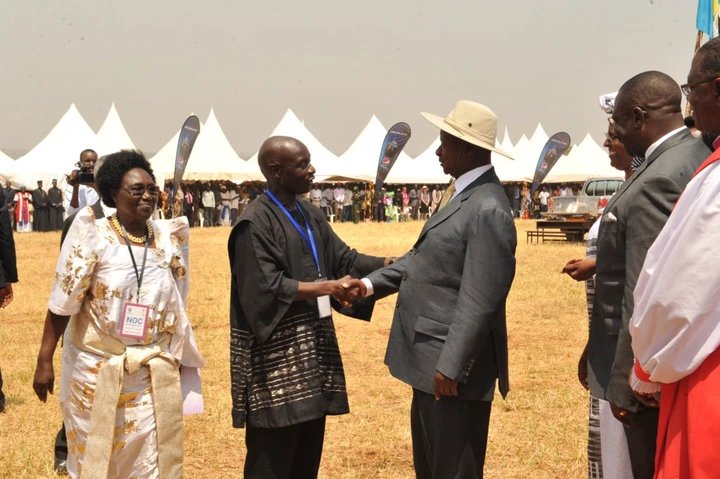

Olara Otunnu (second from left) shakes Museveni's hand during a past function in Gulu
For nearly two decades, Olara Otunnu called President Museveni a mastermind of genocide in northern Uganda.
Then Otunnu was working as the UN’s special representative for children and armed conflict and was in contention to become secretary-general.
Uganda refused to back him, his diplomatic passport was revoked, and he was left with little choice but to seek citizenship in Côte d’Ivoire. The seat went instead to Kofi Annan, a Ghanaian who had at some point been Otunnu’s junior at the UN.
Now, at 75, the same government that once tried to bury his global ambitions has put his name forward as Uganda’s candidate to lead that very institution.
The nomination of Otunnu for the powerful position of UN Secretary-General has been interpreted by many in Uganda as a straightforward story of a distinguished diplomat finally getting his due.
Yet beneath the surface, Otunnu’s rise, fall and rise story is about President Museveni and how over the years, he has managed to turn former critics into strong allies.
Stellar career
Otunnu was born in Mucwini in Chua, northern Uganda, in 1950. He studied at Gulu High School and King’s College Budo before joining Makerere University, Oxford, and Harvard Law School.
He served as Uganda’s permanent representative to the UN from 1980 to 1985 and briefly as foreign minister under Tito Okello in 1985 and 1986.
As president of the UN Security Council in December 1981, he devised the straw-balloting system for electing a secretary-general, a procedure still used today and known as the “Otunnu Formulaâ€.
Otunnu returned to Uganda after years abroad in 2009 and threw himself into opposition politics, becoming president of the Uganda People’s Congress and its presidential candidate in 2011.
He lost badly, taking a distant fourth place as Museveni won two-thirds of the vote.
Days before the vote, he accused Museveni of orchestrating what he called a genocide in the north, telling reporters he had compiled documentary evidence of Museveni’s complicity in the murder of thousands of residents in northern Uganda, and said police had been sent to arrest him over the claims.
In another opinion published in the Daily Monitor, Otunnu said Museveni had divided Ugandans into “us†and “themâ€, “northerners†and “southernersâ€.
However, his political career inside UPC did not end well either. He stepped down as party president in 2015 to make way for elections, but what followed was, by most accounts, a hostile takeover.
Jimmy Akena, son of UPC founder Milton Obote, convened a delegates’ conference that installed him as party leader in a process critics at the time called unconstitutional.
Years later, court rulings would repeatedly question the legitimacy of Akena’s tenure, at one point affirming that Otunnu technically remained UPC’s de facto leader because no lawful election had taken place since 2015.
Otunnu lost the internal fight anyway, and effectively disappeared from frontline politics, resurfacing only occasionally, like during Martyrs’ Day celebrations.
Then, he started softening his hard stance against Museveni.
Otunnu began working alongside retired chief justice Alfonse Owiny-Dollo on the Roco Paco initiative, a community peacebuilding programme which had the full support of Museveni.
The initiative, whose aim was to heal the wounds of the northern Uganda conflict, placed him firmly in the register of reconciliation rather than confrontation.
The clearest public sign of the thaw came in March this year, at Owiny-Dollo’s homecoming celebrations in Gulu, where Otunnu and Museveni were photographed shaking hands and exchanging words in public for what witnesses said was the first time.
Otunnu later told journalists the moment had not been planned, insisting it took him by surprise, though he acknowledged the two men had crossed paths quietly before, including at the consecration of a bishop for a northern Uganda diocese.
It was a striking image for a man who once faced arrest warrants for accusing the same president of genocide.
Is the UN nomination a reward, a reconciliation, or something else?
That is the question some analysts are asking.
Burlington P’Ongwech, a prominent figure in Acholi, described Otunnu’s nomination as “the greatest reward for Acholi for unanimously voting for Museveni in the January elections.â€
Norbert Mao, the minister of Justice and himself a former Museveni critic turned cabinet member, wrote on X that “decades after politics got in the way of Otunnu’s first shot at the job, Uganda had, in the spirit of reconciliation, endorsed one of its most illustrious sons.â€
Yet the timing raises a harder question. Otunnu’s ‘rehabilitation’ has coincided almost exactly with the collapse of Museveni’s working relationship with Jimmy Akena, the man who beat Otunnu for the UPC presidency a decade ago.
Akena was the one who benefited when Museveni’s government effectively let his 2015 hostile takeover of UPC stand.
In the run-up to the 2026 elections, that relationship has soured badly. The Electoral Commission (EC) disqualified Akena from the 2026 presidential race, along with two rivals, citing lapsed party leadership credentials.
Akena blamed Museveni directly, telling supporters he knew exactly who was behind his troubles and vowing to fight the president up to polling day, declaring that Museveni was the one person he was targeting until the election.
Museveni, for his part, did not publicly respond to Akena’s criticisms, but it was clear that the once-cordial relationship between the two politicians had run its course.
Seen against that backdrop, elevating Otunnu, Akena’s old UPC rival, looks less like a random act of grace and more like a calculated political move.
But whether this was Museveni’s primary motive in nominating Otunnu or simply a convenient side effect of a genuine reconciliation is hard to say with certainty.
A worrying pattern
Otunnu is not the first prominent politician from northern Uganda to end up working comfortably alongside Museveni.
Mao spent years as an opposition figure before joining cabinet in 2022. Jacob Oulanyah, the late Speaker, was once a strong critic of Museveni when he was still in UPC. He later joined the NRM and rose to become Speaker of Parliament before he died in 2022.
Otunnu’s trajectory fits that template.
Yet none of this guarantees Otunnu will win the UN top slot. He is one of seven declared candidates and, at 75, the oldest in the field, competing at a moment when many diplomats argue the job should go to a candidate from Latin America or the Caribbean under the UN’s informal regional rotation.
But win or lose, the nomination has already done its work at home. It has repositioned a man once seen as a threat to national security as a symbol of national pride.
It has offered the Acholi sub-region a visible reward for its electoral loyalty in 2021 and 2026. And it has quietly reminded Akena, and anyone else in Lango and Acholi sub-regions weighing their options, that Museveni has other allies to call on.
Whether Otunnu and Museveni have genuinely buried the hatchet, or have simply found it more useful to work with each other, is the question Ugandans will keep asking long after the UN Security Council makes its choice on January 1, 2027.


 Government will not gazette Kijanangoma as King of Tooro for now - Attorney General insists
Ultimate Uganda
Government will not gazette Kijanangoma as King of Tooro for now - Attorney General insists
Ultimate Uganda
 King Oyo’s Body to Arrive Thursday
Ultimate Uganda
King Oyo’s Body to Arrive Thursday
Ultimate Uganda
 Besigye, Lukwago expected to meet Gen. Salim Saleh today at Kapeeke
Ultimate Uganda
Besigye, Lukwago expected to meet Gen. Salim Saleh today at Kapeeke
Ultimate Uganda
 Rwabwogo Advised to ‘Eat His Bishop’ As MK Prepares to Enter State H’se: PREZ MUSEVENI ON HIS WAY OUT
Ultimate Uganda
Rwabwogo Advised to ‘Eat His Bishop’ As MK Prepares to Enter State H’se: PREZ MUSEVENI ON HIS WAY OUT
Ultimate Uganda
0 Comments