
Should Uganda Move Its Capital? Here Are the Cities That Could Take the Pressure Off Kampala

SUMMARY
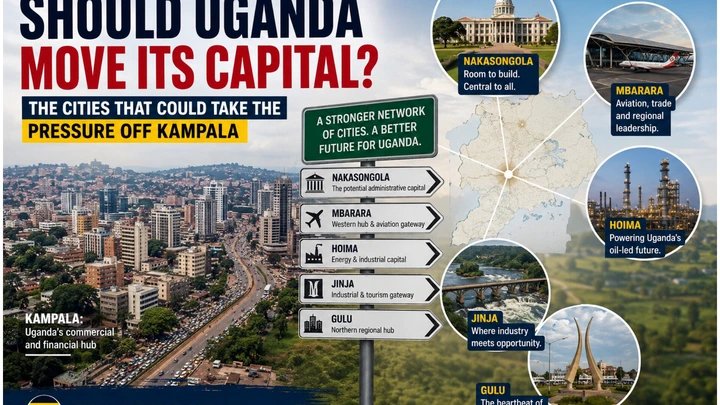
Nakasongola has the strongest case for a purpose-built administrative capital, although major investment and careful land planning would be required.
Mbarara could become a powerful western economic and aviation hub, especially if the proposed Nyakisharara international airport is successfully developed.
Hoima is better positioned as Uganda’s energy and industrial powerhouse, while Kampala could remain the country’s commercial and financial centre.
For decades, Kampala has been the centre of almost everything in Uganda.
Government is here. Big businesses are here. Most major media houses are here. Universities, hospitals, financial institutions, embassies and major employers are concentrated in and around the capital.
But Kampala is increasingly under pressure.
Traffic congestion, flooding, pressure on wetlands, informal settlements, crowded markets and inadequate infrastructure have all raised questions about whether one metropolitan area should continue carrying such a large share of the country’s economic and administrative activity. Parliament has previously debated decentralising government functions as one way of easing the pressure, including proposals to move some functions to Nakasongola while allowing Kampala to focus more heavily on its economic role.
The debate gained fresh attention after Minister of State for Urban Development Margaret Muhanga Mugisa proposed moving Uganda’s capital away from Kampala.
That does not mean Uganda has decided to build a new capital. Kampala remains the country’s capital, and government planning documents still contain major investments and physical-development plans for Greater Kampala. But the proposal raises an important question: if Uganda wanted to create a new administrative centre, where would it make the most sense?
Uganda’s population was 45.9 million in the 2024 Census, showing just how dramatically the country has grown compared with the Uganda in which Kampala’s earlier urban plans were developed.
One of the places that repeatedly comes into the conversation is Nakasongola.
Nakasongola: The strongest candidate for a purpose-built capital
Nakasongola has one major advantage over established cities such as Kampala, Jinja and Mbarara: there is greater scope to plan a new administrative city rather than trying to force one into an already established urban environment.
The idea is not entirely new. Parliament discussed Nakasongola as a possible destination for relocating government functions in 2024, with some MPs arguing that Kampala should increasingly become Uganda’s economic centre while administrative functions are distributed elsewhere.
There is also a geographical argument for Nakasongola. It sits north of Kampala and could potentially serve as a more centrally positioned administrative centre for a country whose regions are becoming increasingly urbanised.
But Nakasongola should not simply be presented as a huge empty piece of land waiting for a city. The district itself faces land, settlement and environmental challenges, including thousands of households affected by the Lake Kyoga buffer-zone issue. A new capital would therefore require serious land-use planning, compensation and environmental safeguards from the beginning.
Still, if Uganda wants to build a capital from scratch, Nakasongola remains one of the more logical places to investigate.
Could Mbarara become Uganda’s capital?
This is where the debate becomes more interesting.
Mbarara already functions as a major regional centre in western Uganda. Unlike a completely new settlement, it has an established urban economy, institutions, businesses, a large surrounding population and an important position on the western transport network.
And now there is another potential advantage: Nyakisharara.
Government and potential private investors have been pushing plans to transform the existing Nyakisharara airfield near Mbarara into a major international airport. Reports in 2026 indicate plans for a large airport complex, although the project remains subject to financing, development and implementation questions.
That makes Mbarara an intriguing candidate.
An international airport, strong road connectivity, a major university and health institutions, a developed commercial base and its role as the economic centre of western Uganda could give Mbarara many of the ingredients required for a major national city.
Could it become the capital? Yes.
But I would not make Mbarara Uganda’s first choice for a completely new administrative capital.
The reason is simple: Mbarara is already an established city. Turning it into the national administrative capital could create another version of the Kampala problem unless government first reserves land, builds transport networks and expands the city according to a clear long-term master plan.
Where Mbarara could really shine is as Uganda’s western economic, medical, education, tourism and aviation hub.
The proposed Nyakisharara airport could strengthen that role substantially—but the airport should not be treated as a guaranteed project until construction, financing and implementation are firmly established.
Then there is Hoima
Hoima may be one of the most important cities to watch over the next two decades.
The city has already been positioned as a strategic urban centre because of Uganda’s oil and gas industry. Government plans include a 60,000-barrel-per-day refinery at Kabaale in Hoima District, while the wider Albertine region is being developed around petroleum infrastructure and industrialisation.
The proposed industrial development around Hoima could transform the city into a major manufacturing and energy centre. Recent reporting on the Kabalega Industrial Park indicates plans for hundreds of factories and substantial industrial activity linked to the petroleum value chain.
But that is precisely why Hoima may be better suited to another role.
Hoima does not necessarily need to become Uganda’s political capital.
It could become something arguably just as important: Uganda’s energy and industrial capital.
Imagine a Uganda where Kampala is the commercial and financial capital, Hoima is the energy and industrial capital, Mbarara is the western regional and aviation hub, Jinja is the industrial-tourism gateway, Gulu is the northern regional hub, and Nakasongola hosts a purpose-built administrative city.
That would be a very different Uganda from one where almost everything flows towards Kampala.
What about Jinja, Gulu and the other cities?
Jinja already has an established industrial history, proximity to the Nile and a strong tourism identity. Rather than moving the entire government there, Uganda could invest heavily in making Jinja an industrial, tourism and logistics centre along the Kampala-Jinja corridor. The government already has a physical-development plan covering the Jinja-Kampala-Mpigi corridor.
Gulu, meanwhile, has the potential to become the strongest urban centre in northern Uganda, serving the region economically, commercially and administratively.
Fort Portal can deepen its role as Uganda’s tourism city, while Mbale could play a similar role for eastern Uganda.
And that is perhaps the bigger lesson.
Uganda does not necessarily have a Kampala problem.
It has a concentration problem.
The Ministry of Lands, Housing and Urban Development is already pursuing programmes intended to strengthen regional cities as engines of economic growth, rather than allowing development to remain concentrated in Kampala.
So what should Kampala become?
Kampala should not be abandoned.
It should become Uganda’s commercial capital.
Its future could be built around finance, trade, technology, media, entertainment, headquarters, professional services, tourism and international business.
At the same time, government could gradually move selected ministries, agencies, institutions and administrative functions elsewhere.
That would be a much more realistic approach than suddenly attempting to empty Kampala and construct an entirely new capital.
The biggest lesson from other countries is that moving a capital does not automatically solve urban problems. The new city still requires roads, water, electricity, housing, public transport, schools, hospitals and jobs.
Uganda therefore needs more than a new capital.
It needs a network of strong cities.
Perhaps the question should not be, “Where will Uganda’s new capital be?â€
Perhaps it should be:
“How do we build five or six cities strong enough that Kampala no longer has to do everything?â€
My take
If Uganda seriously explored a new administrative capital, Nakasongola would deserve the strongest investigation for a purpose-built capital.
Mbarara could work, particularly if Nyakisharara develops into a major international airport, but I see greater value in positioning it as western Uganda’s economic and aviation powerhouse.
Hoima should probably remain focused on becoming the country’s energy and industrial capital, capitalising on the oil economy rather than turning it into another administrative centre.
And Kampala?


 The women who have been in King Oyo’s life
Ultimate Uganda
The women who have been in King Oyo’s life
Ultimate Uganda
 Ex Kagame Guard Commander Tom Byabagamba Dies in Rwandan Prison After 12 Years
Ultimate Uganda
Ex Kagame Guard Commander Tom Byabagamba Dies in Rwandan Prison After 12 Years
Ultimate Uganda
 Government begins salary payments for public sector workers – Reform Committee
Ultimate Uganda
Government begins salary payments for public sector workers – Reform Committee
Ultimate Uganda
 Temangalo land: NSSF, Nzenyi reach agreement
Ultimate Uganda
Temangalo land: NSSF, Nzenyi reach agreement
Ultimate Uganda
0 Comments