
Defeated Wakiso village chairpersons demand Probe into alleged vote rigging
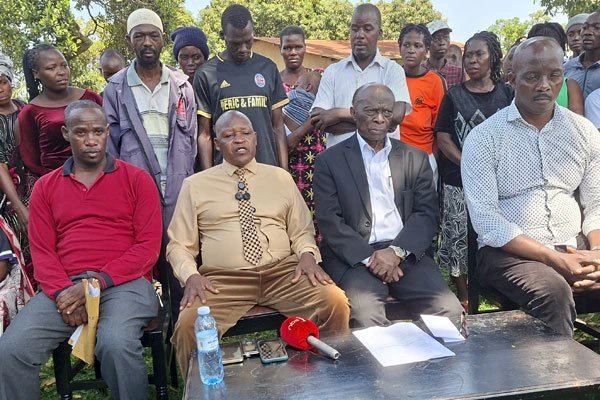

Some of the Wakiso leaders who were defeated in the LC1 chairperson elections address journalists in Abaita Ababiri, Katabi Town Council, Wakiso District on July 30, 2026. Photo/ Paul Adude
Three former Local Council I (LC1) chairpersons in Katabi Town Council, Wakiso District, have expressed bitterness over the outcome of Tuesday’s nationwide village elections, alleging widespread vote rigging orchestrated by security personnel and Electoral Commission (EC) officials.
The complaints emerge in the wake of the highly anticipated LC1 polls, held across over 70,000 villages nationwide. Under the Ugandan Local Governments Act, village elections rely on a open lining-up voting method—where voters queue behind their preferred candidates—rather than secret ballot voting. However, former local leaders claim the established legal process was subverted during the voting and tallying exercises.
Addressing journalists on Thursday, Mr Abbey Ssebowa, the former chairperson of Abayita Ababiri village, claimed that polling officials abandoned the mandatory physical headcount and instead relied on entry slips to declare winners.
“We had three lines of people behind me while my opponent had only one line. We patiently waited for more than 20 minutes to be counted in line to no avail,†Mr Ssebowa said. “Out of nowhere, Electoral Commission officials entered the voting area and collected entry slips that had enabled residents to access the polling site.â€
Mr Ssebowa alleged that an official carrying a large bag proceeded to count these admission slips instead of counting the voters physically standing behind candidates.
“By law, LC1 elections are meant to be conducted by lining up behind candidates, unlike national elections where ballot papers are ticked and dropped in boxes,†he added.
Mr Ssebowa further alleged that rival camps recruited underage, school-going children to inflate voter numbers, wearing religious attire to disguise their age.
“At the time of voting, they made them wear hijabs and join the lines, which was completely wrong,†Mr Ssebowa stated. “We do not refuse to lose, but let us lose in accordance with the law. Losing an election is normal, but subverting the law is unacceptable.â€
Echoing similar concerns, Mr Joseph Musunku, an area councillor, noted that many legitimate village residents were chased away from polling stations by security officers before the vote count or the selection of village executive committees could take place.
“Legally, the village executive committee is supposed to be elected right after the chairperson's vote, but that did not happen. As a result, residents in the area remain completely unsure of who actually won the election,†Mr Musunku said.
In Nkumba–Bufulu village, former chairperson Mr John Chrysestom Luboobi alleged military interference, claiming non-residents were bused in to tilt the vote.
“Military lorries dropped trainees from Kasenyi who are not registered voters in our village, along with a number of students. They forcefully partook in the elections,†Mr Luboobi alleged.
Similarly, Mr Stanley Nsubuga, the former chairperson of Kabale A, Tadeo Zone, accused election officials of announcing candidates who lacked popular support following disruptions caused by security officers.
“We were very peaceful until the army came in and started disrupting voters,†Mr Nsubuga said. “I received 261 votes, while my rivals, Bosco and Balak Jjingo, got 161 and 42 votes respectively. However, officials refused to record these results on the official Declaration of Results (DR) forms. Instead, they wrote numbers on rough paper and started celebrating with Bosco. I have not received my DR form to date.â€
This publication could not independently verify the specific allegations raised by the aggrieved contestants at the time of publication.
When contacted for comment, Electoral Commission Spokesperson Mr Julius Mucunguzi urged all aggrieved candidates to submit formal petitions to the commission for review.
“It is within the rights of anybody—whether a voter or a candidate—if they have reason to believe that whatever was done was not consistent with the law, to raise that complaint formally in writing to the commission,†Mr Mucunguzi said. “The commission will hear, determine, and make a decision.â€
Mr Mucunguzi added that dissatisfied candidates retain the right to seek redress in courts of law by adducing evidence to support their claims. He declined, however, to provide a specific timeline for resolving the petitions.
“If they submit a complaint to the commission, it will be handled. But the commission will not put up a signpost saying today we start, tomorrow we do this, or the next day that,†Mr Mucunguzi explained. “The commission is mandated by law to hear petitions and will communicate directly with those who file them.â€


 Government will not gazette Kijanangoma as King of Tooro for now - Attorney General insists
Ultimate Uganda
Government will not gazette Kijanangoma as King of Tooro for now - Attorney General insists
Ultimate Uganda
 King Oyo’s Body to Arrive Thursday
Ultimate Uganda
King Oyo’s Body to Arrive Thursday
Ultimate Uganda
 Besigye, Lukwago expected to meet Gen. Salim Saleh today at Kapeeke
Ultimate Uganda
Besigye, Lukwago expected to meet Gen. Salim Saleh today at Kapeeke
Ultimate Uganda
 Rwabwogo Advised to ‘Eat His Bishop’ As MK Prepares to Enter State H’se: PREZ MUSEVENI ON HIS WAY OUT
Ultimate Uganda
Rwabwogo Advised to ‘Eat His Bishop’ As MK Prepares to Enter State H’se: PREZ MUSEVENI ON HIS WAY OUT
Ultimate Uganda
0 Comments