
Saudi Arabia, Arab, Muslim countries condemn Israeli attacks on Gaza, warn they threaten ceasefire efforts

Saudi Arabia, Arab, Muslim countries condemn Israeli attacks on Gaza, warn they threaten ceasefire efforts
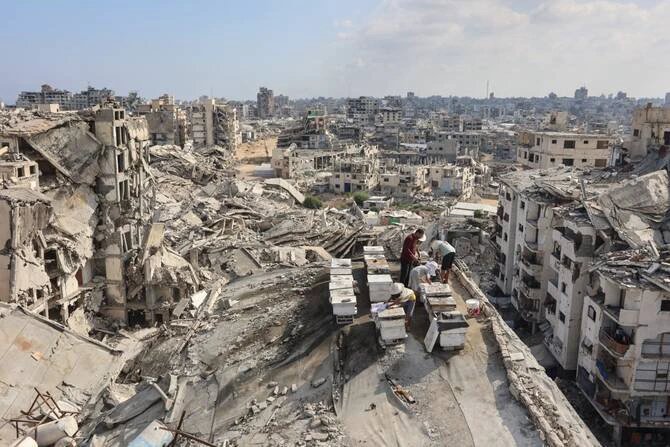
More than two-and-a-half years later, Gaza remains mired in a severe humanitarian crisis, and despite a fragile ceasefire reached between Israel and Hamas in October 2025.
Joint statement says actions represent ‘grave violations’ of international law, international humanitarian law
DUBAI: Saudi Arabia and seven other Arab and Muslim countries on Thursday condemned what they described as ongoing Israeli violations in the Gaza Strip, including attacks on healthcare facilities, civilian infrastructure and the continued loss of civilian lives.
In a joint statement, the foreign ministers of Saudi Arabia, Jordan, the UAE, Qatar, Indonesia, Pakistan, Egypt and Turkiye said the actions represented “grave violations†of international law and international humanitarian law.
The ministers warned that continued violations risked undermining regional and international efforts to advance the next phase of the US-backed plan to end the Gaza conflict, saying they could derail the political process, trigger renewed escalation and worsen the humanitarian crisis.
The statement came after US President Donald Trump announced that Palestinian factions had accepted a road map as part of efforts to end the conflict, including provisions related to the confinement of weapons.
The ministers stressed that protecting civilians, safeguarding medical facilities and humanitarian workers, and ensuring the immediate and unhindered delivery of aid and medical supplies were legal obligations that “must not be compromised.â€
They also linked the situation in Gaza to developments in the occupied West Bank, citing settler attacks, settlement expansion and measures affecting the status quo in occupied East Jerusalem.
The countries said these actions amounted to a broader effort to impose “a fait accompli by force,†undermining prospects for a two-state solution and Palestinian rights.
They called on the international community, particularly the UN Security Council, to take “practical and effective measures†to ensure compliance with international law, hold those responsible for serious violations accountable, and support efforts toward a permanent ceasefire.
The ministers also rejected any attempts to annex occupied Palestinian territory, impose Israeli sovereignty over it, or forcibly displace Palestinians.
They reiterated that a lasting peace could only be achieved through a political process leading to the establishment of an independent Palestinian state along the 1967 borders, with East Jerusalem as its capital.


 DRC opposition urges Tshisekedi to abandon constitutional changes
Ultimate Uganda
DRC opposition urges Tshisekedi to abandon constitutional changes
Ultimate Uganda
 US military transport plane lands in Moscow
Ultimate Uganda
US military transport plane lands in Moscow
Ultimate Uganda
 Putin puppet slaps UK with terrifying 2-word warning over drone factories
Ultimate Uganda
Putin puppet slaps UK with terrifying 2-word warning over drone factories
Ultimate Uganda
 China develops hypersonic weapon to hunt US command aircraft thousands of miles away
Ultimate Uganda
China develops hypersonic weapon to hunt US command aircraft thousands of miles away
Ultimate Uganda
0 Comments