
Bahati urges coffee farmers to prioritise quality, production
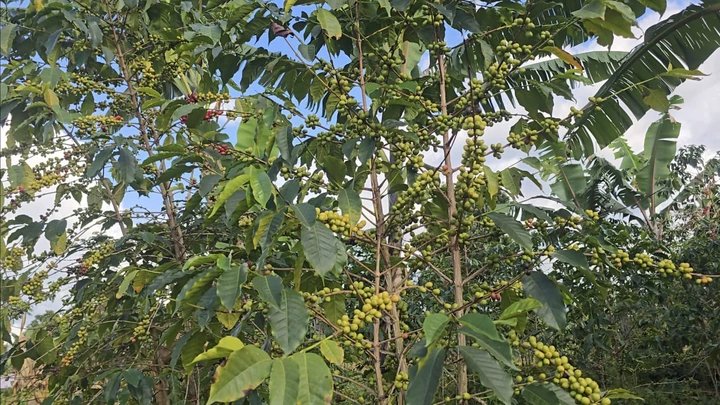

Trade Minister David Bahati has challenged coffee farmers to raise production and maintain quality as Uganda seeks to increase export earnings through processing and wider markets.
State Minister for Trade, Industry and Cooperatives David Bahati has urged coffee farmers to increase production and improve quality as government seeks to expand Uganda’s earnings from coffee exports through value addition and wider market access.
Bahati said Uganda’s coffee sector has expanded significantly in recent years, with the country emerging as Africa’s leading coffee exporter, but warned that farmers must produce enough high-quality coffee to sustain the growth.
“We need production. We need quantity and quality,” Bahati said, urging farmers to increase output while maintaining standards.
He said increasing production alone would not be enough if Uganda continued to export most of its coffee in raw form, arguing that processing could dramatically increase the value earned from the crop.
Bahati said a kilogramme of green coffee that earns Uganda about US$1 when exported in raw form could generate as much as $25 after value addition.
“This means jobs, this means more money, and this means more wealth for the people who are involved,” he said during the launch of Coffee and Cocoa Expo 2026 in Kampala.
He said government was therefore prioritising investment in processing, infrastructure and market access to enable Uganda to retain more value from its agricultural exports.
Bahati said government had approved a US$168 million Market Access project aimed at improving standards and supporting infrastructure, including laboratories, while incentives were being provided to investors in the processing sector.
He said Uganda was also seeking wider markets in East Africa, through the African Continental Free Trade Area (AfCFTA), Europe and Asia.
“We have markets. We signed the protocol of the African Continental Free Trade Area. This we have with a population of 1.2 billion,” he said.
However, Private Sector Foundation Uganda (PSFU) Executive Director Stephen Asiimwe said Uganda’s biggest challenge was not the availability of markets but constraints within the production and value chain.
Asiimwe said many farmers lack access to financing between planting and harvesting, forcing some to sell coffee prematurely and at lower prices.
“Farmers don’t have cash between the time they plant and the time they harvest,” he said.
He said such financial pressure can undermine quality and deny farmers the opportunity to wait for better market prices.
Asiimwe also called for greater investment in irrigation, saying drought had caused high mortality among coffee plants and threatened production.
“The biggest and lowest common denominator in coffee is water. We want water for irrigation,” he said.
He urged government and the private sector to strengthen extension services to help farmers improve agronomic practices, including disease control, fertiliser application, pesticide use and proper storage.
According to Asiimwe, irrigation combined with fertiliser application, known as fertigation, could help improve productivity and farmers’ incomes.
He said international markets already exist for Ugandan coffee, with Europe and America among the major destinations, but Uganda must address weaknesses at farm level and in the value chain to benefit more from those markets.
“The markets are no longer a problem. The issue is what is in the middle and at the base,” he said.
Bahati said government would continue supporting farmers and processors but challenged the sector to respond by increasing production and improving quality.
He also urged participants at the coffee and cocoa sector conference to submit a report identifying challenges facing the industry and recommendations for government action.
“We are waiting for you to tell us what government should do. Give us a report, and we shall take action,” Bahati said.
The minister said stronger production, improved quality and increased local processing would be critical to Uganda’s efforts to raise export earnings and create more jobs from its coffee sector.


 Starlink goes live in Uganda; price comparisons against MTN, Airtel
Ultimate Uganda
Starlink goes live in Uganda; price comparisons against MTN, Airtel
Ultimate Uganda
 NSSF sets September 24 for Annual Members Meeting as savers await interest rate declaration
Ultimate Uganda
NSSF sets September 24 for Annual Members Meeting as savers await interest rate declaration
Ultimate Uganda
 Boda boda riders launch e-commerce, digital loans platform
Ultimate Uganda
Boda boda riders launch e-commerce, digital loans platform
Ultimate Uganda
 Rwanda: We Cannot Sit and Watch As Illicit Alcohol Kills People - Kagame
Ultimate Uganda
Rwanda: We Cannot Sit and Watch As Illicit Alcohol Kills People - Kagame
Ultimate Uganda
0 Comments