
Uganda joins risky military mission in Gaza as it eyes UN top seat
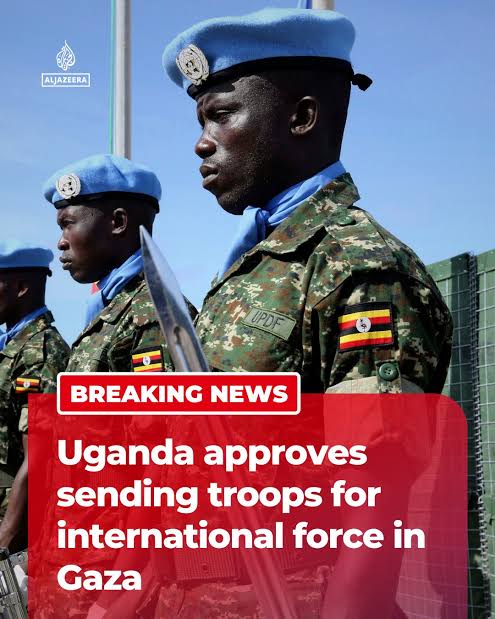

Ugandan army.
Uganda is once again turning to one of its most used foreign policy tools, military deployments abroad, as it joins a US-backed stabilisation mission in Gaza.
It is a move that could bolster Kampala’s standing with global powers but also expose it to new diplomatic and security risks. The goal, however, is to stay close to influential powers, hoping to persuade them to back its candidate for the UN Secretary-General’s seat.
Uganda’s Parliament, on August 6, approved a government motion tabled by Defence Minister Kiryowa Kiwanuka to deploy a Uganda People's Defence Forces (UPDF) contingent to the Gaza Strip as part of the proposed International Stabilisation Force (ISF).
The deployment comes at a politically consequential moment for Uganda. Kampala has nominated veteran diplomat Olara Otunnu for the post of United Nations Secretary-General. And military officials say participation in the Gaza mission could help demonstrate Uganda’s willingness to shoulder international security responsibilities and potentially win support for its candidate.
“Uganda submitted the name of a Ugandan to become Secretary-General of the United Nations. It would be like shooting ourselves in the foot to say that Uganda should not participate in [an international] deployment in Gaza,” Maj Gen David Gonyi, the UPDF representative in Parliament, told legislators.
The Gaza mission will add another chapter to Uganda’s long-running strategy of projecting influence through military deployments. The country became the first troop contributor to the African Union Mission in Somalia (Amisom) in 2007, placing the UPDF at the centre of regional efforts to fight al-Shabaab, an al-Qaeda affiliate. Amisom would change mandate and name several times, but Uganda stayed a part of it to date. The mission is now known as the African Union Support and Stabilisation Mission (Aussom).
Ugandan forces have since become a familiar instrument of Kampala’s regional diplomacy, with deployments in Somalia, South Sudan and the Democratic Republic of Congo, as well as a special military mission in Equatorial Guinea.
Maj-Gen Henry Masiko, Joint Staff Political Commissar and another UPDF representative in Parliament, defended the approach, portraying the army as a force whose influence now extends beyond Uganda’s borders.
“The UPDF is viewed as the anchor of stability in a sea of turbulence, regionally and now globally,” he said.
“The doctrine of the force is that we go out not to dance but to confront threats against society and humanity.”
Uganda’s expanding military role has also attracted interest from international partners.
In November 2025, European Union Special Representative for the Great Lakes Region, Johan Borgstam, met Chief of Defence Forces Gen Muhoozi Kainerugaba to discuss the security and humanitarian crisis in eastern Congo.
One issue on the table was a Brussels proposal to expand the UPDF’s role in Ituri and North Kivu, where more than 6,000 Ugandan troops are already deployed as part of operations against armed groups and efforts to improve security and humanitarian access.
The Somalia mission has similarly cemented Uganda’s position as a key Western security partner in East Africa. The United States has extensively trained and supported Ugandan forces involved in the operation, including through the US Marine Corps and US Africa Command.
Gaza, however, presents a more complicated diplomatic proposition.
Uganda maintains relations with actors across the Middle East, including the Palestine Liberation Organisation (PLO), and is a member of the Organisation of Islamic Cooperation. Joining a US-backed force in Gaza could therefore force Kampala to navigate competing relationships while trying to convince Palestinians and the wider Muslim world that its troops are there as neutral peacekeepers rather than as an extension of Washington’s policy.
Emma Belinda Were, Head of International Relations at the Government Media Centre, said the deployment would require particularly careful communication.
“This calls for clear communication about Uganda’s objectives,” she said, pointing to Kampala’s diplomatic relationships across the region.
There is also a direct security risk.
Ugandan troops participating in a US-backed mission could become targets for Hamas and other armed groups, particularly if the force is perceived as enforcing an arrangement that lacks Palestinian political legitimacy.
Were cautioned that the military component cannot resolve the underlying conflict.
“A political solution to the Israeli-Palestinian conflict has been one of the most difficult issues,” she said. “If Palestine remains without a credible political future and self-determination, military arrangements can only manage the situation, not end the conflict.”
That tension lies at the heart of Uganda’s Gaza gamble. Uganda has built stronger relations with Israel since the July 4, 1976 tragic raid on Entebbe, during the era of Idi Amin. Last month, Uganda installed a statue of Yonatan Netanyahu at Entebbe International Airport. Yonatan, the brother of Israeli Prime Minister Benjamin Netanyahu, died in a deadly air mission to rescue hostages in a hijacked flight by the pro-Palestinian hijackers.
Yet the modern conflict in Gaza that is rooted in more than a century of competing national movements, disputed territory, wars and failed peace efforts, has displaced millions and created an acute humanitarian crisis.
Supporters of the stabilisation force argue that an international presence is needed to protect civilians and facilitate humanitarian access.
However, any force operating in Gaza will inevitably confront the politics of who controls the territory, who provides security and what political future Palestinians are offered.
Kiwanuka has sought to draw a clear line between those political questions and Uganda’s military role.
He said Ugandan troops would remain neutral, comply with international humanitarian law and protect civilians without taking sides in political disputes. Their operations, he said, would be governed by clearly defined rules of engagement.
The ISF is part of a US-backed post-war plan under President Donald Trump’s Board of Peace. Five countries—Albania, Indonesia, Kazakhstan, Kosovo and Morocco—have been formally identified by the United Nations as founding troop-contributing states. Uganda is set to become the sixth.
Other countries, including Egypt, Jordan, Türkiye, Saudi Arabia, Qatar, the United Arab Emirates and Pakistan, have participated in the wider Gaza peace and Board of Peace initiatives but have not committed combat troops to the ISF.
Opposition legislators questioned whether the strategic returns justified the risks. Bukooli County North MP Jamal Ayagalaki asked who would finance the mission and what would happen to Ugandan troops and their families if soldiers were killed or injured.
“We need answers on who will pay the UPDF, what the terms and conditions of service will be, and what support will be available to soldiers and their families. Some return in coffins, while others come back with complaints about their welfare,” he said.
He also questioned Uganda’s strategic interest in the mission, asking why Kampala would involve itself in a conflict “that is not ours” and warning that the deployment could expose the country to new security threats.


 Government will not gazette Kijanangoma as King of Tooro for now - Attorney General insists
Ultimate Uganda
Government will not gazette Kijanangoma as King of Tooro for now - Attorney General insists
Ultimate Uganda
 King Oyo’s Body to Arrive Thursday
Ultimate Uganda
King Oyo’s Body to Arrive Thursday
Ultimate Uganda
 Besigye, Lukwago expected to meet Gen. Salim Saleh today at Kapeeke
Ultimate Uganda
Besigye, Lukwago expected to meet Gen. Salim Saleh today at Kapeeke
Ultimate Uganda
 Rwabwogo Advised to ‘Eat His Bishop’ As MK Prepares to Enter State H’se: PREZ MUSEVENI ON HIS WAY OUT
Ultimate Uganda
Rwabwogo Advised to ‘Eat His Bishop’ As MK Prepares to Enter State H’se: PREZ MUSEVENI ON HIS WAY OUT
Ultimate Uganda
0 Comments