
Gov’t Issues New Fishing Guidelines; All Fishermen to Apply for Licenses before September 15
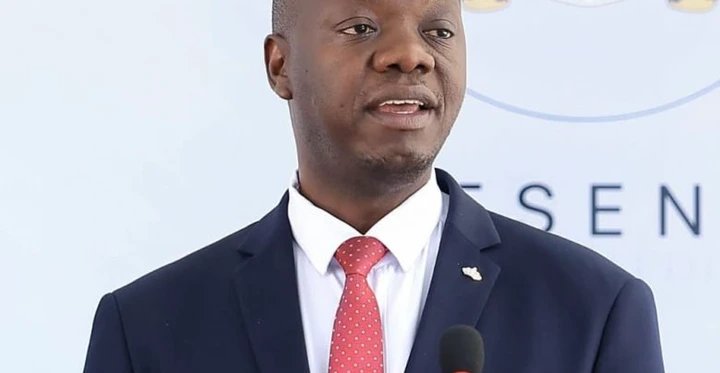

The Minister of State for Fisheries Robert Migadde speaking to reporters in Kampala on Thursday
In a bid to address challenges affecting the fishing sector in Uganda, the government has issued new guidelines which among others require all fisher men to obtain a license.
The new guidelines were announced on Thursday by the Minister of State for Fisheries, Robert Migadde.
After September 15, 2026, Migadde said that all fishing boats that will not have applied for license will be removed from all lakes and other fishing water bodies.
“I also call upon all the fishers to apply for licenses before the 15th of September 2026 because after that date, enforcement to reduce fishing capacity (removal of boats that are not licensed) will start,” Migadde said.
The licenses that will be issued will be species specific. Meaning the license issued for example for fishing of Nile perch will be different from that for fishing of Nile Tilapia. Each fishing activity will have its own independent accompanying license. The licenses are non-transferable and can’t be shared unless they lose their purpose.
According to government, some of the biggest challenges affecting the fisheries industry in Uganda include; scarcity of fish and increasing fishing capacity meaning too many fishers and fishing boats and gears are targeting the few fish available in the waters, difficulties in implementing species specific licensing as very few boats are being licensed and majority unlicensed, rampant use of monofilament nets, continuous importation and use of other illegal gears that are locally made at the landing sites.
Others include; excessive use of lights for fishing of the small pelagics (silver fish), use of hurry up methods, wrong members in the co-management committees, harvesting of fish in fish breeding and nursery grounds etc.
“All these are causing low production and productivity of the fish that we require. This means our fish processing plants cannot receive the required number of fish for processing, the foreign exchange earnings are also therefore reduced, fish available for human consumption in the country is inadequate etc,” Migadde said.
To address these challenges, the Ministry of Agriculture, Animal Industry and Fisheries (MAAIF) has finalized the development of new sets of regulations which provide in detail with the laws that guide all fisheries and aquaculture activities in the country.
These regulations include the following
1. The Fish (Fishing Capacity Management) Regulations 2026: These regulations, amongst other provisions, sets the maximum number of boats allowed per water body per person and their sizes. Guides on the procedures for licensing stipulating punitive penalties for defaulting. It also provides the sizes and types of gears allowable for fishing each type of fish per water body. For example, it is provided that the small pelagic fishes (silver fish) will be harvested using scoop nets and lift nets during the dark phase of the moon at 2km off the shoreline. The regulation restricts the fishing of silver fish to specific landing sites.
It also provides for the various sizes of fish to be harvested in all water bodies.
“The regulation is envisioned to manage capture fish harvesting and rebuild fish stocks in all water bodies in the country,” said Migadde.
2. The (Closed Fishing) Regulations, 2026: This regulation provides for closing of fishing activities in all waterbodies in time and space. Closure of fishing activities will be done as guided by research.
3. The (Protection of Fish Breeding Areas) Regulations, 2026; with this regulation all fish breeding grounds will be demarcated and protected.
4. The (Quality Assurance) Regulations, 2026: This regulation addresses the issue of the safety of fish and fish products for human consumption.
5. The (Aquaculture) Regulations, 2026: Guides the management and development of all aquaculture activities.
6. The (Fish Maw) Regulations, 2026: peculiar nature this special regulation is for controlling the harvesting and trading in fish maw.
7. The Fish (Co-management) Regulations, 2026; this regulation guides the establishment, operation and roles of the fish landing committees ensuring that only qualified and substantial members are appointed to support fisheries management and development in the country.
8. The Fish (Stocking and Restocking) Regulations, 2026. The purpose of this regulation is to guide the stocking and restocking of fish in natural water bodies. Furthermore, the Ministry will soon be looking at further improving post-harvest handling, processing, and marketing; Developing high-value products of fish; reviewing policy guides for development and utilization of all fishes and preparing a species-specific management plan for each of the fish species.
9. The Establishment of the (Monitoring, Control and Surveillance Unit) Regulation: Establishes the Surveillance Unit at the Ministry to support fisheries enforcement work.


 Starlink goes live in Uganda; price comparisons against MTN, Airtel
Ultimate Uganda
Starlink goes live in Uganda; price comparisons against MTN, Airtel
Ultimate Uganda
 NSSF sets September 24 for Annual Members Meeting as savers await interest rate declaration
Ultimate Uganda
NSSF sets September 24 for Annual Members Meeting as savers await interest rate declaration
Ultimate Uganda
 Boda boda riders launch e-commerce, digital loans platform
Ultimate Uganda
Boda boda riders launch e-commerce, digital loans platform
Ultimate Uganda
 Rwanda: We Cannot Sit and Watch As Illicit Alcohol Kills People - Kagame
Ultimate Uganda
Rwanda: We Cannot Sit and Watch As Illicit Alcohol Kills People - Kagame
Ultimate Uganda
0 Comments