
HUGE SCANDAL: Top Uganda Airlines Officials Under Fire as Audit Raises Questions Over Shs1.6bn Advertising Expenditure
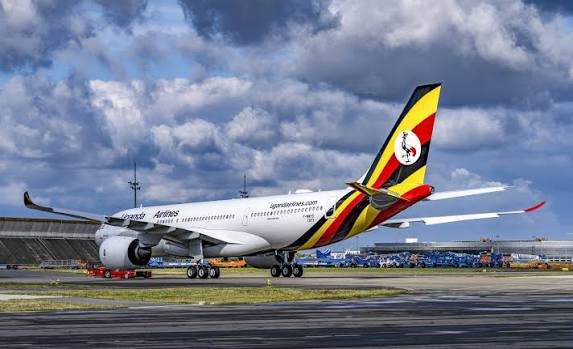

When Shakila Rahim Lamar signed off on the advertising arrangements at Uganda Airlines, the decisions may have appeared to be part of the ordinary business of running a national carrier: improve the brand, expand its visibility and put Uganda Airlines in front of more travellers at home and abroad.
What followed was anything but ordinary.
An internal audit has now put Shs1.6 billion in expenditure under scrutiny, raising questions about how two advertising companies came to share work that had initially been presented as a single assignment, why millions of shillings were spent on services the airline already had staff to perform, and how transactions continued even after one of the contracts had expired.
Lamar, the airline’s Corporate Affairs and Public Relations Manager and contract manager for the arrangement, is now among the officials named in the audit report authored by internal auditor Ronald Otukol.
The report recommends tough disciplinary action against her, the chairperson of the Contracts Committee and Chief Finance Officer Allan Kyeyune, finding them culpable for aspects of the loss.
But the story of the Shs1.6 billion begins earlier, with an apparently straightforward plan to give Uganda Airlines a stronger public image.
A $300,000 ambition
In 2023, Uganda Airlines set aside $300,000, roughly Shs1.1 billion at the time, for brand and image improvement.
The assignment was put out for competition, and Metropolitan Republic Uganda Ltd emerged as the best evaluated bidder, submitting a quotation of $276,231 — comfortably within the airline’s budget.
Then the procurement took an unexpected turn.
Rather than awarding the entire assignment to Metropolitan Republic, the evaluation committee divided the work between two companies.
TBH Holding Ltd was proposed for global footprint content, while Metropolitan Republic Uganda Ltd was assigned content creation.
That decision became one of the central points of Otukol’s audit.
According to the auditor, the original bidding documents did not envisage splitting the work.
“It is important to note that only Metropolitan Republic Uganda Ltd submitted a bid within the Airline’s budget and should therefore have been the sole Best Evaluated Bidder (BEB),” the report reads.
“TBH Holding Ltd, with an evaluated price of $382,013, should not have been recommended for contract award.”
The two companies were nevertheless invited into negotiations with the Contracts Committee on November 30, 2023.
By the end of those discussions, Metropolitan Republic had agreed to a contract worth Shs500 million, while TBH Holding Ltd was to receive Shs650 million.
The combined amount was close to the original $300,000 allocation.
That coincidence did not escape the auditor.
“As both entities were contracted for a similar scope of work, it may be inferred that these negotiations aimed at including TBH Holding Ltd as an additional BEB within the Airline’s overall budget of $300,000,” reads the report.
The audit concluded that the Contracts Committee had moved away from the framework under which the procurement had originally been advertised.
“The contracts committee, thus, inadvertently awarded a contract to TBH Holdings Limited in deviation from its pre-approved terms of reference.”
The global campaign that stayed largely at home
There was another problem.
The contract was ambitious on paper.
Uganda Airlines had sought agencies capable of working across East Africa, Southern Africa, West Africa, Europe, Asia, the Middle East and North Africa. Bidders were expected to demonstrate international competence.
Yet the audit found that the work ultimately remained almost entirely within Uganda.
There was only one notable exception: an English Premier League spot buy from Multichoice in May 2025.
No initiatives, the auditor noted, necessitated activating the contracted agencies’ global partners.
The question raised by the auditors was not simply whether the money had been spent, but whether the airline had properly established what it actually needed before committing itself to the contracts.
That concern runs through much of the report.
The work Uganda Airlines already knew how to do
Some of the services purchased from the agencies presented another difficulty.
The contracts provided for television, radio, print, digital, social and outdoor media management. They also covered press conferences, reputation management, sales materials and concept designs.
But Uganda Airlines already employed graphic designers and creatives, alongside a sales and marketing manager.
The audit therefore questioned whether some of the outsourced work should have been procured at all.
“There is no documented evidence confirming that these items were implemented during the contract period, despite their inclusion in the new procurement cycle,” the report further noted.
“This situation reflects inadequate planning and needs assessment, with resources allocated to areas where they are not required.”
The recommendation was straightforward: use the airline’s purchasing power to negotiate directly with media houses and outdoor advertising companies and reduce dependence on third-party agencies.
Then came the money
By the time the auditors traced the purchase orders and invoices, the figures had moved well beyond the original allocation.
The actual execution was valued at Shs1.6 billion, representing a 42 per cent overrun, or approximately Shs478 million above the budget or contract value.
Metropolitan Republic received Shs408 million.
TBH Holding received about Shs1.2 billion.
Within that spending, the audit identified Shs258 million in expenditure on creative and brand designs that it considered unjustified.
The reason was particularly uncomfortable for an airline that already employed designers.
Their job descriptions included creating aesthetic images, conceptualising visuals and adapting graphics for different media.
Shakila Lamar, the auditor recommended, should justify and account for the expenditure of that money incurred.
Then there were five payments to TBH Holdings.
They totalled Shs164 million and were authorised in April 2025 without purchase orders having been raised by Uganda Airlines.
“As the contract manager, Shakila Lamar should provide justification and an account for the money that was paid without call-offs or purchase orders,” the reports reads.
The contract had already expired
Perhaps the most consequential finding came when auditors followed the transactions beyond the original life of the contract.
TBH Holdings’ contract ended on March 12, 2025.
Yet Uganda Airlines continued conducting transactions with the company.
The audit found no documented approval from the Contracts Committee extending the contract.
“As such, 40 transactions worth Shs 778m were procured without a valid contract with TBH Holdings. This represents a risk transfer failure where all the operational and financial risks shift to the procuring entity.”
For an institution entrusted with public resources, the finding goes to the heart of procurement controls: what happens when a contract ends but the payments do not?
And then there was the missing paper trail
The auditors’ final concern was perhaps the most basic one.
After Shs1.6 billion had been spent, where was the evidence of what had been delivered?
The report says it could not find sufficient proof of delivery or contract management reports showing what Uganda Airlines had actually received.
The missing records included delivery notes, job cards, monitoring reports from media houses and social media, proof of billboard installations, repositories of content produced, minutes of meetings with contractors, performance evaluations and budget reports.
“These are neither evidenced in the Oracle Fusion ERP nor in the procurement files,” the auditor noted.
“It is recommended that as the contract manager, Shakila Lamar should provide the contract management records related to the contract for the global communication strategy and prove delivery of any such deliverables under the contract.”
That is where a branding exercise became an accountability question.
The audit does not merely question whether Uganda Airlines spent money on advertising. It questions how the need was established, why the original procurement was divided, why work was outsourced despite internal capacity, why payments were made without purchase orders, why transactions continued after a contract expired and whether the airline can produce evidence for everything it paid for.
For Lamar and the other officials named in the report, those questions now sit behind what might once have looked like routine procurement decisions.
The Shs1.6 billion was spent in the name of strengthening Uganda Airlines’ image.
The audit has left the airline with a different image to explain.
Uganda Airlines is currently under an Ethiopian boss after Jennifer Bamuturaki was forced out, as reported Here and There.


 Starlink goes live in Uganda; price comparisons against MTN, Airtel
Ultimate Uganda
Starlink goes live in Uganda; price comparisons against MTN, Airtel
Ultimate Uganda
 NSSF sets September 24 for Annual Members Meeting as savers await interest rate declaration
Ultimate Uganda
NSSF sets September 24 for Annual Members Meeting as savers await interest rate declaration
Ultimate Uganda
 Boda boda riders launch e-commerce, digital loans platform
Ultimate Uganda
Boda boda riders launch e-commerce, digital loans platform
Ultimate Uganda
 Rwanda: We Cannot Sit and Watch As Illicit Alcohol Kills People - Kagame
Ultimate Uganda
Rwanda: We Cannot Sit and Watch As Illicit Alcohol Kills People - Kagame
Ultimate Uganda
0 Comments