
Govt targets 1.5 million hectares under irrigation by 2040
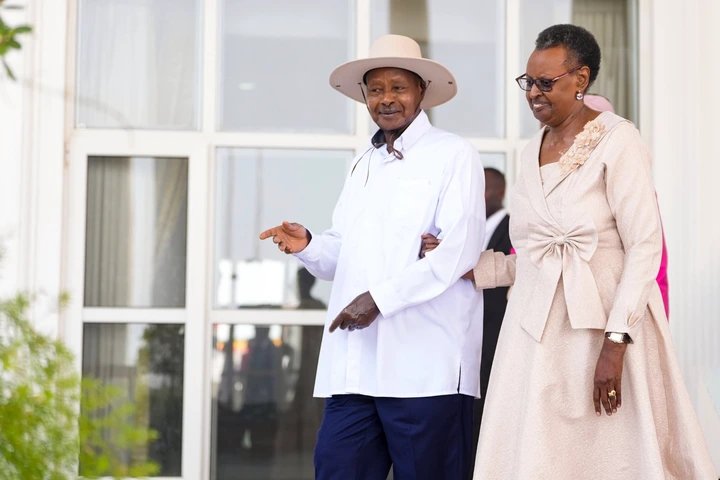

Despite rising investments, most Ugandan farmers remain exposed to drought due to limited irrigation access. Photo / File
The government has set a target of putting 1.5 million hectares of farmland under irrigation by 2040 as it moves to shield farmers from the increasingly unreliable rainfall and boost agricultural productivity.
Speaking at the Agri-connect stakeholders consultation in Kampala, Mr Allan Ollando, a senior engineer in the Ministry of Agriculture, Animal Industry and Fisheries (MAAIF), said the government is shifting its approach from relying mainly on large irrigation schemes to promoting smaller systems that can directly benefit individual farmers.
“Government has always been interested in expanding irrigation because we know that it is one of the ingredients to enhance production and productivity for key high-value commodities within the country,” Mr Ollando said.
Uganda has about 24.2 million hectares of arable land, but only about 8.4 million hectares are currently being utilised.
About 3.03 million hectares are considered irrigable under the country’s irrigation policy, while irrigation coverage has increased from 1.1 percent when the policy was formulated to about 1.5 percent currently.
Mr Ollando said the government has so far brought about 40,000 hectares under irrigation in the past five years, but acknowledged that the pace needs to increase significantly if the 2040 target is to be achieved.
“We want to achieve 1.5 million hectares by 2040, and this is land under irrigation. Currently, all the interventions and activities that we are doing are aligned towards hitting this target,” he said.
He said the government is increasingly working with the private sector to expand access to irrigation, arguing that public resources alone cannot meet the demand from farmers.
Under the collaborations, he said government plans to simplify administrative procedures, streamline tax waivers on imported irrigation equipment and address procurement bottlenecks that delay implementation.
“Government has resources, but the resources are finite and depending on the demand, we are not able to meet the full demand. The private sector has come in very strongly through the irrigation service providers to pilot new technologies that are low cost and efficient,” he said.
The government is also using matching grants to enable smallholder farmers to acquire micro-irrigation equipment. Mr Ollando said the model has proved successful and the government intends to continue supporting individual farmers instead of concentrating only on large-scale irrigation schemes.
“We have seen that this model is very successful in terms of efficiency and also scale, reaching out to the government and farmers. Government has taken more interest in continuing with this approach targeting smallholder farmers,” he said.
However, he identified access to water, financing, technology and land as some of the major obstacles slowing irrigation development.
“Access to water is one of the major impediments. Yes, we have abundant water resources, but in most cases these water resources are not where we need them to be,” he said.
He also said access to land has previously delayed large irrigation projects because of compensation demands from farmers.
Farmers demand financing
Mr Tony Mugoya, the chief executive officer of Uganda Coffee Farmers Alliance, said farmers need affordable financing to invest in irrigation, quality inputs and other productive activities.
“We need a National Agriculture Financing Scheme which can enable farmers in villages to access finance. We also need a national input scheme because, as you know, in villages we don't have access to good quality inputs like fertilizers,” he said.
Mr David Kyeyune, a coffee and cocoa farmer, said climate change is already undermining efforts by farmers to expand plantations, particularly because of declining and unpredictable rainfall.
He urged the government to concentrate resources in selected areas instead of spreading interventions thinly across the country.
He cited Tanzania as an example, saying he was impressed by irrigation infrastructure he saw around Dar es Salaam that enabled farmers to draw water from a common irrigation system, saying such a focused approach would deliver greater impact than scattering limited resources across the country.
“Assuming that the government does that in a place like Kayunga and then you find that maybe almost 70 per cent of the farmers in Kayunga can access irrigation in the first three years, then after another three years, the target is shifted to another place,” he said.
Mr Ollando said the government seeks to decentralize irrigation service delivery through strengthening the capacity of local governments.
He said the technical institutions will also be supported to update their curricula and establish regional irrigation hubs to train farmers and improve the operation and maintenance of irrigation systems


 Government will not gazette Kijanangoma as King of Tooro for now - Attorney General insists
Ultimate Uganda
Government will not gazette Kijanangoma as King of Tooro for now - Attorney General insists
Ultimate Uganda
 King Oyo’s Body to Arrive Thursday
Ultimate Uganda
King Oyo’s Body to Arrive Thursday
Ultimate Uganda
 Besigye, Lukwago expected to meet Gen. Salim Saleh today at Kapeeke
Ultimate Uganda
Besigye, Lukwago expected to meet Gen. Salim Saleh today at Kapeeke
Ultimate Uganda
 Rwabwogo Advised to ‘Eat His Bishop’ As MK Prepares to Enter State H’se: PREZ MUSEVENI ON HIS WAY OUT
Ultimate Uganda
Rwabwogo Advised to ‘Eat His Bishop’ As MK Prepares to Enter State H’se: PREZ MUSEVENI ON HIS WAY OUT
Ultimate Uganda
0 Comments