
Dry spell cuts milk supply, pushes prices higher in Ankole, Kigezi
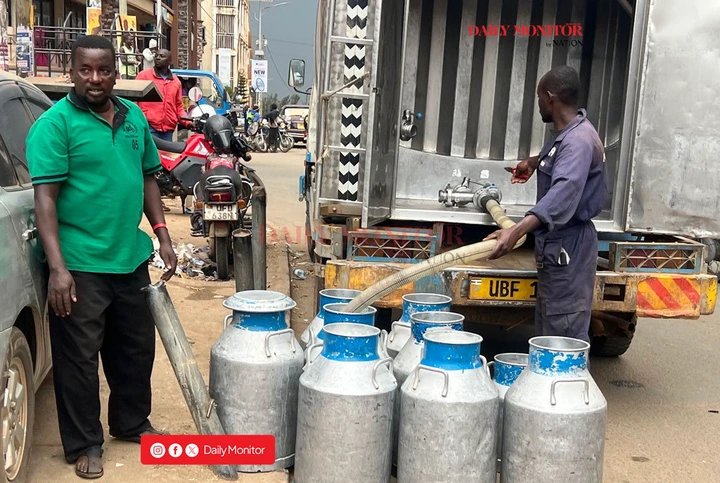

Workers of Abaamu Dairy in Mbarara deliver milk to a milk vendor
Residents in the cattle corridor are experiencing increased milk prices as dry spells continue to ravage the region.
The dry spell, which started in May 2026 and was expected to stop in July, has extended into August, affecting milk production in Ankole, Kigezi and parts of greater Masaka.
This has led to low milk supplies from farmers, forcing residents to dig deep into their pockets to afford a litre of milk. Before the dry spell, a litre of milk was going for between Shs1,000 and Shs1,500, but it is now selling at between Shs2,500 and Shs3,000, depending on where you buy it.
Mr Colleb Tibamanya, a milk dealer at Ankole Fresh Milk Dairy in Mbarara City, said they never expected milk prices to reach this level but blamed the increase on the continued dry spell, which has led to a drop in production.
“The dry spell has been too much; farmers no longer have water and feed for their animals. The milk volumes have reduced at farms. Initially, I have been getting 600-700 litres, but now it is hard to get 300 litres, yet demand is very high,” he said.
He added: “We wouldn’t have increased the price if it was not for that. Before the dry season, the price of a litre was Shs1,500, but now it is Shs2,500 and we anticipate that it will go higher.”
Mr Tibamanya said suppliers have to move across different villages and farms searching for milk, which used to find them in their comfort zones.
“A farmer would sell a litre at Shs1,200, but now they sell at Shs1,800 and when you add the other costs, you find you cannot make any profits. We buy milk in advance from farmers; you have to pay a lot of money and book milk from them, otherwise you cannot work,” he said.
Mr Wilber Mugume, a milk vendor in Mbarara City, said he had never experienced such a dry spell.
“However much the season would be too dry, now it is too much. There is no milk in the villages. I have been selling a litre at Shs1,400, but now I sell at Shs2,300 and some vendors sell it at Shs3,000. We have never hiked prices to this extent. At least we would make it to Shs1,800,” he said.
Ms Vastar Nuwagira, another milk vendor in Mbarara City, was selling milk at Shs1,200 in June but has since increased the price to Shs2,500.
Mr John Bosco Asiimwe, a milk vendor, explained that the forces of demand and supply, coupled with increased prices for inputs such as acaricides, have pushed milk prices up.
“Animal drugs are so expensive that when you are producing few litres of milk, you find yourself making losses if you sell at the same price as when you are having high volumes. Feeding the same cows with also high demand for milk, we have to increase the price to meet the expenses but also remain in the market,” he said.
In Ntungamo District, the chairperson of Ntungamo Dairy Farmers’ Cooperative Union (NDFCU), Mr Emmanuel Arinaitwe, said farm-gate prices have also increased from between Shs700 and Shs1,000 to Shs1,200 a litre as milk volumes have drastically gone down.
“People who have been bringing between 40 and 60 litres can't bring any milk to the union now. Those who were bringing up to 400 litres now bring about 60. The farm-gate price has increased, but still we can't get enough volumes,” he said.
He said the long dry spell from April to August has dried up water facilities and streams, dried grass and forced farmers to walk their animals long distances in search of water.
“We had foot-and-mouth disease in February, which brought the closure of markets. In April, when the issues were not much, drought came in. The farmer is suffering,” he said.
In Kabale, the manager of Kabale Tukore Dairy Cooperative Society Ltd, Ms Agatha Tumusiime, said they increased the price from Shs1,800 to Shs2,000 per litre because of limited supply from farmers.
“We have lost about 20 per cent of our daily customers because of the increased milk prices. We are working almost at a loss because the operational costs such as rent, electricity and other utilities have remained the same despite losing customers,” she said.
The situation is not different at J&B Farmer’s Dairy in Kabale town, where the assistant manager, Mr Dickens Twehikire, said the scarcity of milk has come at a time when demand is high as children go for holidays.
“Scarcity of milk due to the prolonged dry season has forced us to increase the price from Shs1,800 to Shs2,000 because the farmers that supply us this milk have also increased the farm-gate price,” he said.
Across Mpigi District, milk prices vary significantly depending on whether the product is sold at the farm gate, to a trader, at a milk outlet or as processed milk in shops and supermarkets.
Market information shows that fresh milk currently retails at Shs3,000 a litre at some milk points, while processed milk commands a higher price. A recent market listing for Mpigi Central Market, for example, puts fresh milk at Shs3,000 a litre at retail level.
Mr Fred Karangwa, a cattle keeper in Bbaale Sub-county, Kayunga District, said the long dry spell has resulted in the death of a number of animals due to a lack of drinking water and grazing grass, leading to increasing prices as supply is reduced.
Ms Teddy Tafumba, a milk trader in Kayunga Town, said milk prices have gone up from Shs2,000 to Shs2,200. She said the prices increased in June due to the long dry spell, which has resulted in low milk production.
In the island district of Kalangala, a litre of raw milk costs between Shs2,000 and Shs2,500.
According to Eugene Kitatire, a farmer in Dajje Village, Bujumba Sub-county, Kalangala District, this is due to a decline in the number of cattle in Kalangala.
“When they chased cattle from oil palm gardens, milk production reduced, making the prices go up,” he said.
In Masaka, a litre of raw milk is sold at Shs2,500 at some outlets, while others are selling it at Shs2,300 at wholesale points in Masaka City.
The dealers have attributed the fluctuating prices to the long dry spells, which have also pushed meat prices in the city to increase to Shs21,000 a kilogramme from Shs18,000 three months ago.
Response from Dairy Development Authority
Mr Moses Ahimbisibwe, the Principal Dairy Development Officer at the Ministry of Agriculture, Animal Industry and Fisheries in the Department of Dairy Development and Production for the south-western region, said milk production has drastically reduced, affecting supply.
“We have an annual production of around 1.35 billion litres of milk in this region of south-western, which is composed of about 21 districts. But when the dry season sets in, like now, you normally see a significant reduction from that by about 40 per cent to 50 per cent of that amount,” he said.
Mr Ahimbisibwe said as production reduces, the farm-gate price tends to go up.
“At the moment, the average farm-gate price is around Shs1,200 per litre at the farm. Compared to the season when the situation is okay, the price is averaging Shs800. So, you can see a sharp increase in the milk price and as a result also, the consumers are finding it tough,” he said.


 Starlink goes live in Uganda; price comparisons against MTN, Airtel
Ultimate Uganda
Starlink goes live in Uganda; price comparisons against MTN, Airtel
Ultimate Uganda
 NSSF sets September 24 for Annual Members Meeting as savers await interest rate declaration
Ultimate Uganda
NSSF sets September 24 for Annual Members Meeting as savers await interest rate declaration
Ultimate Uganda
 Boda boda riders launch e-commerce, digital loans platform
Ultimate Uganda
Boda boda riders launch e-commerce, digital loans platform
Ultimate Uganda
 Rwanda: We Cannot Sit and Watch As Illicit Alcohol Kills People - Kagame
Ultimate Uganda
Rwanda: We Cannot Sit and Watch As Illicit Alcohol Kills People - Kagame
Ultimate Uganda
0 Comments