
How the Mobile Court helped Juveniles involved in youth gang violence access justice
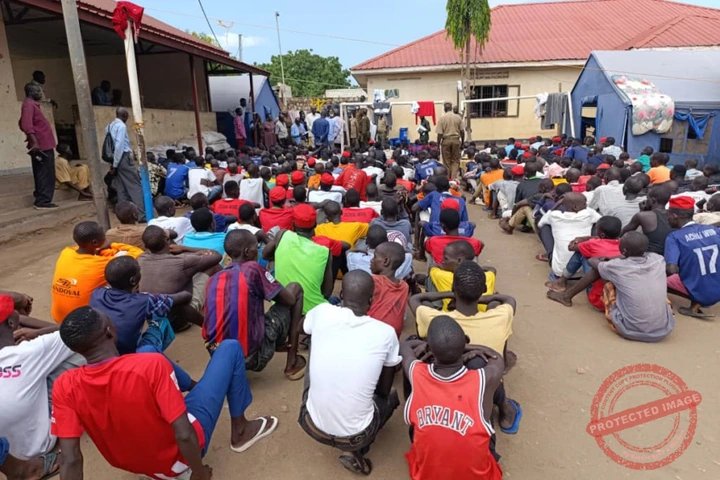

FILE: Underage detainees line up during a judiciary authority visit to assess the conditions of juveniles held at Juba prison in October 2024. Credit: Michael Daniel/Eye Radio
For nearly four years, 15 juveniles accused of murder remained in detention at Juba Central Prison awaiting trial. Their cases, dating back to 2022, had stalled within the justice system, leaving the young detainees in prolonged pretrial detention without a court decision.
Multiple challenges contributed to the delays. Chief among them was the long distance between the prison and the regular courts and the lack of resources, particularly fuel, needed to transport detainees to court hearings. As a result, many court sessions were repeatedly postponed, forcing the juveniles to spend years behind bars while waiting for their cases to be heard.
The situation changed when the Judiciary of South Sudan, with support from the United Nations Development Programme (UNDP), established a Mobile Court at Juba Central Prison.
The initiative was designed to fast-track pending cases involving juveniles and survivors of gender-based violence, reduce case backlogs, ease prison congestion, and improve access to justice for vulnerable groups.
Speaking to Eye Radio, several of the juveniles described how the Mobile Court finally gave them an opportunity to appear before a judge and have their cases heard after years of uncertainty.
The detainees, aged between 15 and 17, were able to participate in court proceedings and follow the presentation of evidence and submissions from prosecutors, defense lawyers, and witnesses. For many, it was their first meaningful engagement with the judicial process since their arrest.
The Mobile Court began its sittings on 10th June 2026, with hearings continued until 29th July 2026. During this period, the court handled a significant number of cases aimed at addressing the backlog at juvenile and Reformatory.
Out of the 109 cases registered before the Mobile Court, 92 have already been adjudicated, demonstrating the initiative’s effectiveness in accelerating access to justice and reducing delays in the court system.
The court was composed of four judges, including two female judges, supported by four prosecutors, three defense lawyers, and ten court police officers who provide security and administrative support throughout the proceedings.
For some of the accused, the court has provided their first real opportunity in years to appear before a judge, follow proceedings and begin to understand what the outcome of their cases could be.
An 18-year-old accused of murder says he was only 14 when he entered prison and has spent about four years awaiting the conclusion of his case.
“Before the mobile court, we didn’t attend the sessions,” he says. “If it weren’t for the mobile court in the prison, which streamlined the procedures, we might have spent more than four years in prison.”
Another 18-year-old accused, who was 14 when arrested in 2022 in connection with a murder case, says the mobile court has allowed prisoners to attend hearings that were previously repeatedly postponed.
“This is the first time we’ve seen the judge here in the mobile court,” he says.
He recalls that previous sessions were sometimes cancelled because of transportation difficulties and fuel shortages.
“Now we no longer need the vehicle, we just walk a couple of steps to the courtroom,” he says.
The Public Prosecutor for Central Equatoria State, Lillian George Lado, says the mobile court has significantly reduced the challenges faced by prosecutors and other justice actors.
She says numerous cases had remained pending since 2022 because accused persons could not be transported from prison to court.
“Sessions were often postponed because of transportation issues, but now the situation has changed,” Lado says. “We are now attending sessions in the mobile court right here in the prison.”
According to the prosecutor, the court operates from morning until 5 p.m. handling an average of ten or more cases each day.
She says complainants and people released on bail are also attending the proceedings.
The court’s sitting period has also been extended by another week to address the backlog of cases where verdicts have not yet been delivered.
Lado says the mobile court is helping address overcrowding in the prison, a problem that has contributed to the spread of diseases.
More than 20 defendants have reportedly been released following the proceedings, giving other prisoners hope that their cases can also be resolved.
For some accused persons, she says, even knowing the outcome of a trial would bring relief after years of uncertainty.
Defense lawyer Josephine David Hakim says the mobile court has also reduced the financial burden on litigants.
She says transportation costs and the difficulties of moving accused persons from prison to court were among the major reasons for repeated adjournments.
“Now they can be assured that a session will be held, and there will be no reason to postpone it as used to happen,” Hakim says.
According to the defense lawyer, the mobile court has accelerated the resolution of cases and reduced the possibility of accused persons remaining in prison for years without trial.
Previously, she says, cases could be postponed because one of the parties could not attend due to transportation challenges.
“Now this excuse no longer exists, and a large number of pending cases have been resolved,” she says.
The initiative reflects broader efforts by the Judiciary of South Sudan and UNDP to strengthen the rule of law, improve judicial efficiency, and expand access to justice across the country.
For the young people who have spent years waiting behind prison walls, the mobile court represents more than a change in where hearings are held. It offers them an opportunity to be heard, follow their cases and, ultimately, find out whether they will be convicted or regain their freedom.
After years of uncertainty, the courtroom has finally come closer to them.


 The women who have been in King Oyo’s life
Ultimate Uganda
The women who have been in King Oyo’s life
Ultimate Uganda
 Ex Kagame Guard Commander Tom Byabagamba Dies in Rwandan Prison After 12 Years
Ultimate Uganda
Ex Kagame Guard Commander Tom Byabagamba Dies in Rwandan Prison After 12 Years
Ultimate Uganda
 Government begins salary payments for public sector workers – Reform Committee
Ultimate Uganda
Government begins salary payments for public sector workers – Reform Committee
Ultimate Uganda
 Temangalo land: NSSF, Nzenyi reach agreement
Ultimate Uganda
Temangalo land: NSSF, Nzenyi reach agreement
Ultimate Uganda
0 Comments