
Africans Want Elections but Don't Trust Electoral Management Bodies to Ensure They're Free and Fair

Assessments of election quality have worsened over the past decade.
Key findings
On average across 38 countries, about three-quarters (74%) of Africans support choosing their leaders through regular, open, and honest elections. This is the majority position in every surveyed country, although support for elections has weakened over the past decade.
Strong majorities favour multiparty competition (63%) and reject dictatorship (79%) and one-party rule (76%) as alternatives to elections.
Seven in 10 citizens (71%) say they voted in their country's most recent national election.
Self-reported voting is highest among older age cohorts (82%), rural residents (75%), men (74%), and citizens without formal education (76%).
Regionally, reported voting rates are highest in West Africa (78%) and lowest in North Africa (53%).
More than half (55%) of Africans rate their most recent national election as largely free and fair (either "completely" or with "minor problems"), but 36% disagree.
Across 28 countries surveyed consistently since 2014/2015, the perception of free and fair elections has declined by 7 percentage points.
But most Africans say they are "somewhat" or "completely" free to join any political organisation of their choice (77%) and to vote for any candidate without feeling pressured (86%).
About one in five respondents (19%) say they feared political intimidation or violence during their country's most recent campaign period, and almost three in 10 (28%) consider it likely that powerful people could find out how they voted.
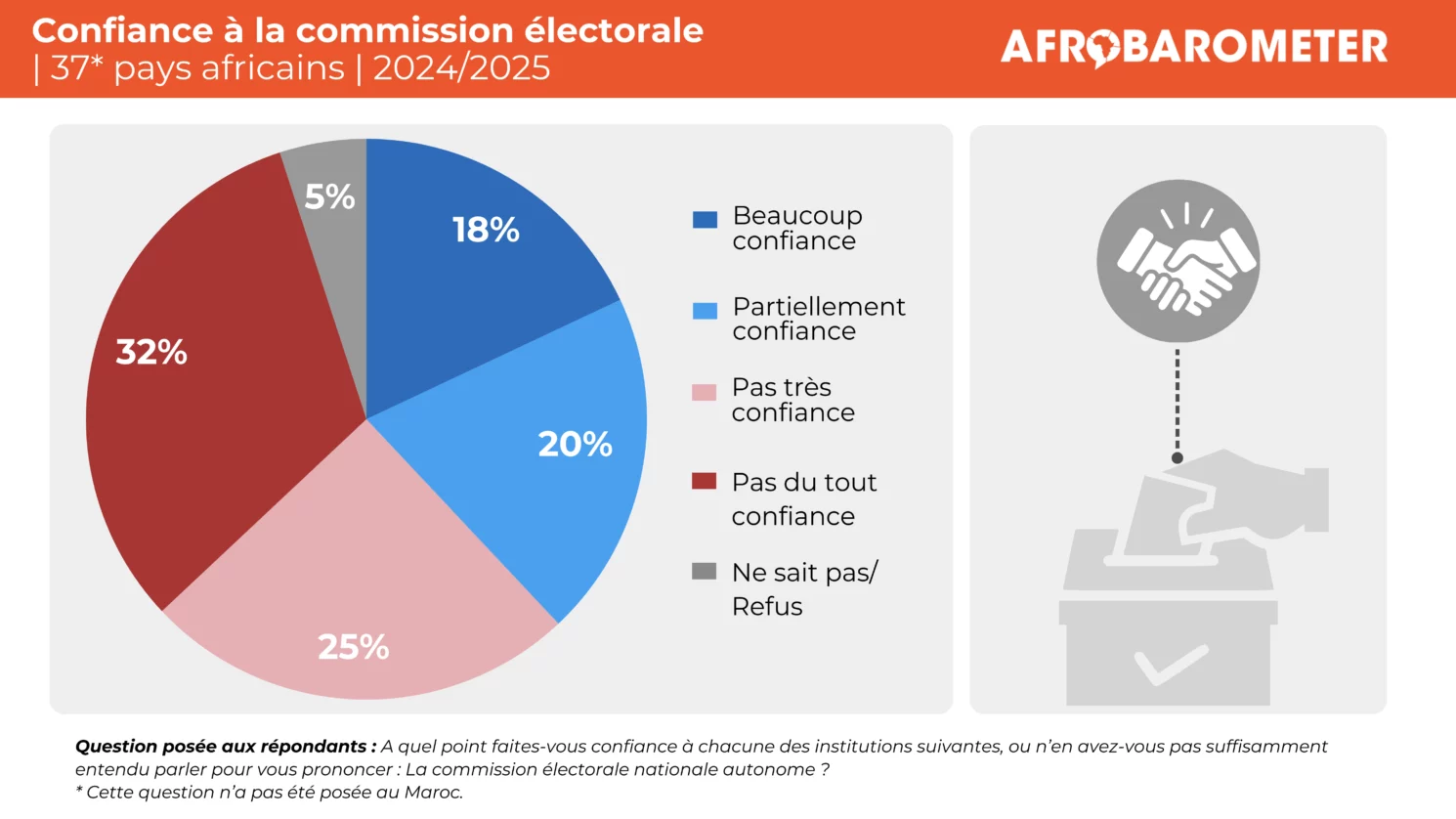
Only about four in 10 Africans (38%) say they trust their country's electoral management body "somewhat" or "a lot."
More than three-fourths (77%) of citizens say that elected officials should follow voters' demands, rather than their own ideas.
But only 17% say their members of Parliament (MPs) "often" or "always" do their best to listen to what ordinary people have to say.
Follow us on WhatsApp | LinkedIn for the latest headlines
Elections are widely accepted as a cornerstone of democracy, providing citizens with a peaceful means to choose their leaders and hold them accountable. Across Africa, voters turned out in almost 40 countries in 2024 and 2025, reflecting enduring citizen commitment to participate in democratic governance, and another 17 countries are expected to vote in 2026 (Gerenge, 2025; EISA, 2026).
But the value of elections depends not only on whether they occur. Do they meet basic standards of fairness, transparency, and competitiveness? Do citizens enjoy fundamental political freedoms to organise and to vote without pressure? Can they participate without fear? Can their votes lead to real change?
African elections have produced a notable series of peaceful transfers of power in recent years, as in Botswana, Ghana, Liberia, Mauritius, and Senegal (Brown, 2025). But other contests have highlighted the fragility of election integrity, as in heavily manipulated contests in Cameroon and Guinea in late 2025 (Wojtanik, 2026). Opposition leaders were jailed in Tanzania amid reports of widespread manipulation, intimidation, and violence, as well as in Uganda, where President Yoweri Museveni's seventh term has renewed debates about whether elections in countries with long-entrenched regimes still serve as genuine mechanisms of democratic choice (Wambi, 2025; Mwaniki, 2026; Gavin, 2025; Impact International, 2025).
Finally, elections matter not only because they select leaders, but because they are expected to produce responsive governance. Electoral efficacy - the belief that voting leads to representation and accountability - shapes whether citizens view elections as meaningful (Banducci & Karp, 2009). When elected officials are perceived as unresponsive or unaccountable, public confidence in elections erodes.
Weakening support for democracy and growing tolerance for military rule in some African countries (Afrobarometer, 2024) underscore the importance of understanding how Africans see their elections, political freedoms, and electoral efficacy.
Findings from the Afrobarometer Round 10 survey in 38 African countries show that most Africans want to choose their leaders through fair elections and report participating in the electoral process. More than half see their most recent election as largely free and fair, though that confidence has weakened. Most feel free to vote without pressure and to join political organisations, but substantial minorities report fearing violence or intimidation during the last election campaign and doubt that their ballots are truly secret. A majority of Africans distrust the election management body charged with ensuring the fairness and transparency of their country's elections.
And most doubt that elections produce responsive leaders: While the vast majority of citizens say that elected officials should heed voter demands, few think their members of Parliament are listening.


 DRC opposition urges Tshisekedi to abandon constitutional changes
Ultimate Uganda
DRC opposition urges Tshisekedi to abandon constitutional changes
Ultimate Uganda
 US military transport plane lands in Moscow
Ultimate Uganda
US military transport plane lands in Moscow
Ultimate Uganda
 Putin puppet slaps UK with terrifying 2-word warning over drone factories
Ultimate Uganda
Putin puppet slaps UK with terrifying 2-word warning over drone factories
Ultimate Uganda
 China develops hypersonic weapon to hunt US command aircraft thousands of miles away
Ultimate Uganda
China develops hypersonic weapon to hunt US command aircraft thousands of miles away
Ultimate Uganda
0 Comments