
LANDS OFFICE SCANDAL! 277,000 Land Files Stuck, Fraud Rampant & Titles Forged as Fresh Probe Reveals Shocking Rot
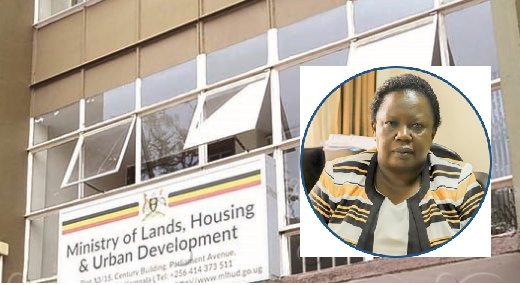

A Value for Money audit has detonated a political and administrative bombshell at the Ministry of Lands, Housing and Urban Development, exposing deep cracks in Uganda’s land administration system despite years of digitalisation and decentralisation reforms.
At the centre of the storm is the Ministry of Lands, Housing and Urban Development, headed administratively by Permanent Secretary Dorcas W. Okalany, who doubles as the Accounting Officer, Chief Executive Officer of the Ministry and Information Officer under the Access to Information Act, 2005. As Accounting Officer, the buck stops at her desk.
The Office of the Auditor General conducted a Value for Money audit on the implementation of Land Administration through the Ministry Zonal Offices, and what it found paints a troubling picture of inefficiency, backlog, weak fraud controls and deteriorating service delivery — even after the establishment of 22 Ministry Zonal Offices and the rollout of the National Land Information System.
Land administration in Uganda is supposed to rest on five pillars: land registration, land surveying, land valuation, land use planning and dispute resolution. The Ministry is mandated to ensure rational, sustainable and effective use and management of land, orderly development of urban and rural areas, and safe, planned housing for socio-economic development.
In 2013, the Ministry established six pilot Ministry Zonal Offices in Kampala, Wakiso, Mukono, Jinja, Masaka and Mbarara after developing the Uganda National Lands Information System. By 2018, fourteen more were rolled out across Lira, Fort Portal, Kibaale, Masindi, Arua, Gulu, Mbale, Mityana, Luwero, Mpigi, Tororo, Soroti, Moroto, Kabale and Rukungiri in a bold move to decentralize services and bring land administration closer to the people.
But more than a decade later, the digital promise appears to be faltering.
Out of 934,645 land registration applications received over the review period, only 657,384 were completed. That leaves over 277,000 applications hanging in limbo.
Even more alarming, despite digitalisation, processing of land transactions consistently exceeded the standard timelines set in the Client Service Charter across all land offices. The average completion rate per transaction deteriorated dramatically from 77 percent in 2021/22 to a shocking 41 percent in 2024/25.
In simple terms, service delivery is getting worse, not better.
The Auditor General found that the delays were mainly caused by incomplete digitisation and serious problems within the National Land Information System. There are missing parcel details, incomplete or inaccurate mapping, weak front-desk verification processes and survey details that cannot be reliably aligned to the cadastral map.
One senior land officer, speaking to RedPepper on condition of anonymity, described the situation bluntly: “You have scanned records stuck at Quality Control for months. Files move in circles. Clients think digitisation means speed, but sometimes it means confusion.â€
Fraud remains another cancer eating away at public trust.
Forged titles, double titling and fraudulent transactions still exist, with Wakiso-Busiro Ministry Zonal Office taking the lead in reported cases. Despite efforts to mitigate land fraud, the audit noted that staff at MZOs lack adequate training and controls to detect forged national IDs, land titles and Local Council recommendation letters.
An insider confessed, “We rely too much on individual experience to detect fraud. There are no comprehensive fraud-prevention guidelines. If a clever forger comes in, many staff may not detect it.â€
The audit found that fraud risk management is still weak, with no unified fraud-prevention framework, limited internal audits and detection efforts heavily dependent on personal judgment rather than structured systems.
To make matters worse, public sensitization has been inconsistent. Despite the Ministry’s commitment to educate citizens on land services and required documentation, many clients remain unaware of the National Land Information System and what documents are required. This lack of awareness leads to incomplete submissions, repeated visits and further delays.
The Auditor General concluded that while the Ministry has expanded access to land services and processed a large number of transactions, the overall implementation of land administration is falling short of expectations. Service delivery remains slow and inconsistent. Backlogs continue to grow each year. Data quality issues persist. Integration with key institutions remains weak.
The recommendations were clear and sharp.
The Accounting Officer was advised to develop and implement a time-bound data cleaning and digitisation plan to clear the backlog of scanned but uncommitted records stuck at Quality Control. Front-desk verification must be strengthened through continuous training of receptionists and data entry clerks, making them responsible for verifying all client submissions before acceptance. Lands officers and registrars need regular training in fraud detection techniques and document verification. Comprehensive fraud-prevention guidelines must be developed and issued to all MZOs.
The audit also recommended stronger integration with NIRA, the Courts of Law, Police and other public institutions. Full integration of the National Land Information System with external databases such as NIRA, URA, URSB and the Passport Office was emphasized to enable automated verification of identity, ownership and transaction authenticity. A national standardized sensitization strategy was also recommended to guide all MZOs in conducting regular and uniform outreach programs.
So what could have gone wrong?
Was digitisation rolled out faster than staff capacity could handle? Were project managers and system coordinators overly optimistic about the readiness of data? Did the Ministry underestimate the complexity of cleaning decades of paper records? Or has weak supervision allowed inefficiencies and fraud risks to fester?
As Accounting Officer and Chief Executive Officer of the Ministry, Dorcas W. Okalany carries the statutory responsibility for financial management, performance and compliance. The question now being asked in policy circles is whether stronger oversight and internal controls should have been enforced earlier to prevent the backlog from ballooning and fraud risks from persisting.
“This is not just about computers and scanners,†one governance expert remarked. “It is about systems, leadership and accountability. If the completion rate drops from 77 percent to 41 percent in four years, someone must explain.â€
For ordinary Ugandans, land is not just property. It is inheritance, livelihood and security. When titles are delayed, when fraud persists and when digital systems stall, trust in the land administration system erodes.
Is it time to crack the whip on project managers and coordinators who oversaw the rollout of the National Land Information System? Should internal audits and performance reviews be intensified? And will stronger inter-agency integration finally close the loopholes that allow forged documents to slip through?
The Auditor General’s verdict is clear: progress has been made, but it is not enough. Without significant improvements in data quality, staff capacity, fraud detection, inter-agency integration and citizen sensitization, the dream of a modern, efficient and corruption-free land administration system will remain just that — a dream.
And as the backlog grows and frustrated citizens queue at zonal offices, the pressure is mounting at the very top.


 Government will not gazette Kijanangoma as King of Tooro for now - Attorney General insists
Ultimate Uganda
Government will not gazette Kijanangoma as King of Tooro for now - Attorney General insists
Ultimate Uganda
 King Oyo’s Body to Arrive Thursday
Ultimate Uganda
King Oyo’s Body to Arrive Thursday
Ultimate Uganda
 Besigye, Lukwago expected to meet Gen. Salim Saleh today at Kapeeke
Ultimate Uganda
Besigye, Lukwago expected to meet Gen. Salim Saleh today at Kapeeke
Ultimate Uganda
 Rwabwogo Advised to ‘Eat His Bishop’ As MK Prepares to Enter State H’se: PREZ MUSEVENI ON HIS WAY OUT
Ultimate Uganda
Rwabwogo Advised to ‘Eat His Bishop’ As MK Prepares to Enter State H’se: PREZ MUSEVENI ON HIS WAY OUT
Ultimate Uganda
0 Comments