
ALL IS WELL? UNOC Bosses Exposed as Leaked Dossier Flags Strategic Failures, Fuel Security Gaps Amidst Middle East War
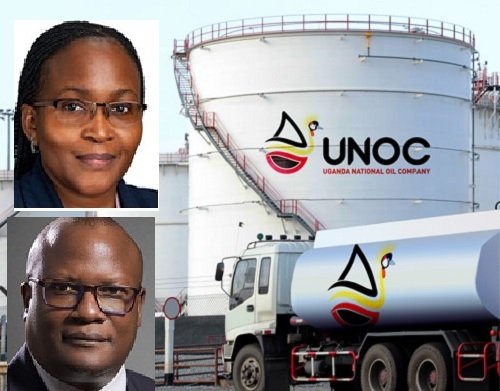

The heat is on at the Uganda National Oil Company (UNOC) after the Auditor General’s December 2025 report tore through the glossy public relations spin amidst war on Iran and laid bare troubling gaps in fuel security, funding shortfalls, underperformance and strategic failures that now raise uncomfortable questions about those entrusted with steering Uganda’s oil dream.
At the helm of the UNOC board is former DFCU Bank Managing Director Mathias Katamba, now Chairman of UNOC. Sitting alongside him are Eng. Dr. Ivan Lule, Zulaika Mirembe Kasajja, Dr. Simon Echegu, Gorrettie Justine Isenyi, Moses Kabanda and Herbert Magyezi Mugizi. In the executive suite is Chief Executive Officer Proscovia Nabbanja, who has held the substantive position since 2019.
Yet as the Auditor General points to glaring structural weaknesses in fuel supply security, UNOC on Tuesday March 3rd boldly assured Ugandans that all is well.
“Following the recent reports of the situation in the Middle East and concerns about possible disruptions within the global petroleum supply routes, at UNOC we are working closely with our partner, Vitol, to make sure that we mitigate these disruptions as much as possible,†said Chief Corporate Affairs Officer Tony Otoa. “There should be no cause for alarm.â€
But the Auditor General’s findings tell a far more complicated story.
UNOC’s Jinja Storage Terminal has a capacity of just 30 million litres. Uganda’s average daily petroleum demand stands at approximately 6.5 million litres. That means the entire country can be covered for roughly four days. Worse still, trade stocks average between 5.2 and 7.5 million litres per month, essentially matching daily national consumption and leaving no room for strategic buffer stocks.
The Auditor General warns that this limited capacity exposes Uganda to “high risk from both external supply shocks and internal operational disruptions, potentially threatening national energy security.â€
But UNOC will still tell Ugandans that ‘all is well’.
UNOC, wholly owned by the Government of Uganda and established under the Petroleum laws of 2013 before incorporation in 2015, is mandated to manage the State’s commercial interests in petroleum and ensure sustainable exploitation of the resource. It is also required under the Petroleum Supplies Act to import all petroleum products destined for Uganda to guarantee security of supply.
On paper, UNOC a picture of ‘all is well’ and looks profitable. The company recorded a staggering UGX 359.7 billion profit, a dramatic turnaround from the UGX 3.7 billion loss reported in the previous period. Its Return on Assets jumped from negative 0.3% to an impressive 17.2%, attributed to lucrative bulk trading of petroleum products after acquiring relevant importation licenses.
But scratch beneath the surface and the cracks begin to show.
UNOC’s operating margin improved slightly but remained low, moving from 4.88% to 5.37%, still far below the 15% threshold considered strong performance. While other entities such as Mandela National Stadium posted operating margins as high as 94.96%, UNOC lagged far behind.
Then comes the liquidity puzzle. UNOC’s current ratio dropped sharply from a staggering 25.21 to 6.44. While still above the ideal 1.5 to 2 range, the drastic fall was attributed to increased trade payables, accrued expenses and rising prepayments following implementation of the sole importation mandate. The Auditor General noted that exceptionally high current ratios can signal ineffective utilization of current assets or short-term financing facilities. Even at 6.44, questions linger.
Most alarming, however, is the issue of storage capacity.
UNOC’s Jinja Storage Terminal has a capacity of just 30 million litres. Uganda’s average daily petroleum demand stands at approximately 6.5 million litres. That means the entire country can be covered for roughly four days. Worse still, trade stocks average between 5.2 and 7.5 million litres per month, essentially matching daily national consumption and leaving no room for strategic buffer stocks.
The Auditor General warns that this limited capacity exposes Uganda to “high risk from both external supply shocks and internal operational disruptions, potentially threatening national energy security.â€
Management responded that plans are underway to construct an additional 10 million litre tank at Jinja and a massive 240 million litre Kampala Storage Terminal. Once complete, combined storage would reach 280 million litres, covering up to 40 days of national consumption. But even that comes with a massive challenge: financing stockholding for 40 days is estimated at UGX 1.3 trillion.
The restrictions on vessel sizes compound the headache. Uganda faced delivery vessel caps of 58,000 metric tonnes for PMS, with a maximum 5% tolerance. UNOC would prefer larger vessels to enhance efficiency and supply security, but these restrictions constrained operational and economic advantages. Only in November 2025 was UNOC allowed to deliver an additional 25,000 MT vessel. Negotiations continue to increase preferred vessel size to 85,000 MT.
The strategic planning record is equally troubling. UNOC’s strategic plan for FY 2019/2020–2023/2024 was underfunded by UGX 358.65 billion, representing 17.82% of the required UGX 2,012.45 billion. This affected key projects such as development and operationalization of the Kabalega Industrial Park and refurbishment of Jinja Storage Terminal.
For FY 2024/2025, out of 64 planned strategic initiatives, only 28 were fully achieved. Twenty-three were partially achieved and thirteen were not achieved at all. Out of a board-approved budget of UGX 744.265 billion, only UGX 578.181 billion was funded, leaving a funding gap of UGX 336.476 billion.
Revenue projections also fell short. Of the approved UGX 573.114 billion forecast as internally generated revenue, only UGX 387.106 billion was realized, creating a variance of UGX 186.008 billion. Out of UGX 139.033 billion available for spending, only UGX 87 billion was spent, reflecting an absorption capacity of just 63%. The underutilization was blamed on delays in recruitment and unrealized anticipated business growth.
And yet, despite posting UGX 359.7 billion in profits, UNOC did not distribute dividends to the Government. Instead, it cited plans to retain earnings to fund investments. The Auditor General advised the Accountant General to ensure development of clear dividend policies to provide clarity on profit allocation between reinvestment and shareholder returns.
All this comes against the backdrop of UNOC’s public reassurance over fuel stability amid Middle East tensions.
“We are doing whatever it takes and putting in the measures that are needed to ensure that there’s uninterrupted supply of petroleum products in the country,†Otoa insisted. “We are still receiving vessels with fuel products for us to consume as a country, so there is no cause for alarm.â€
But with only four days’ effective storage at Jinja, vessel restrictions, underfunded strategic plans, unachieved initiatives, revenue shortfalls and liquidity swings, Ugandans are left wondering whether the alarm bells are already ringing.
At the center of it all stands CEO Proscovia Nabbanja, a geologist with 19 years of oil and gas experience who served three years as Chief Operating Officer – Upstream before being appointed CEO in 2019, succeeding Dr. Josephine Wapakabulo.
However, insider whispers suggest that beneath the calm exterior, a quiet but intense succession battle is brewing over who will eventually replace Proscovia Nabbanja as CEO. Now serving her second term — which many believe could be her last — speculation is mounting within the corridors of power. Insiders point to Samantha Muhwezi, the Chief Operating Officer, as the noisiest-dreamer alongside Gilbert Kamuntu, the Chief Commercial Officer to succeed Nabbanja. But the full details of this unfolding power struggle are a story we shall unveil in a subsequent publication.
The billion-shilling question echoing in UNOC partners’ boardrooms and oil depots alike is unavoidable: after overseeing Uganda’s oil dream chase through breakthroughs, profits, setbacks, storage constraints and strategic underperformance, has Nabbanja outlived her usefulness? Is it time for a new hand to take Uganda’s oil dream wheels?
For Chairman Mathias Katamba and his board, the Auditor General’s report is more than just paperwork. It is a loud wake-up call. And for a country banking its future on black gold, the stakes could not be higher.


 Starlink goes live in Uganda; price comparisons against MTN, Airtel
Ultimate Uganda
Starlink goes live in Uganda; price comparisons against MTN, Airtel
Ultimate Uganda
 NSSF sets September 24 for Annual Members Meeting as savers await interest rate declaration
Ultimate Uganda
NSSF sets September 24 for Annual Members Meeting as savers await interest rate declaration
Ultimate Uganda
 Boda boda riders launch e-commerce, digital loans platform
Ultimate Uganda
Boda boda riders launch e-commerce, digital loans platform
Ultimate Uganda
 Rwanda: We Cannot Sit and Watch As Illicit Alcohol Kills People - Kagame
Ultimate Uganda
Rwanda: We Cannot Sit and Watch As Illicit Alcohol Kills People - Kagame
Ultimate Uganda
0 Comments