
Iran’s missiles, drones stored under impenetrable granite mountains
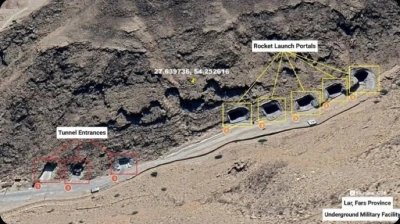

US President Donald Trump claims US forces have destroyed Iran’s missile and drone stockpiles. But since the first days of the war the Iranian Revolutionary Guard Corps (IRGC) triggered its Decentralized Mosaic Defence doctrine (DMD) and hidden its weapons deep inside solid granite mountains that even the most powerful American bunker busting bombs cannot reach.
A game of cat and mouse has developed. Iran has constructed a deeply ballistic missile complex beneath its granite mountain south of Yazd, allowing continued launches despite repeated US and Israeli strikes, according to open-source analysis and satellite imagery reviewed in recent weeks.
Iranian forces wheel their drones and missiles out of caves, fire them and then scuttle back into the mountainous safety. Once the launch is detected US and Israeli forces retaliate but the best they can do is blow up the entrance to the caves. Rubble blocking the entrance can be cleared in a matter of days, but the weapons themselves remain untouched.
“Iran built a subway system for ballistic missiles inside a granite mountain south of Yazdâ€, Shanaka Anslem Perera, an analyst wrote on X describing a network in which “automated rails move warheads and transporter-erector-launchers between assembly halls, storage vaults, and three to ten blast-door exits carved into the mountainside at depths reaching 500 metresâ€.
The US and Israel have targeted the Imam Hussein facility near Yazd on March 1, March 6 and March 17, as well as in subsequent strikes, damaging surface infrastructure. Satellite imagery cited by analysts shows “collapsed portals, cratered ventilation shafts, and destroyed surface infrastructureâ€, though “the invisible infrastructure is intactâ€.
On March 20, a long-range ballistic missile launched from the complex failed during its boost phase and crashed at Yazd, in what analysts say demonstrates continued operational capability. “The launch failed. The fact that it happened at all is the proof,†Perera said, adding that “three weeks of precision strikes on the portals did not stop the railway behind them from delivering a missile to a surviving exitâ€.
Independent assessments have supported elements of the claims. CNN reported on March 22 that satellite analysis indicated structured tunnel layouts, while Alma Research has mapped parts of the network. The Israel Defence Forces has said roughly 60% of launch infrastructure has been destroyed, while US estimates suggest about 50% of capacity remains.
Military analysts note that the facility’s depth presents a significant challenge. The GBU-57 Massive Ordnance Penetrator, the most powerful of America’s bunker busters that was used in last year’s strike on Iran’s nuclear enrichment facilities, can breach about 60 metres of reinforced concrete or roughly 40 metres of rock. That is far short of the reported 500-metre depth of the caves inside the Yazd mountain. “The gap between the bomb and the tunnel is not a margin of error. It is a physical impossibility,†Perera said.
The design allows operations to continue even after strikes, with each blast door functioning as a separate exit point and tunnels rerouted when entrances are hit. “The IRGC did not prepare for this war by building rockets. It was prepared by building railways inside mountains,†Perera said, adding that “the railway inside it is still delivering missiles to the surfaceâ€.


 DRC opposition urges Tshisekedi to abandon constitutional changes
Ultimate Uganda
DRC opposition urges Tshisekedi to abandon constitutional changes
Ultimate Uganda
 US military transport plane lands in Moscow
Ultimate Uganda
US military transport plane lands in Moscow
Ultimate Uganda
 Putin puppet slaps UK with terrifying 2-word warning over drone factories
Ultimate Uganda
Putin puppet slaps UK with terrifying 2-word warning over drone factories
Ultimate Uganda
 China develops hypersonic weapon to hunt US command aircraft thousands of miles away
Ultimate Uganda
China develops hypersonic weapon to hunt US command aircraft thousands of miles away
Ultimate Uganda
0 Comments