
How Iran destroyed US base’s $500m battlefield nerve centre
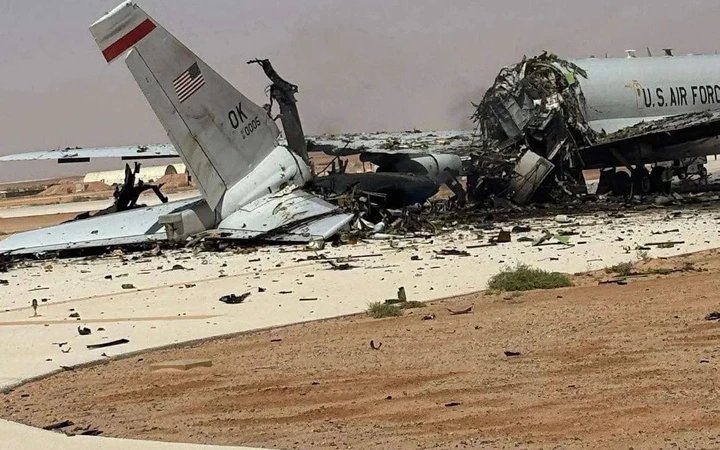

In a picture verified by AFP, the mangled airframe of the US air force jet stands on the runway of Prince Sultan air base in Saudi Arabia
The mangled airframe of the four-engined US air force jet stands on the runway of Prince Sultan air base in Saudi Arabia.
Amid the twisted metal, what looks like a large flying saucer lies upside down.
It is, or was, the rotating radar dome that usually sits above the E-3 Sentry, one of the jewels in America’s military crown – essentially a $500m (£375m) flying battlefield nerve centre that allows commanders to track everything in the air across hundreds of miles.
As of Friday morning, the United States had 16 of the vital but ageing Cold War-era aircraft, with roughly 40 per cent of the fleet deployed to the Middle East.
Now they have 15, after Iran attacked Prince Sultan with, it is believed, ballistic missiles and drones, injuring 12 US personnel, two seriously, and damaging up to five air-to-air refuelling tankers.
The point of impact, just where the radar dome attaches to the Sentry, suggests a precision strike by a drone, a more accurate weapon than a ballistic missile when used by Iran.
It also hints at a worrying level of intelligence on the part of Tehran.
A satellite image shows planes at Prince Sultan Air Base in Saudi Arabia February 21, 2026.
The Iranian attack on Prince Sultan air base injured 12 US personnel and damaged up to five air refuelling tankers - Planet Labs/Reuters
On Saturday, Volodymyr Zelensky revealed that Russia – already accused of sharing military information and hardware with Iran during the war – had taken satellite images of the Saudi base in the days before the strike.
“Do they [Russia] help Iranians?†the Ukrainian president said in an interview with NBC. “Of course. How many per cent? One hundred per cent.â€
It is the latest of several successful Iranian hits on US bases in the region which, it emerged this week, had forced some personnel to evacuate to the relative safety of nearby offices and hotels.
Coming almost four weeks since the launch of Operation Epic Fury, a war Donald Trump promised would enable the Iranian people to overthrow the regime, the attack suggests the Pentagon underestimated the potency and resilience of Tehran’s offensive capability.
The destruction of an E-3 Sentry is a particular setback for United States Central Command (Centcom).
The ageing planes – the youngest of which was delivered in 1992 – known as airborne early warning and control aircraft are among the most precious assets in America’s conventional arsenal, able to track other aircraft, drones and missiles across a 250-mile radius.
A direct replacement for the high-tech aircraft would cost $500m in today’s money. However, there is no existing production line. Boeing’s E-7 Wedgetail, the nearest equivalent, has a $700m price tag.
Commanders will have to consider how to protect the aircraft, just when maximum attention is needed to plan for a US ground assault on southern Iran, should Mr Trump give the order.
The loss will also mean extra sorties for the remaining Sentries in the Middle East, placing additional stress on those aircraft and crews, which were already working harder than expected because of Iranian strikes on ground-based radar systems during the last month.
Prof Kelly Grieco, senior fellow at the US-based Stimpson Centre think tank, said: “E-3s are now compensating for those gaps too, flying double duty on an already overstretched fleet.
“This is a shrinking, irreplaceable capability. Taking fire.â€
She added: “Bottom line: the US cannot quickly replace the aircraft that tells every other aircraft what to do.
“Iran didn’t just hit a plane. It hit a battle management layer, and at the moment when that layer is needed most.â€
3003 E-3 Sentry airborne warning and control system
3003 E-3 Sentry airborne warning and control system
Mr Trump and Benjamin Netanyahu appear to have more or less given up on the idea of toppling the Islamic Republic, at least in the short term.
For Israel, the overriding aim is to destroy as much military infrastructure and the supporting industrial base.
But for the White House, the challenge is more complicated: reopening the vital Strait of Hormuz to international shipping and then finding a way to end the war in a way that can be sold to the US public as a victory.
A diplomatic initiative towards a ceasefire is gearing up under the auspices of Pakistan.
As of this weekend, however, both sides appear to remain far apart on the original issues of nuclear, ballistic missiles and proxies, as well as on the new risk of a Tehran-controlled Hormuz.
In the meantime, two US marine expeditionary units of 5,000 assault troops are being “surged†to the Gulf. About 3,000 soldiers from the elite 82nd Airborne Division are also being prepared for deployment.
On Thursday it was revealed the Pentagon is considering sending an additional 10,000 troops.
In parallel, Britain is among six nations which have expressed readiness to “contribute to appropriate efforts†to reopen the Strait, but hopes for the success of this as yet vague initiative are not high.
Mr Trump is hoping that his much publicised build-up persuades Iran, now thought to be effectively ruled by the radical Islamic Revolutionary Guard Corps (IRGC), to agree acceptable terms.
But there is no shortage of experts who say that, by virtue of surviving a month of joint US-Israeli bombardment, the regime believes it is winning.
Furthermore, they say the new leadership is relishing the fight.
Mohammad Bagher Ghalibaf, speaker of Iran’s parliament, warned on Sunday that “our men are waiting for the arrival of American troops on the ground to set them on fire and punish their regional partners foreverâ€.
What could start as a raid on Kharg Island, the principal oil export hub, or any number of other strategic points, may mature into a ground operation lasting several weeks, US officials told The Wall Street Journal.
In this, pessimists see a quagmire, a new Vietnam.
More optimistic analysts view a targeted ground operation as the proper means to break the deadlock.
Either way, the coming days and weeks will put US military hardware under ever greater strain, as well as troops, 13 of whom have now died in Epic Fury.
Analysis of the munitions spent so far against known inventories suggests Mr Trump is already in a race against time to wrap things up before critically important weapons run out.
The Royal United Services Institute calculates that the Pentagon is just one month away from running out of Terminal High Altitude Area Defence (THAAD) interceptor missiles and some classes of guided bombs, given how many have been fired since Feb 28. An estimated 11,000 munitions have been launched at a cost of $26bn in the first 16 days alone.
It raises the prospect of US jets having to support an intricate and hazardous ground operation using “dumb†bombs – all while the now reduced fleet of Sentries works overtime to limit any blind spots in the battlefield.
Meanwhile, despite the bombardment it has suffered, Iran, for now, retains the capacity to escalate the situation in the Strait of Hormuz.
Olivier Guitta, from the GlobalStrat geopolitical consultancy, said: “The announcement of six western countries committing to secure the strait is not a foolproof solution.
“One should not underestimate the extremism of the regime even at a lower level that could decide to go all in and use sea mines.
“In fact, the IRGC has transformed the narrow waterway into a latent minefield.
“With an estimated 5,000 to 6,000 naval mines at its disposal and facilities positioned along both approaches to the Strait, the IRGC possesses the capability to seal off this vital artery within hours.
“What makes this threat particularly insidious is not Iran’s ability to deploy the mines, but the US’s limited capacity to remove themâ€
The US public is broadly against the war, with between 55 and 60 per cent saying they oppose the operation across multiple major polls.
More than half (55 per cent) oppose sending any ground troops to Iran, according to Ipsos, while only 7 per cent back a large-scale ground invasion.
JD Vance, the vice-president, seen as the most authentically Maga senior member of the administration in his scepticism of military intervention, has been handed the role of chief negotiator.
In a phone call last week, he reportedly chided Mr Netanyahu for overselling the chances of regime change at the outset.
For his part, Mr Trump insists that the war is going well, that the Iranian regime wants a deal, but that if an agreement cannot be found the US will keep “blowing them awayâ€.
His threat to destroy Iran’s power stations, an act that would almost certainly provoke Tehran to further attack energy infrastructure in the Gulf, has been postponed until April 6.
As the conflict rages on, echoes of the war in Ukraine grow louder.
Russia is providing practical assistance to Iran in the form of intelligence, analysts believe, perhaps even in the form of upgraded Shahed drones, of the type that may have taken out the E-3 Sentry in Saudi Arabia on Friday.
At the same time Vladimir Putin benefits from the disruption in Hormuz because it has resulted in Mr Trump allowing partners to buy Russian oil.
Meanwhile, Mr Zelensky, spent last week touring Gulf states seeking to strike deals providing Ukraine’s hard-won air defence know-how to small kingdoms now also under threat of terror from the skies.
Speaking of Russia’s alleged satellite reconnaissance on behalf of Iran before the strike on Prince Sultan, he said: “We know that if they make images once, they are preparing. If they make images a second time, it’s like a simulation. The third time it means that in one or two days, they will attack.â€
Rear Adm Shaham Irani, Iran’s navy commander, has threatened to use land-to-sea missiles to attack the USS Abraham Lincoln aircraft carrier.
If Mr Zelensky is correct, it is surely conceivable that, as with the stricken E-3, Iran would use Russian satellite data to target that unimaginably greater prize.


 DRC opposition urges Tshisekedi to abandon constitutional changes
Ultimate Uganda
DRC opposition urges Tshisekedi to abandon constitutional changes
Ultimate Uganda
 US military transport plane lands in Moscow
Ultimate Uganda
US military transport plane lands in Moscow
Ultimate Uganda
 Putin puppet slaps UK with terrifying 2-word warning over drone factories
Ultimate Uganda
Putin puppet slaps UK with terrifying 2-word warning over drone factories
Ultimate Uganda
 China develops hypersonic weapon to hunt US command aircraft thousands of miles away
Ultimate Uganda
China develops hypersonic weapon to hunt US command aircraft thousands of miles away
Ultimate Uganda
0 Comments