
BUSTED! URA CBUSTED! URA Customs Smashes Major Rice Smuggling Syndicate at Uganda Bordersustoms Spies Crush Massive Rice Smuggling Racket at Uganda Borders

For an entire month, Uganda Revenue Authority (URA) Customs Intelligence officers operated like undercover spies in a high-stakes economic war quietly unfolding at Uganda’s porous borders with Tanzania and Kenya.
Away from the public eye, intelligence teams tracked suspicious truck movements, monitored unusual trade patterns and gathered sensitive information from informants planted along smuggling routes notorious for fueling illegal trade into Uganda.
What initially appeared like ordinary cargo transportation soon exposed a highly coordinated network determined to flood Ugandan markets with undeclared rice worth millions of shillings while dodging taxes and official customs procedures.
The smugglers had perfected the game.
Using backroads, informal border crossings and night movements to evade official checkpoints, the network allegedly relied on deception and camouflage to outsmart enforcement teams. Trucks carrying sacks of rice disguised their operations by mixing the cargo with ordinary household commodities including toilet tissues, edible salt and baking flour in an attempt to divert suspicion from enforcement officers.
But Customs Intelligence was already several steps ahead.
By the time the intelligence team finalized its operation plan, the trap had already been set.
One by one, the suspicious trucks were intercepted and verified, exposing the true scale of the smuggling racket.
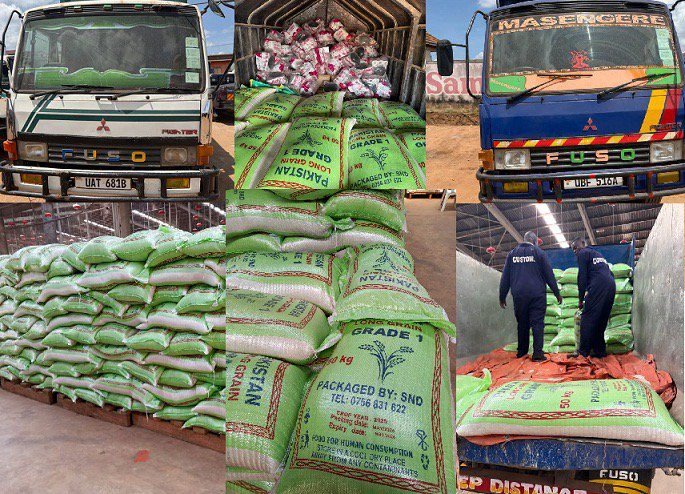
Motor vehicle registration number UBG 216W was intercepted carrying 7,000 kilograms of rice smuggled from Tanzania.
Another vehicle, UBE 277N, was found transporting 1,050 kilograms of Pure Basmati Parboiled Rice under the Pakistan-Baraf brand.
But it was motor vehicle UAT 681B that revealed just how sophisticated the smugglers had become.
Inside the truck, officers discovered 121 bags each weighing 50 kilograms of Pakistan Long Grain Grade 1 Rice with expiry dates marked November 2026. The same vehicle was also loaded with 150 packets containing 12 rolls each of Modern Deluxe two-ply toilet paper, 30 bags of Kay iodized edible salt manufactured in Kenya with expiry dates stretching to February 2029 and 149 packages of Azam Unga baking flour manufactured in Uganda and expiring on October 31, 2026.
To investigators, the mixed cargo was no coincidence.
It was a deliberate smuggling tactic designed to confuse enforcement officers and conceal the illegal rice shipments among ordinary commercial goods.
Another truck, registration number UBF 516A, was intercepted transporting 200 bags of Pakistan Long Grain Grade 1 Rice with expiry dates marked November 2026.
Then came one of the biggest interceptions of the operation.
Truck registration numbers T818EBC and T738EBB were busted while ferrying a staggering 23,800 kilograms of rice from Tanzania into Uganda.
By the time the operation ended, Customs Intelligence officers had dismantled what appears to have been a carefully organized smuggling syndicate operating across regional borders.
For enforcement officers, the operation is about far more than just seizing contraband goods.
It is a major victory in the ongoing battle against economic sabotage, tax evasion and illegal cross-border trade that continues to cost Uganda billions in lost revenue annually.
The successful crackdown also exposes the growing sophistication of smugglers who now exploit porous borders, hidden routes and deceptive cargo packaging to penetrate Ugandan markets unnoticed.
But this time, intelligence, surveillance and coordination proved stronger.
Behind the dramatic truck interceptions was weeks of silent monitoring, intelligence gathering and strategic coordination by Customs officers determined to outsmart the smugglers at their own game.
And as the seized trucks sat grounded under tight security, one message rang loudly across Uganda’s smuggling corridors: Customs Intelligence is watching.


 Starlink goes live in Uganda; price comparisons against MTN, Airtel
Ultimate Uganda
Starlink goes live in Uganda; price comparisons against MTN, Airtel
Ultimate Uganda
 NSSF sets September 24 for Annual Members Meeting as savers await interest rate declaration
Ultimate Uganda
NSSF sets September 24 for Annual Members Meeting as savers await interest rate declaration
Ultimate Uganda
 Boda boda riders launch e-commerce, digital loans platform
Ultimate Uganda
Boda boda riders launch e-commerce, digital loans platform
Ultimate Uganda
 Rwanda: We Cannot Sit and Watch As Illicit Alcohol Kills People - Kagame
Ultimate Uganda
Rwanda: We Cannot Sit and Watch As Illicit Alcohol Kills People - Kagame
Ultimate Uganda
0 Comments