
Street Boys Fill Gap Amid 60% Plastic Crisis
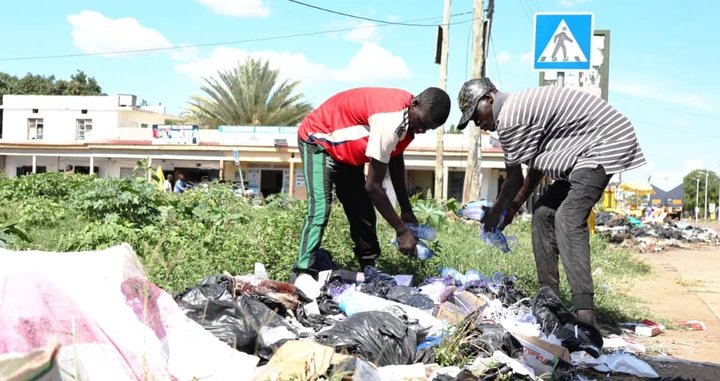

Peter Lotimo on red and another street boy picking waste plastic bottles along one of the streets in Soroti City
SOROTI – Every morning before the streets of Soroti return to life, 20-year-old Peter Lotimo walks the back alleys of the city with a sack over his shoulder, pulling plastic bottles from the culverts.
He works bare-handed, smoke from burning dumpsites stinging his lungs and broken-glass pieces slicing his fingers.
I do this every day for survival because home means beatings and the streets are not kind either. I go days without food, Lotimo says, adding that the bottles earn him UGX 200 shillings a kilogram.
Lotimo and other street-dwelling boys are now Sorotis force against plastic waste, yet they are unpaid, unprotected and uncounted in official plans.
Globally, 400 million tons of new plastics are produced annually, projected to reach over 516 million tons in 2025 and 1.2 billion tons by 2060.
In Uganda, 600 tons of plastic waste are generated each day, or about 219,000 tons annually, Kampala alone generating an estimated 180,000 tons each year, about 82% of the national total.
According to a new report, Beating Plastic Pollution in Uganda, by the National Environment Management Authority (NEMA), only 9% of plastic is recycled, representing about 21% of economically recyclable plastics.
“Forty percent ends up in landfills, another 11 million tons leaking into lakes and rivers each year across the country, yet only 40 to 50 percent of Ugandas plastic waste is collected,†the NEMA report reads in part.
“It’s the responsibility of everyone to create, maintain and enhance a safe environment. When the environment is affected, it impacts on everyone,†said Environment Education and Advocacy Manager at NEMA, Wilbert Ikilai said.
He said a mindset change towards the responsibilities associated with the environment is critical, strongly urging lower local authorities to take up stringent enforcement of the environment laws.
“Children like Lotimo are cleaning our failures. There story shows why we must shift from blaming institutions like NEMA to fixing our behaviour. We must get every stakeholder to act on their respective responsibilities,†Samuel Peter Otim, Project Manager at Action for Grassroots Empowerment. The organization engages in social and behaviour change communication and advocacy on climate change, health and livelihoods.
Globally, 8.3 billion tons of plastic have been produced to date, only 12% of which has been recycled and 79% in landfills or the environment.
Ironically, Africa produces 5% of the worlds plastic and consumes 4%, Uganda accounting for 0.04% of global production.
However, plastics remain central to daily life. Syringes, IV bags and protective equipment rely on plastic for infection control. Food packaging extends shelf life and cuts waste.
Water pipes, tanks and containers ensure clean water access. PVC pipes, roofing and insulation materials are durable and cheap. Farmers use plastic materials for seedling bags, irrigation pipes and silage wrap to raise yields. Car makers fit lightweight plastic parts to improve fuel efficiency and safety.
But the waste lasts, as plastics take 100 to 500 years to decompose, wildlife dying from eating it or getting trapped, chemicals like BPA and phthalates leaching into food and water.
Menacingly, burning plastic emits toxic fumes linked to respiratory illness including cancer and it has been established microplastics are now found in human blood, lungs and food.
In cities, plastics block drains and trigger floods, Kampala alone spending billions annually on cleanup and flood-related health care and NEMA estimates the total cleanup costs at US$3,000, about Shs11.4 million per ton, with Shs1.9 million to Shs5.7 million in direct costs.
However, with only 9% recycled nationally, most plastics end up in drains, landfills or open spaces and the same culverts Lotimo clears by hand.
Sorotis 20222027 Environment Action Plan targets a 40% cut in plastic litter but In reality, the policy is on paper. Lotimo and his group, the plan.
Senior Climate Change Officer at the Ministry of Water and Environment, Stella Amongin, says Uganda Vision 2040 and the Third National Development Plan call for a green economy and community-led climate action.
The NEMAs report urges a ban or limit on single-use plastics like bags, straws and packaging, calling for better collection systems and investment in recycling infrastructure.
Other steps include adopting biodegradable alternatives, running public awareness campaigns and enforcing the Extended Producer Responsibility law, compelling producers to pay for waste management.
The authority also recommends stronger laws and penalties for illegal dumping, waste-to-energy projects for non-recyclables and product design for reuse and recycling alongside regular community cleanups and incentives for responsible disposal.
But for now, the cleanup runs on children like Lotimo. He wipes his palm and drops another plastic bottle into the sack – now his livelihood.


 The women who have been in King Oyo’s life
Ultimate Uganda
The women who have been in King Oyo’s life
Ultimate Uganda
 Ex Kagame Guard Commander Tom Byabagamba Dies in Rwandan Prison After 12 Years
Ultimate Uganda
Ex Kagame Guard Commander Tom Byabagamba Dies in Rwandan Prison After 12 Years
Ultimate Uganda
 Government begins salary payments for public sector workers – Reform Committee
Ultimate Uganda
Government begins salary payments for public sector workers – Reform Committee
Ultimate Uganda
 Temangalo land: NSSF, Nzenyi reach agreement
Ultimate Uganda
Temangalo land: NSSF, Nzenyi reach agreement
Ultimate Uganda
0 Comments