
Inside Centenary Bank’s Executive Reset: Why the Board Brought in Michael Opira as the Second Executive Director
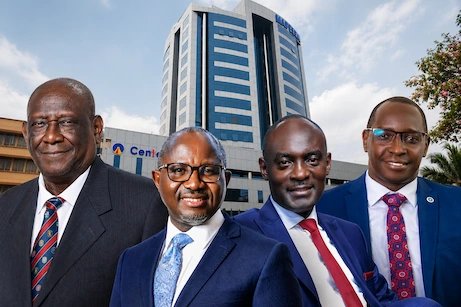

Centenary Bank’s top leadership (L–R): Chairman Gustavo Bwoch, Managing Director Fabian Kasi, Executive Director, Business Joseph Balikuddembe, and Executive Director, Operations Michael Opira. The bank is resetting its executive leadership through a dual-Executive Director structure aimed at strengthening oversight, improving coordination, and enhancing execution as it scales operations in Uganda’s increasingly complex banking landscape.
Centenary Bank’s recent appointment of Michael Opira as Executive Director, Operations is more than a routine leadership change—it is part of a deliberate and strategic board-led restructuring of the bank’s executive architecture aimed at strengthening oversight, improving decision-making, and positioning the institution for its next phase of growth, CEO East Africa Magazine has learnt.
According to a Board Chairman’s letter to staff dated April 9, 2026, seen by CEO East Africa Magazine, the creation of the second Executive Director role was driven by the need to “reduce the span of work and strengthen executive oversight across the Bank.â€
The move is also intended to ensure “sustained focus, timely decision-making, and improved coordination of operations†by easing the workload previously concentrated at the top.
From One Executive Director to Two
Under the new structure, Centenary Bank—Uganda’s second-largest bank—now operates with two Executive Directors: Joseph Balikuddembe, who serves as Executive Director, Business, and Michael Opira, who takes on the role of Executive Director, Operations.
Gustavo Bwoch, Chairman of Centenary Bank, whose communication to staff outlined the introduction of a second Executive Director role and a restructured reporting framework aimed at strengthening executive oversight and improving operational efficiency across the bank.
This arrangement effectively formalises a dual-executive model that separates responsibility for business growth from operational execution, a structure commonly adopted by large and complex financial institutions seeking greater scale and efficiency. The Board has further clarified that the two roles will be designated as ED Business and ED Operations, signalling a clearer delineation of responsibilities within the bank’s leadership framework.
A Rebalanced Power Structure at the Top
The restructuring significantly reshapes reporting lines at the bank’s Executive Committee (EXCO) level, introducing a more defined and functional allocation of responsibilities.
Under the new arrangement, according to the internal communication, the Managing Director now directly supervises core governance and control functions, including Finance, Strategy, Compliance, Risk, Audit, Legal, and Information Security Assurance.
Joseph Balikuddembe, the Executive Director, Business, will oversee the bank’s growth-facing divisions, namely Retail & Distribution, Agribusiness, Microfinance & SME, Commercial, Financial Markets, Corporate Communications & Marketing, and Human Resources.
On the other hand, the Executive Director, Operations—Michael Opira—takes charge of critical execution functions, including Business Technology, Centralised Back Office, Credit Management, Corporate Services, and Security & Investigations. This redistribution reflects a clear strategic intent to separate growth from execution, and oversight from operations—a move designed to enhance focus, efficiency, and accountability at each level of the bank’s leadership.
Why Opira—and Why Now
As previously reported by the CEO East Africa Magazine, Opira joins from Housing Finance Bank, where he served as Chief Operations Officer since 2021, leading digitisation, operational efficiency, and technology-driven transformation across the bank. He was also a key member of the Executive Committee, contributing to overall strategy and execution.
Before that, he spent nearly eight years at Ecobank Uganda as Head of Operations and Technology, delivering secure and scalable banking platforms while supporting assignments across multiple African markets.
Michael Opira, Executive Director, Operations at Centenary Bank, appointed as part of the bank’s new dual-Executive Director structure to strengthen operational oversight and execution.
Michael Opira, Executive Director, Operations at Centenary Bank, appointed as part of the bank’s new dual-Executive Director structure to strengthen operational oversight and execution.
With over 27 years in banking, Opira brings a rare combination of deep operational expertise, technology leadership, and institutional memory.
Crucially, this is also a homecoming.
Opira began his banking career at Centenary Bank in 1999, rising through branch-level and operational roles before moving on to broader leadership positions in the industry. His return, as the Board itself noted, is “effectively coming homeâ€â€”but now with the experience and perspective of a seasoned executive.
Scaling a Systemically Important Bank
The timing of this executive reset is equally significant. Centenary Bank remains Uganda’s second-largest bank by deposits, assets, profitability, and lending, and its sustained growth has naturally increased the complexity of its operations. The Board’s decision to introduce a second Executive Director reflects a clear recognition that scale demands structure.
By splitting responsibilities and strengthening leadership depth, the bank is positioning itself to improve execution speed and operational efficiency, enhance customer experience across channels, drive digital transformation at scale, and reinforce risk management and internal controls.
Joseph Balikuddembe, Executive Director, Business at Centenary Bank, who oversees the bank’s growth-facing divisions under the newly introduced dual-Executive Director structure.
Joseph Balikuddembe, Executive Director, Business at Centenary Bank, who oversees the bank’s growth-facing divisions under the newly introduced dual-Executive Director structure.
Importantly, Centenary Bank is not alone in adopting this model. Several of Uganda’s large and systemically important banks—including Stanbic Bank, the country’s largest lender, and PostBank Uganda—have implemented similar dual-Executive Director structures to manage complexity, balance growth with execution, and strengthen oversight at the top.
Execution Will Be the Real Test
While the structure is now in place, the real test lies in execution. Opira steps into a role at the core of the bank’s operational engine—overseeing technology, back-office systems, credit processes, and institutional support functions. These are the areas that ultimately determine whether strategy translates into results.
His track record suggests strong alignment with this mandate. However, within a bank of Centenary’s scale and systemic importance, expectations will be both high and immediate.
For Centenary Bank, the appointment signals more than continuity—it signals intent: an intent to professionalise scale, sharpen execution, and future-proof leadership in an increasingly competitive and technology-driven banking environment.


 Starlink goes live in Uganda; price comparisons against MTN, Airtel
Ultimate Uganda
Starlink goes live in Uganda; price comparisons against MTN, Airtel
Ultimate Uganda
 NSSF sets September 24 for Annual Members Meeting as savers await interest rate declaration
Ultimate Uganda
NSSF sets September 24 for Annual Members Meeting as savers await interest rate declaration
Ultimate Uganda
 Boda boda riders launch e-commerce, digital loans platform
Ultimate Uganda
Boda boda riders launch e-commerce, digital loans platform
Ultimate Uganda
 Rwanda: We Cannot Sit and Watch As Illicit Alcohol Kills People - Kagame
Ultimate Uganda
Rwanda: We Cannot Sit and Watch As Illicit Alcohol Kills People - Kagame
Ultimate Uganda
0 Comments