
Uganda, Poland mark wartime refugee history with railway exhibition
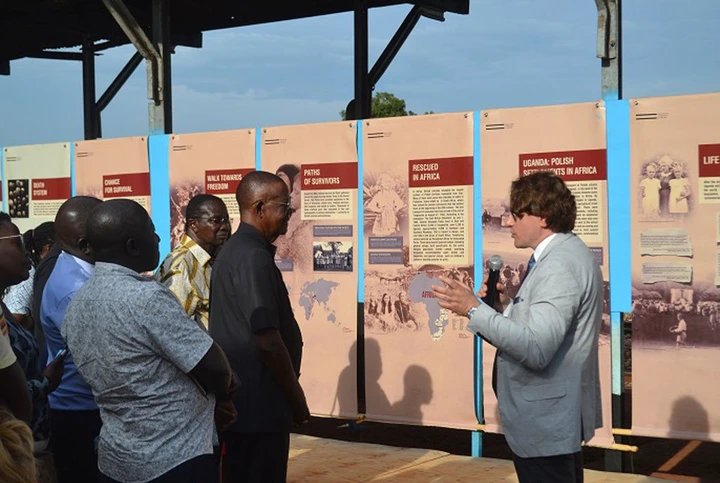

Prof Wojciech Śleszyński, Director of the Museum Pamięci Sybiru, who led the Polish delegation for the expedition, explains photographs of Polish refugees to Prof. Ephraim Kamuntu, Honorary Consul of the Republic of Poland in Kampala (left), and other officials at the Uganda Railway Museum in Jinja City on May 5, 2026. PHOTO/DENIS EDEMA
Uganda, in partnership with Poland, has launched a week-long exhibition in Jinja City to commemorate Polish refugees who travelled by railway from Kenya to Uganda during the 1940s.
The exhibition, themed “Sybir – Prison of Nations,†opened Tuesday at the Uganda Railway Museum. It has been organised by the Cross-Cultural Foundation of Uganda in collaboration with the Sybir Memorial Museum.
Organisers said the exhibition will run for a week in Jinja before moving to Masindi.
Speaking at the launch, Ephraim Kamuntu, Honorary Consul of Poland in Kampala, highlighted Uganda’s long-standing humanitarian record.
“Uganda is remembered for its hospitality in hosting refugees, a humanitarian approach that continues to this day,†Kamuntu said.
Between 1942 and 1945, during World War II, thousands of Polish refugees fled instability and were transported by rail from Kenya into Uganda. They settled in areas including Koja in Mukono District and Nyabyeya Forestry College in Masindi District before eventual resettlement elsewhere.
“These settlements became safe havens where refugees built schools, churches, and health facilities, preserving their cultural identity while contributing to Ugandan communities,†Kamuntu added.
Leading the Polish delegation, Wojciech Śleszyński, Director of the Sybir Memorial Museum, said the exhibition honours a shared past.
“We want this partnership to continue, as it benefits both Ugandan and Polish people, building on the hospitality that has been shown,†ŚleszyÅ„ski said, noting that Uganda had welcomed refugees “warmly and with friendship.â€
Cultural advocates say the exhibition also highlights gaps in public awareness about Uganda’s heritage.
Barbara Babweteera said many Ugandans remain unfamiliar with the origins of key historical sites.
“Heritage is not only about preserving artifacts but also about ensuring that stories, traditions, and historical events are recorded and shared widely. Without proper documentation, valuable aspects of Uganda’s past risk being forgotten, leaving younger generations disconnected from their cultural identity,†Babweteera said.
She noted that the arrival of Polish refugees played a role in shaping local history and contributed to the establishment of the Uganda Railway Museum as a heritage site.
Railway officials also used the event to outline future plans.
Daudi Migereko, Chairman of the Uganda Railways Corporation, said efforts are underway to improve railway infrastructure and boost tourism.
“For those who wish to travel to Kampala by train, they can consult the station manager in Jinja for the morning travel schedule. I sometimes use the train to Mukono because of traffic,†Migereko said.
He added that authorities are planning to beautify railway stations and expand train services from Mukono to Jinja and other parts of eastern Uganda.
The exhibition underscores Uganda’s historic role as a refuge and its evolving efforts to preserve and promote cultural heritage for future generations.


 DRC opposition urges Tshisekedi to abandon constitutional changes
Ultimate Uganda
DRC opposition urges Tshisekedi to abandon constitutional changes
Ultimate Uganda
 US military transport plane lands in Moscow
Ultimate Uganda
US military transport plane lands in Moscow
Ultimate Uganda
 Putin puppet slaps UK with terrifying 2-word warning over drone factories
Ultimate Uganda
Putin puppet slaps UK with terrifying 2-word warning over drone factories
Ultimate Uganda
 China develops hypersonic weapon to hunt US command aircraft thousands of miles away
Ultimate Uganda
China develops hypersonic weapon to hunt US command aircraft thousands of miles away
Ultimate Uganda
0 Comments