
‘I don’t want to be president.'
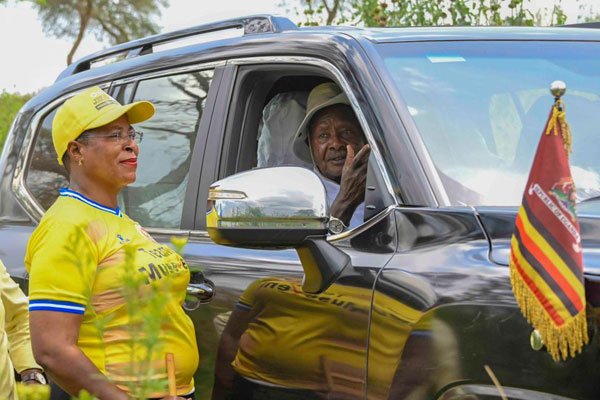

While the presidency is a coveted position, its allure has put prospective suitors in sharp focus of succession battles in the ruling National Resistance Movement (NRM) party.
Parliament Speaker Anita Among has become the latest in a long line of presumptive or declared suitors, stretching from Dr Kizza Besigye in 2001, through Amama Mbabazi in 2016.
Ms Among, last month, gave the talk of eyeing the Uganda presidency a wide berth, reinforcing the belief that the top job is ring-fenced and that its limit should not be crossed, even when the Constitution grants every Ugandan above 18 years the right to contest for it.
While speaking at the Patriotic League of Uganda (PLU) headquarters in Kampala, Ms Among rebuked those reportedly spreading the claims that she harbours presidential ambitions for the next race in the 2031 elections. PLU is a loose political pressure group pushing for the first son and Chief of Defence Forces (CDF) Gen Muhoozi Kainerugaba to be the “stand-by generator†or next leader of Uganda after his father, President Yoweri Museveni.
Among joins denial team
But Ms Among, perhaps mindful not to cross the undeclared red line, said: “I have heard a section of people out there speaking; I don’t want to call it rubbish, but it is rubbish. That Honourable Anita in 2031 wants to stand for the presidency. I want to tell the Ugandans that even where I am now, I have overachieved. “I didn’t expect to be here (Speaker), and I am saying that in 2031, I am retiring from active politics. I am happy that in one way, God made me become a Speaker because I didn’t (even) expect to become a Speaker,†she said. Ms Among became Speaker of the 11th Parliament on March 25, 2022, replacing the late Jacob Oulanyah. “I only thought of trying [to become] Deputy Speaker because I wanted to help Honourable Oulanyah to win, and when I tried, I got it, and by bad luck, Honourable Oulanyah passed on, and I ended up being a Speaker,†Ms Among explained.
To further downplay her ambition and distance herself from the presidency, Ms Among said she doesn’t even know how to cock a gun, a weapon the current President used to ascend to power in 1986, retain it, and suppress many revolts. “This country still needs people like …. I don’t have that patience to be a President; I don’t even have the urge, I don’t even have the wish, but I am happy that in one way or the other, God gave me [an opportunity] to be a Speaker.†Besides Ms Among’s self-denial on eyeing the presidency, there has also been the fear of rivalry and being upstaged by junior or less deserving suitors among the presumptive line-up of successors.
Kutesa dismisses talk
In a similar self-denunciation, in March 2011, then Foreign Affairs minister Sam Kutesa ruled himself out of the potential race to succeed President Museveni, and described any succession-related stories with him in the picture as being ‘extremely diversionary’. WikiLeaks had revealed the alleged jostling over succession in which Mr Kutesa was put in a certain camp with Ms Amelia Kyambadde, the former principal private secretary (PPS) to the President, reportedly trying to sideline the Mbabazi camp. WikiLeaks is a non-profit organisation that publishes leaked documents, hosting millions of files exposing government and corporate secrets.
Addressing this matter, Mr Kutesa said at the time: “Every time we finish an election, the next five years, people are engaged in succession battles. I think people should concentrate on doing well what they are doing now.†Mr Kutesa said he had heard about the succession debate since 2011 and wondered if the presidency was vacant to elicit such talk. Pressed on if he would consider running for President, Mr Kutesa was categorical: “No, I wouldn’t! I think I have served enough, and I can best serve the country at this level [Foreign minister].â€
Mbabazi and jumping the queue A decade earlier, when Opposition leader Dr Kizza Besigye declared his candidacy for the 2001 presidential election, Mr Amama Mbabazi, then minister in-charge of the Presidency, famously accused him of “jumping the queue†to succeed President Museveni. As a veteran of the Front for National Salvation (Fronasa) and later working in the external wing of the successor National Resistance Movement (NRM), recruiting and smuggling fighters and equipment, Mr Mbabazi, who was also a former security minister, assumed he was more senior and in pole position to succeed Mr Museveni. But in May 2014, Mr Mbabazi came face-to-face with the hurdles of the succession game.
The police in Kampala vowed to arrest suspected pro-Mbabazi NRM youth soliciting signatures to hold a delegates’ conference without approval from the NRM party structures. The police action came days after they arrested three youth who were soliciting signatures from NRM members over an alleged objective to hold a delegates’ conference with a proposal to push then prime minister Amama Mbabazi to stand as the NRM presidential flag bearer in 2016. Mr Mbabazi immediately told a press conference in Kampala that he would not be a candidate in the election where President Museveni would be running.
“I will not stand against President Museveni. This is something I have said before, and I am repeating now for the last time.
I will not stand against the President. There are individuals who think I should stand in 2016, which is alright because that is democracy, but I ultimately decide what I will do and not those individuals.†Referring to himself as a “disciplined cadre of the Movementâ€, Mr Mbabazi said the ruling party has structures and organs that deal with leadership-related questions, something he is not about to undermine, but work within as it enforces its responsibilities at the time. “I do what I am deployed to do by my party. And this has been the case for the last 40 years,†Mr Mbabazi said. Days later, a section of the NRM youth league held a press conference and castigated the NRM caucus for endorsing a candidate outside the party structures, but said they had nominated Mr Mbabazi to run in the delegates’ conference – the proper structure.
But the final blow to knock out this fuzzy ambition of Mbabazi to succeed Mr Museveni within the NRM came during the NRM Caucus retreat at the National Leadership Centre in Kyankwanzi in 2014. The plot to execute this was left to then-Northern Uganda Youth MP Evelyn Anite, who sank to her knees and begged President Museveni to seek re-election in 2016 as the NRM party's sole candidate. Mr Mbabazi, with no option left at the retreat, appended his name to endorse the resolution. However, on June 25, 2015, Mr Mbabazi, in a recorded video, bounced back to formally declare his bid for the presidency as an independent candidate, challenging his long-time colleague, President Museveni.
Prof Bukenya's turn
Earlier, in July 2007, the lot fell on then vice president, Prof Gilbert Bukenya, to run away from the talk of eyeing the presidency. In a statement issued by his office through Ms Lindah Nabusaayi, VP Bukenya denied nursing any plans of assuming the country’s top job after reports suggested he was pursuing a presidential bid. This followed loud allegations that the old, good professor had travelled to Kabale District incognito, fuelling speculation of such an underground bid. But the reports were quickly rebutted as “outright lies†and “unfounded rumoursâ€, and that Prof Bukenya was instead traversing the country to promote Bona Bagaggawale (Prosperity for All), a government poverty alleviation programme.
At the time, a section of Ugandans pointed to Prof Bukenya's avid master parody of President Museveni’s mannerisms of ideological speak, pep talks, dressing, swagger, and even gestures. Before that, in 2005, Prof Bukenya had kicked up a political storm with claims that the government was being controlled by a corrupt mafia clique that was plotting his downfall due to his alleged ever-increasing popularity and his closeness to the powerful Catholic Church. When he took to traversing the country to popularise the cultivation of upland rice, he was accused of using those tours to hold secret meetings with soldiers and Catholic leaders, an insinuation that he was pursuing presidential ambitions. As recently as August 2021, Prof Bukenya reignited the “mafia talkâ€, and advised then newly-appointed Prime Minister, Ms Robinah Nabbanja, to “go slowâ€.
What others say
Dr Gerald Kagambirwre Karyeija, a professor of Public Administration and Management at the Uganda Management Institute (UMI), reckoned that expressing interest in the presidency always attracts adverse attention from the State. “Ms Among is also expressing her loyalty to President Museveni and indicating that, in case Gen Muhoozi becomes a presidential candidate under PLU, she is proactively subordinating herself to him.
Kira Municipality MP, Mr Ibrahim Ssemujju Nganda, puts it more tersely when he said: “The Muhoozi army is determined to destroy anyone with presidential ambition. If you want to be spared, you declare your lack of interest and survive for another day.â€
He added: “For Speaker Among, you have to go back to the commissioning of her health facility. She named [medical] wards after Museveni’s children ... and so on. Only Gen Muhoozi is supposed to have and express ambitions. With interest in Speakership, you must show you will not use it as a platform to mobilise for the presidency.†Ms Perry Aritua, the executive director of Women Democracy Network-Uganda Chapter, said the Constitution and the Presidential Elections Act are clear on the terms that one needs to fulfil in order to become president, including those seeking the top job from within a political party. “I think Ms Among is sort of ‘agitated’ about the conversation around her ambitions, and this may be because of history.
If you read the past in terms of the men who aspired for this position, which courted some subtle intimidation of the previous aspirants, that may inform the statement that the Speaker made. “Otherwise, within the law, it is within her own right to aspire for this position; the Constitution is clear. I think it is just the past, which is leading to some of the statements that she makes in the media in terms of not aspiring,†Ms Aritua said in an interview for this article. Mr Timothy Chemonges, the executive director at the Centre for Policy Analysis (CEPA), said Ms Among’s self-denial sounds more like “a response of convenience meant to avoid unnecessary attention and being targeted in a system where showing presidential ambition can be riskyâ€. Mr Chemonges noted that Ms Among’s deflection paints a picture of someone whose rise has been spontaneous and not planned.
He says Ms Among’s statement can also calm the situation while leaving the door open. “So, the denial doesn’t fully settle the question, but just manages it for now,†he said. Mr Chemonges said even if Ms Among says she never set out to be Speaker, and her current position does not in any way signal any bigger ambition, the role of Speaker comes with national visibility, influence, and the ability to build strong political networks.
“When you look at how that position is exercised, it can naturally project someone beyond just parliamentary leadership. So, even if she says she has no presidential ambitions, it’s understandable why many would still read her trajectory as one that could eventually point in that direction.â€


 Government will not gazette Kijanangoma as King of Tooro for now - Attorney General insists
Ultimate Uganda
Government will not gazette Kijanangoma as King of Tooro for now - Attorney General insists
Ultimate Uganda
 King Oyo’s Body to Arrive Thursday
Ultimate Uganda
King Oyo’s Body to Arrive Thursday
Ultimate Uganda
 Besigye, Lukwago expected to meet Gen. Salim Saleh today at Kapeeke
Ultimate Uganda
Besigye, Lukwago expected to meet Gen. Salim Saleh today at Kapeeke
Ultimate Uganda
 Rwabwogo Advised to ‘Eat His Bishop’ As MK Prepares to Enter State H’se: PREZ MUSEVENI ON HIS WAY OUT
Ultimate Uganda
Rwabwogo Advised to ‘Eat His Bishop’ As MK Prepares to Enter State H’se: PREZ MUSEVENI ON HIS WAY OUT
Ultimate Uganda
0 Comments