
Ssenyonyi hands over Leader of Opposition office
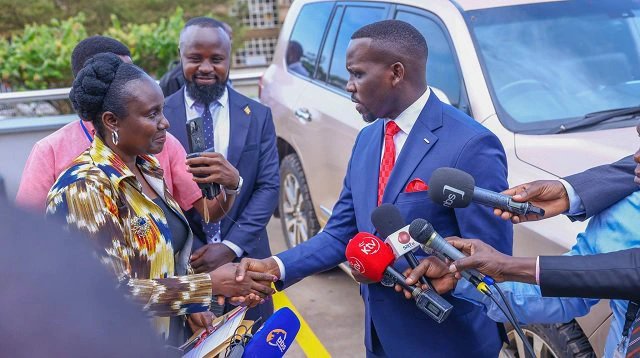

Kampala, Uganda | URN | As Uganda’s 12th Parliament concluded the final day of swearing-in ceremonies on Friday, one political moment quietly stood out beyond the routine oaths, photographs, and celebrations.
Moments after taking the Oath of Allegiance and Oath of Member of Parliament, Nakawa West legislator Joel Ssenyonyi handed over the official vehicles, office keys, security detail, and privileges attached to the Office of the Leader of Opposition (LoP).
The gesture may have lasted only minutes, but politically it carried a powerful message: public office is temporary, and state privileges do not belong to individuals.
In a country where political transitions are often associated with attachment to power, entitlement, and prolonged control of state resources, Ssenyonyi’s conduct contrasted sharply with that of several government officials who continue to enjoy ministerial privileges even after the dissolution of the Cabinet.
President Yoweri Museveni recently dissolved the Cabinet following the end of the previous government term, pending the appointment of a new Cabinet for the new administration cycle.
Yet weeks later, several former ministers continue to be seen using government vehicles, moving with official escorts, and operating with the visibility of active office holders despite technically no longer holding ministerial authority.
The contrast has amplified public debate about accountability, political culture, and respect for public institutions.
In many democracies, the peaceful surrender of office is viewed as one of the clearest tests of leadership maturity. For governance observers, Ssenyonyi’s action projected a rare but important political principle in Uganda: that power belongs to institutions, not individuals.
“This is the essence of constitutional leadership,†said governance analyst Bob Kijja. “When leaders voluntarily relinquish state privileges immediately after leaving office, they reinforce the idea that public resources are held in trust for citizens, not as personal entitlements.â€
He argued that symbolic acts of accountability often shape public trust more deeply than speeches.
“Citizens watch how leaders behave when power is ending. That moment reveals whether someone respects institutions or merely enjoys the benefits attached to office,†he said.
Uganda’s political history has long been shaped by debates over the personalization of power. From prolonged occupancy of offices to disputes over official vehicles, residences, and state privileges, political transitions have often exposed tensions between institutional rules and personal entitlement.
The continued use of ministerial privileges after Cabinet dissolution has repeatedly drawn criticism, particularly during periods of economic hardship when taxpayers question government expenditure.
Legally, Cabinet ministers cease holding office once the President dissolves the Cabinet under constitutional transition processes ahead of the formation of a new government. While caretaker arrangements may continue administratively until new appointments are made, governance experts argue that prolonged use of state privileges without clear accountability mechanisms raises ethical and political concerns.
Political analyst Moses Oker said optics matter significantly in a democracy struggling with public trust deficits.
“When leaders continue enjoying the trappings of office after their mandates expire, citizens interpret it as attachment to privilege rather than service,†Oker said.
“That is why Ssenyonyi’s gesture resonates. It presents a different political image, one where office is treated as temporary stewardship.â€
The Office of the Leader of Opposition is provided for under Uganda’s parliamentary framework and facilitated through public funding under the Administration of Parliament Act.
The office holder is entitled to official transport, security personnel, staff, and office accommodation strictly for the duration of the tenure.
Similarly, ministerial privileges derive from constitutional appointment to the Cabinet and are tied to active office holding.
Article 113 of the Constitution provides for the appointment of ministers by the President with the approval of Parliament, while ministerial authority exists within the tenure of that government arrangement.
Although caretaker conventions may permit limited continuity during transitions, experts say the broader ethical expectation is that leaders exercise restraint in the use of public resources once their mandates lapse.
Ssenyonyi’s action may also reflect a growing generational shift within Uganda’s opposition politics, where younger politicians are increasingly seeking to brand themselves around transparency, modesty, and institutional accountability.
During the 11th Parliament, Ssenyonyi built a profile as one of the most vocal critics of government expenditure, corruption, and misuse of public resources.
By immediately surrendering the privileges attached to the LoP office, analysts say he reinforced consistency between his rhetoric and personal conduct.
On social media, many Ugandans described the gesture as “statesmanlike,†“disciplined,†and “refreshing.â€
Others questioned why surrendering state property should even attract praise, arguing that it ought to be standard practice for all public officials.
But therein lies the deeper issue. Globally, democracies are strengthened not only by elections but also by leaders’ willingness to peacefully relinquish office and privilege.


 Government will not gazette Kijanangoma as King of Tooro for now - Attorney General insists
Ultimate Uganda
Government will not gazette Kijanangoma as King of Tooro for now - Attorney General insists
Ultimate Uganda
 King Oyo’s Body to Arrive Thursday
Ultimate Uganda
King Oyo’s Body to Arrive Thursday
Ultimate Uganda
 Besigye, Lukwago expected to meet Gen. Salim Saleh today at Kapeeke
Ultimate Uganda
Besigye, Lukwago expected to meet Gen. Salim Saleh today at Kapeeke
Ultimate Uganda
 Rwabwogo Advised to ‘Eat His Bishop’ As MK Prepares to Enter State H’se: PREZ MUSEVENI ON HIS WAY OUT
Ultimate Uganda
Rwabwogo Advised to ‘Eat His Bishop’ As MK Prepares to Enter State H’se: PREZ MUSEVENI ON HIS WAY OUT
Ultimate Uganda
0 Comments