
Giant National Flag on Mbuya Hill Becomes Kampala Landmark Amid Military Visibility Debate
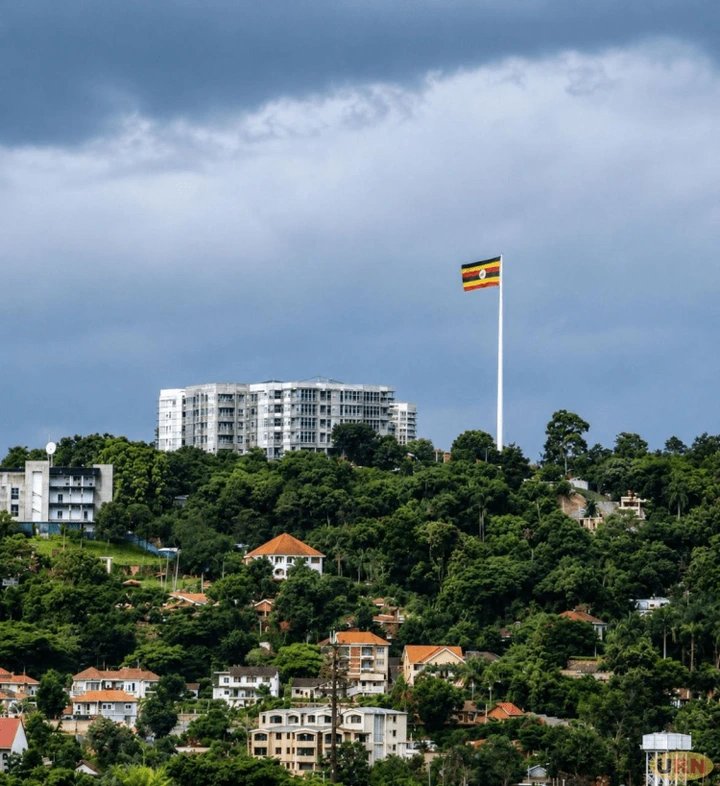

New flag mast at the Uganda People’s Defence Forces (UPDF) and Ministry of Defence and Veteran Affairs headquarters in Mbuya
KAMPALA, Uganda — Perched atop Mbuya Hill, a giant new national flag towering above the Uganda People’s Defence Forces and Ministry of Defence and Veteran Affairs headquarters has rapidly emerged as one of Kampala’s most striking new landmarks, dominating the city skyline as a symbol of patriotism and growing military visibility in public life.
Visible from several parts of the capital, the giant flag mast is part of an ongoing multi-billion-shilling redevelopment of the UPDF/MODVA headquarters complex, a flagship infrastructure project strongly backed by Chief of Defence Forces Gen. Muhoozi Kainerugaba.
The twin-tower military headquarters project, estimated to cost about Shs94 billion, is reportedly more than 75% complete. Beyond the modern glass-and-concrete structures rising over Mbuya Hill, it is the towering illuminated flag — visible miles away at night — that has captured the most attention.
“This flag pole is only halfway complete. Our engineers were waiting for our crane to arrive from abroad to finish it. It’s going to be the tallest in Eastern Africa,†Gen. Muhoozi said, adding, “Rather than salaries and exorbitant allowances, money should be spent in making our Fatherland Uganda great.â€
Supporters have praised the mast as a bold symbol of sovereignty, patriotism and national pride. Critics, however, see it as part of a broader projection of military influence during a politically sensitive period.
Lillian Aber, the women representative for Kitgum District praised the project, describing the giant flag as “a powerful symbol of pride for our nation.†“You are a true patriot, Gen., who truly has Uganda at heart. We applaud you for your strong stand against corruption and wastage of public resources,†she said.
Yet the project has also generated criticism, particularly online, where some Ugandans have questioned whether such symbolic investments align with the country’s socioeconomic realities. Former Uganda People’s Congress spokesperson Okello Lucima dismissed the project as a pointless and futile effort.
“Love for the motherland cannot be coerced,†he said. “Nor do sovereign people need a law to validate and protect their sovereignty. Those impulses are innate.â€
Another critic, Gordon Musiige, questioned the priorities behind the project, arguing that the country faces far more urgent needs. “There are no medicines in hospitals, no books in libraries, no decent housing for soldiers and police, no well-planned roads, and the list goes on and on,†Musiige said.“It won’t be the fi rst ‘patriotic’ project in Africa that many citizens consider unnecessary.â€
Although government officials have yet to publicly disclose the mast’s exact height, its elevated location and sheer scale make it one of the most visually dominant flag installations in Uganda and potentially the wider East Africa.
Infrastructure observers comparing major African flagpoles note that Egypt currently hosts one of the world’s tallest at 202 metres in its New Administrative Capital, while Jordan’s Aqaba flagpole stands at 130 metres. Nigeria’s Kwara State recently unveiled a 70-metre mast promoted as West Africa’s tallest.
While Ministry of Defence has not officially confirmed the Mbuya structure’s measurements, urban planners and skyline observers say its hilltop positioning gives it exceptional visual prominence. The flag mast project aligns with broader government efforts to modernize military infrastructure and project institutional confidence within the UPDF.
Gen. Muhoozi has personally championed the headquarters redevelopment, repeatedly directing UPDF Engineers Brigade teams to accelerate construction works. Critics argue that in a country grappling with unemployment, pressure on healthcare systems, underfunded schools and rising living costs, major spending on symbolic infrastructure risks appearing disconnected from the daily struggles of ordinary citizens.
Others interpret the project through a political lens, arguing that the increasing visibility of military symbolism reflects the growing public and political influence of both the UPDF and Gen. Muhoozi himself.
Uganda’s National Flag and Armorial Ensigns Act of 1962 strictly regulates the display, handling and dignity of the national flag. The law prohibits misuse, disrespectful display and inappropriate exposure of the flag to damaging conditions, while granting the responsible minister authority to prescribe official procedures for its display.
Police backed by the army have in recent years repeatedly reminded the public that the national flag must be treated with dignity and not used casually or commercially in ways that diminish its symbolic value. Located within a state military installation, the Mbuya mast falls squarely within official state use and reflects constitutional obligations under the 1995 Constitution, which mandates the UPDF to defend Uganda’s sovereignty and constitutional order.
Uganda’s national flag, adopted at independence in 1962, carries deep symbolic meaning: black represents the people of Africa, yellow symbolizes sunshine, red stands for brotherhood, while the crested crane embodies peace and gentleness.


 The women who have been in King Oyo’s life
Ultimate Uganda
The women who have been in King Oyo’s life
Ultimate Uganda
 Ex Kagame Guard Commander Tom Byabagamba Dies in Rwandan Prison After 12 Years
Ultimate Uganda
Ex Kagame Guard Commander Tom Byabagamba Dies in Rwandan Prison After 12 Years
Ultimate Uganda
 Government begins salary payments for public sector workers – Reform Committee
Ultimate Uganda
Government begins salary payments for public sector workers – Reform Committee
Ultimate Uganda
 Temangalo land: NSSF, Nzenyi reach agreement
Ultimate Uganda
Temangalo land: NSSF, Nzenyi reach agreement
Ultimate Uganda
0 Comments