
Ugandan general (the president's son) says $3.1bn railway project with Turkish contractor "cancelled"
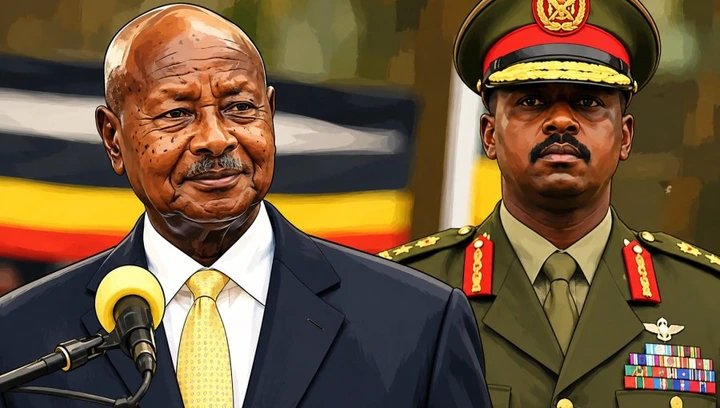

Uganda's €2.7bn ($3.1bn) Standard Gauge Railway (SGR) project could be under threat, with Chief of Defence Forces Gen Muhoozi Kainerugaba proclaiming on June 16 that the contract awarded to Turkey’s Yapi Merkezi had been “cancelledâ€.
There has been no confirmation or denial from the government ministry responsible for the railway project on that score. It seems likely that the military leader – who is the Ugandan president’s son and heir apparent – is looking to pressure Istanbul to turn over critics of the government living in self-exile in Turkey.
In a post on X, Muhoozi, who also serves as senior presidential adviser for special operations and chairs the Patriotic League of Uganda (PLU), said the government had terminated the Turkish firm's contract and instructed supporters to demonstrate outside the Turkish Embassy in Kampala on June 19.
"We have cancelled the contract with the Turkish company to build the SGR. We will get another one that is more worthy of our country! PLU should demonstrate on Friday comrade! ALL Security Services are instructed to leave our supporters/ordinary Ugandans to demonstrate at the Turkish Embassy on Friday 19th June 2026!" Kainerugaba wrote.
He later announced that the protest had been postponed following a request from a member of parliament. "We have postponed it. My demands from the Turks are simple. They should IMMEDIATELY hand over (Fred) Lumbuye or expel him from their country. If they don’t, we will fight them!" he wrote.
Lumbuye is a Ugandan political blogger, activist and government critic who has lived in Turkey for several years. He became widely known for his social media broadcasts and commentary critical of President Yoweri Museveni and the Ugandan government. He has also been associated with opposition circles, particularly supporters of perennial presidential candidate Robert Kyagulanyi (aka Bobi Wine).
Kainerugaba’s inflammatory remarks against Turkey follow months of threats and hostile rhetoric, according to Turkey Today. In April, he demanded $1bn from Ankara, and threatened to cut diplomatic ties and ban Turkish Airlines from Ugandan airspace, again calling for the extradition of Lumbuye.
At the time, Omer Celik, spokesperson for Turkey's ruling Justice and Development Party (AKP), dismissed the Ugandan military man’s remarks. “We know that this person has made similarly baseless statements about other countries,†Celik said, as quoted by Turkey Today. “That statement is wrong and must be corrected. We hope he speaks more carefully from now on.†Kainerugaba later deleted his posts.
As of the afternoon of June 17, neither Uganda's Ministry of Works and Transport nor the SGR Project Secretariat had issued a statement on the status of the Yapi Merkezi contract. Neither had any formal demand for Lumbuye’s extradition been issued.
The latest controversy also marks a sharp reversal in Kainerugaba’s public stance towards the Turkish contractor. In December 2025, he hosted a delegation from Yapi Merkezi at the Special Forces Command headquarters in Entebbe, where company representatives briefed him on project designs, including a planned tunnel crossing military land in Kampala. At the time, he urged the contractor to deliver the project on schedule and supported the commencement of construction activities.
The political development comes less than 18 months after Uganda signed a contract with Yapi Merkezi to construct the country’s first SGR line linking Kampala with the Kenyan border town of Malaba, and ultimately to the Port of Mombasa on the Indian Ocean.
The railway project has already moved beyond the planning stage. Following the signing of the contract in October 2024, preliminary works, including the establishment of worker camps and sleeper manufacturing facilities, have been progressing. That means any formal cancellation would have significant financial and contractual implications.
The railway forms part of a wider East African regional network intended to improve trade connectivity between Uganda, Kenya, Tanzania, Rwanda and South Sudan, all of which are East African Community (EAC) member states.
Financing still on track?
The contract with Yapi Merkezi followed Uganda's decision in 2023 to terminate a 2015 construction contract with China Harbour Engineering Company, under an arrangement requiring the contractor to secure financing from the Chinese government. It was cancelled in 2023, after years of unsuccessful efforts to secure that financing.
At the 2024 contract signing ceremony, then Works Ministry Permanent Secretary Bageya Waiswa said the project would be completed within 48 months using a combination of Ugandan government funding, commercial credit facilities and export credit support. Treasury Secretary Ramathan Ggoobi described the railway as a project capable of significantly reducing freight costs for Uganda's importers and exporters, and therefore a future significant drive of economic growth.
In April, Uganda appointed U.S.-based Citibank as lead arranger for syndicated debt financing linked to the SGR project. Authorities also announced the release of an initial $83mn funding tranche to support preliminary works by Yapi Merkezi on the Malaba–Kampala section of the railway.
Last month, the country said it was preparing to issue its first sovereign sukuk as part of efforts to finance construction. The Ministry of Finance said that proceeds from the sukuk issuance would finance 15% of the estimated cost of the SGR. Export credit agencies are expected to provide 60% of the project financing, while development finance institutions would contribute the remaining 25%.
Uganda's Ministry of Finance also announced on May 29 that the lender had tentatively allocated $650mn under the African Development Fund (ADF), the concessional lending arm of the African Development Bank Group (AfDB), to support construction of the approximately 272-km electrified railway between Kampala and Malaba. As IntelliNews reported, the World Bank has also indicated plans to provide financial support for the project.
According to Ugandan officials, the financing package is expected to be finalised during an appraisal mission scheduled for July. The railway has been promoted by policymakers as a strategic infrastructure investment capable of reducing transport costs between Uganda and the Kenyan port of Mombasa, one of East Africa's busiest trade corridors.
Yapi Merkezi at the forefront of Turkish-East African relations
Yapi Merkezi is one of Turkey’s largest engineering and infrastructure companies and has become a major player in east Africa's railway sector. The company is the lead contractor on Tanzania’s SGR, where it has delivered several sections of the network linking Dar es Salaam to the country's interior. The Tanzanian project is widely regarded as one of Africa's largest rail infrastructure developments and has enhanced the Turkish firm's reputation across the continent.
The Ugandan political dispute therefore carries broader diplomatic implications. Turkey has expanded its economic and political engagement across Africa over the past decade through infrastructure projects, trade initiatives and development partnerships. In Uganda, Turkish companies have increased their presence in construction, manufacturing and logistics, while bilateral trade and diplomatic ties have strengthened steadily.
Turkish Ambassador to Uganda Mehmet Fatih Ak previously described the SGR partnership as a strategic project capable of improving Uganda's access to regional and global markets. Any formal cancellation of the contract could therefore affect not only the railway project but also wider commercial relations between Kampala and Ankara.
Turkey has become an increasingly significant investor and contractor across East Africa, particularly in transport, construction and manufacturing. Apart from Tanzania’s SGR, Turkish firms have played leading roles in major infrastructure projects including airport developments, industrial parks and road construction schemes. Flag carrier Turkish Airlines has developed one of the region’s most extensive route networks, serving key regional hubs including Kampala, Dar es Salaam, Nairobi, Kigali and Mogadishu.
Waiting in the wings
Yoweri Museveni, Uganda’s president since 1986 and one of Africa’s longest-serving leaders, was sworn in on May 12 for another five-year term, extending his rule to four decades and intensifying speculation over a possible succession by his son, Gen. Muhoozi Kainerugaba.
Museveni, 81, secured another term following elections whose outcome was rejected by opposition groups, extending a presidency that has shaped Uganda’s political and security landscape since he seized power after a guerrilla war in 1986.
Africa's third-longest governing president, he won more than 71.65% of the vote according to the official tally, while the country’s most prominent opposition leader, Robert Kyagulanyi (known as Bobi Wine), took 24.72%. Voter turnout stood at 52%, the lowest level since Uganda's return to multiparty politics in 2006.
Attention is increasingly shifting toward Kainerugaba, who is widely viewed by political observers as the ruling establishment’s preferred successor. He has repeatedly signalled his presidential ambitions in public comments and social media posts, fuelling speculation that Uganda may eventually experience its first dynastic political transition.
Analysts say Kainerugaba’s path to power could emerge either through a constitutional arrangement backed by the ruling National Resistance Movement (NRM), which holds a dominant parliamentary majority, or through a more informal consolidation of power centred on military influence.
An outright electoral victory may prove more difficult given the continuing popularity of Bobi Wine, who has twice challenged Museveni for the presidency and rejected the outcome of the January election.
Meanwhile, political figures, military officials and ruling-party elites have increasingly sought to align themselves with Kainerugaba as Museveni ages. His growing prominence has intensified concerns among critics and civil-society groups over democratic succession, military influence in politics and the concentration of power within Uganda’s ruling family.


 Government will not gazette Kijanangoma as King of Tooro for now - Attorney General insists
Ultimate Uganda
Government will not gazette Kijanangoma as King of Tooro for now - Attorney General insists
Ultimate Uganda
 King Oyo’s Body to Arrive Thursday
Ultimate Uganda
King Oyo’s Body to Arrive Thursday
Ultimate Uganda
 Besigye, Lukwago expected to meet Gen. Salim Saleh today at Kapeeke
Ultimate Uganda
Besigye, Lukwago expected to meet Gen. Salim Saleh today at Kapeeke
Ultimate Uganda
 Rwabwogo Advised to ‘Eat His Bishop’ As MK Prepares to Enter State H’se: PREZ MUSEVENI ON HIS WAY OUT
Ultimate Uganda
Rwabwogo Advised to ‘Eat His Bishop’ As MK Prepares to Enter State H’se: PREZ MUSEVENI ON HIS WAY OUT
Ultimate Uganda
0 Comments