
A Makerere University registrar walked out of her matrimonial home in 2005. Court granted husband divorce
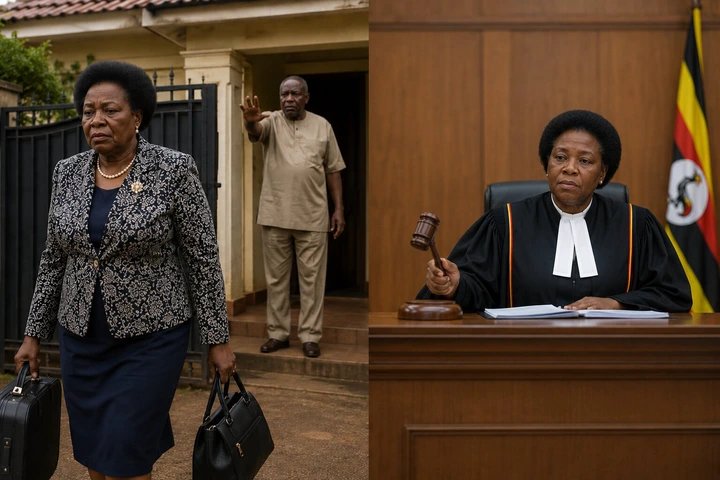

On the morning of December 13, 2005, Victoria Awor, then working as an assistant registrar at Makerere University, packed her bags and left her matrimonial home at Plot 415B Nakasero Hill Road in Kampala.
She left behind her husband Alex Bwangamoi Okello and their three children. She moved into a house at the university, and when she retired, she did not return to her husband. She went instead to her village in Gulu, and later to Bobi in Omoro District, where she currently lives.
Okello and Awor exchanged vows on January 6, 1990, at the All Saints Cathedral in Kampala in a ceremony conducted under the Marriage Act.
They had three children together, who are all now adults.
After waiting for 20 years for Awor to return to their home, Okello filed for divorce in 2025, citing two grounds: cruelty and desertion.
Awor was served with the court papers twice, but she did not respond. She did not even appear in court, and the judge, Justice Celia Nagawa, ordered the case to proceed without her.
Okello said their marriage was marked from its early years by relentless quarrelling. He told the court that Awor was “persistently quarrelsome,†that she constantly walked out of the matrimonial home, and that whenever he faced difficulties, she refused to offer him any support whatsoever.
He said the marriage subjected him to “untold emotional and psychological torture and stress.â€
Because Awor never appeared in court or filed any documents contradicting Okello’s claims, Justice Nagawa accepted Okello’s account as unchallenged.
She described cruelty as conduct that is willful and unjustifiable, and serious enough to endanger a person’s life, health, or mental wellbeing, or to make them reasonably fear such harm.
She found that Awor’s behaviour had crossed that line. She said the persistent quarrels, the repeated abandonment of the home, and the complete refusal to support Okello during hard times had “affected her husband mentally, caused him emotional distress, and undermined his mental peace.â€
Justice Nagawa concluded that this amounted to cruelty sufficient to end the marriage.
On desertion, she applied a different legal test. She had to establish that Awor had physically left, that she intended to end the marriage permanently, that Okello had not agreed to the separation, and that there was no good reason for her to have left.
Justice Nagawa found all four elements present in the case.
She noted that Awor had lived away from the matrimonial home for close to 19 years by the time the petition was filed, far exceeding the two-year minimum required under Section 4(f) of the Divorce Act.
When she left the job at Makerere, she still did not go back to her husband. She went to Omoro. Justice Nagawa said that decision “clearly demonstrates the animus deserindi,†a Latin phrase meaning the intention to permanently end the union.
Okello had tried to get her back. He reached out to the couple’s best man and matron and also approached the Bishop of Gulu Church of Uganda. All attempts at reconciliation failed.
On June 5 2026, the court granted Okello his prayers and dissolved the marriage.
The court also distributed five pieces of land the couple had acquired during the marriage.
The land at Plot 4 Onono Road in Gulu, registered in Okello’s name since 1997, was confirmed as his. Okello also got another piece of land in Kireka.
A commercial plot in Bweyale along the Kampala-Gulu Road, the court ordered, will be split equally, 50/50, between the two.
The land in Lugazi was awarded to Awor, and she was also given a piece of land in Bobi, Omoro, the area where she now lives.


 The women who have been in King Oyo’s life
Ultimate Uganda
The women who have been in King Oyo’s life
Ultimate Uganda
 Ex Kagame Guard Commander Tom Byabagamba Dies in Rwandan Prison After 12 Years
Ultimate Uganda
Ex Kagame Guard Commander Tom Byabagamba Dies in Rwandan Prison After 12 Years
Ultimate Uganda
 Government begins salary payments for public sector workers – Reform Committee
Ultimate Uganda
Government begins salary payments for public sector workers – Reform Committee
Ultimate Uganda
 Temangalo land: NSSF, Nzenyi reach agreement
Ultimate Uganda
Temangalo land: NSSF, Nzenyi reach agreement
Ultimate Uganda
0 Comments