
FROM COFFEE CLAIMS TO VICTORY: How Rogers Bulegeya’s Shs450 Million Saga Became a Test of NRM’s Grassroots Promise
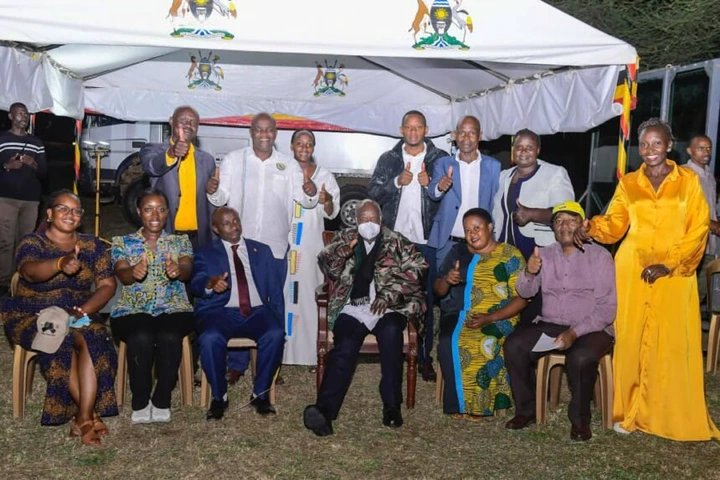

MASAKA, Uganda — Dressed in a crisp white shirt and black trousers, Rogers Bulegeya stood beside Ms. Cissy, smiles replacing months of anxiety as they received millions of shillings disbursed by State House through Minister Balaam Barugahara. For Bulegeya and his fellow suppliers, the payout brought an end to a protracted financial ordeal.
For six months, a high-stakes controversy involving coffee seedlings, unpaid supplier claims, and grassroots mobilization had remained trapped in a maze of unmet expectations, lingering questions, and administrative delays.
Behind the political gatherings and community mobilization drives was a group of suppliers who had committed significant personal financial resources to support a massive coffee seedling distribution campaign during the 2026 mobilization period — only to spend half a year fighting to get paid.
Now, the saga involving Bulegeya, the National Resistance Movement (NRM) Chairperson for Masaka City, and his fellow suppliers has taken a positive turn. Bulegeya has lauded President Yoweri Museveni’s leadership and the NRM government for demonstrating a genuine commitment to listening to grassroots actors and resolving local grievances.
The Shs600 Million Dispute
At the heart of the dispute were coffee supplies delivered through R and R Coffee Suppliers, a company associated with Bulegeya, along with claims from other local suppliers, including Ms. Cissy.
According to figures provided by the affected parties, the outstanding claims totaled Shs600 million — with approximately Shs450 million tied to R and R Coffee Suppliers and Shs150 million linked to Ms. Cissy’s supply.
The suppliers maintained that the coffee seedlings were distributed directly to community members as part of a broader government effort to encourage coffee farming, deepen grassroots political engagement, and promote household economic empowerment.
Six Months of Waiting and Bureaucratic Deadlocks
The path to settlement was fraught with administrative hurdles.
Suppliers reported that after fulfilling their deliveries, they were left in limbo for nearly six months as officials debated documentation, institutional responsibility, and verification procedures. The prolonged delay generated severe financial strain and frustration among suppliers who had leveraged their own capital to ensure the distribution reached the intended beneficiaries.
The standoff also ignited internal friction regarding institutional accountability. One notable flashpoint involved Ms. Cissy’s claim, which Hon. Justine Nameere publicly distanced herself from, denying any responsibility or requirement to settle the supplier’s balance.
The conflicting narratives underscored the critical need for clear contractual agreements, formal documentation, and robust accountability mechanisms when private suppliers engage in public mobilization initiatives.
The Turning Point
The breakthrough came after the suppliers systematically escalated their claims through formal government channels.
The matter eventually reached State House, where the Office of the State House Comptroller, headed by Jane Barekye, initiated a comprehensive verification process to validate the claims and establish a path forward.
The climax of the resolution unfolded during high-level engagements in Sembabule, where Minister Balaam Barugahara directly interacted with the aggrieved suppliers — an encounter captured on video. For the suppliers, who had endured months of uncertainty, the interaction marked the official recognition and validation of their efforts.
Rogers Bulegeya’s Message
Reflecting on the resolution, Bulegeya commended President Museveni and the NRM leadership, stating that the outcome proved the importance of maintaining an active, responsive connection with grassroots cadres and local business owners.
He emphasized that initiatives linking agriculture with political mobilization yield lasting benefits when communities are empowered economically.
For Bulegeya, the coffee program was far more than a short-term campaign strategy; it was a long-term development vehicle. “A coffee seedling planted today represents guaranteed household income for tomorrow,†he noted.
Coffee, Politics, and Masaka’s Shifting Dynamics
Beyond the financial dispute, the coffee initiative has reshaped the local political narrative in Masaka City.
Organizers emphasize that distributing seedlings through structures tied to President Museveni’s campaign created a direct, tangible bridge between political rhetoric and community livelihood. They attribute this strategy to a visible shift in local political support, pointing to an increase in President Museveni’s vote share in Masaka City from 21 percent in previous cycles to approximately 33 percent.
While political analysts note that election outcomes are influenced by a combination of factors — including candidate performance, organizational logistics, and local dynamics — the integration of economic empowerment into campaign strategy clearly left a mark on the region.
Beyond the Shillings
The Masaka coffee saga highlights a broader narrative about the quiet operators behind major national mobilization programs. Suppliers, organizers, and grassroots actors frequently absorb significant financial risks to make public initiatives succeed, yet their sacrifices often remain unacknowledged until public disputes erupt.
As Uganda’s primary export and economic backbone, coffee supports millions of households across the nation. For the residents of Masaka who received the seedlings, the true measure of success will be whether those plants mature into thriving, income-generating gardens.
For Rogers Bulegeya and his fellow suppliers, the six-month journey stands as a testament to persistence, accountability, and the power of grassroot advocacy. Ultimately, the Masaka coffee saga serves as a reminder that the credibility of any political promise relies on honoring the commitments made to the people who build it from the ground up.


 Starlink goes live in Uganda; price comparisons against MTN, Airtel
Ultimate Uganda
Starlink goes live in Uganda; price comparisons against MTN, Airtel
Ultimate Uganda
 NSSF sets September 24 for Annual Members Meeting as savers await interest rate declaration
Ultimate Uganda
NSSF sets September 24 for Annual Members Meeting as savers await interest rate declaration
Ultimate Uganda
 Boda boda riders launch e-commerce, digital loans platform
Ultimate Uganda
Boda boda riders launch e-commerce, digital loans platform
Ultimate Uganda
 Rwanda: We Cannot Sit and Watch As Illicit Alcohol Kills People - Kagame
Ultimate Uganda
Rwanda: We Cannot Sit and Watch As Illicit Alcohol Kills People - Kagame
Ultimate Uganda
0 Comments