
Uganda, Japan sign contract for construction of new Karuma Bridge

The new Karuma Bridge is expected to improve road safety, reduce travel time and support economic growth by ensuring uninterrupted movement of passengers and cargo along the corridor.
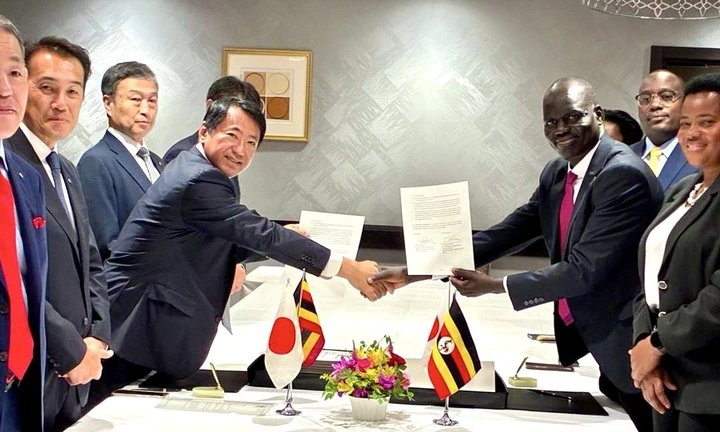
Ugandan and Japanese officials pose after signing the civil works contract for the construction of the new Karuma Bridge in Tokyo, Japan. (Photo/Handout)
Tokyo, Japan: Uganda has signed the civil works contract for the construction of the new Karuma Bridge along the strategic Kampala–Gulu Highway, marking a major milestone in efforts to improve transport connectivity, road safety and regional trade.
The contract was signed during a ceremony held in Tokyo on Friday, with the project being financed by the Government of Japan through the Japan International Cooperation Agency (JICA).
Representing the Acting Permanent Secretary of the Ministry of Works and Transport, Commissioner for National Roads Eng. Isaac Wani said the new bridge will enhance the efficiency of one of Uganda’s busiest transport corridors linking the central region to northern Uganda and neighbouring countries.
“The project, supported by the Government of Japan through the Japan International Cooperation Agency (JICA), will improve safety, connectivity, trade and regional integration along the Kampala–Gulu corridor,†Eng. Wani said.
The civil works will be undertaken by Zenitaka Corporation, a Japanese engineering and construction company selected to execute the project.
The new bridge is expected to replace the aging Karuma Bridge, which has served as a critical crossing over the River Nile for decades but has increasingly faced structural and maintenance challenges due to heavy traffic volumes.
The Kampala–Gulu Highway forms part of the Northern Corridor, a key regional transport route connecting Uganda to South Sudan and facilitating trade with other countries in the East African region.
Government says the project is expected to improve road safety, reduce travel time and support economic growth by ensuring uninterrupted movement of passengers and cargo along the corridor.
Advertiser's Message
The bridge will also strengthen regional integration by improving connectivity between Uganda and neighbouring countries that rely on the Northern Corridor for trade.
The project forms part of Uganda’s broader infrastructure development agenda aimed at modernising the national road network and supporting industrialisation.
The Ugandan delegation that witnessed the contract signing included H.E. Tophace Kaahwa, Uganda’s Ambassador to Japan; Pius Perry Biribonwoha, Solicitor General; Eng. Isaac Wani, Commissioner for National Roads at the Ministry of Works and Transport; Nurh Byarufu, Minister Counsellor at the Embassy of Uganda in Japan; and Elizabeth Zungu Akimpye, Acting Head of Commercial Law.
The contract signing marks the official commencement of the civil works phase, with construction expected to begin after mobilisation by the contractor.
The project is one of several major infrastructure initiatives being implemented with support from the Government of Japan through JICA to improve Uganda’s transport network and promote sustainable economic development.


 Government will not gazette Kijanangoma as King of Tooro for now - Attorney General insists
Ultimate Uganda
Government will not gazette Kijanangoma as King of Tooro for now - Attorney General insists
Ultimate Uganda
 King Oyo’s Body to Arrive Thursday
Ultimate Uganda
King Oyo’s Body to Arrive Thursday
Ultimate Uganda
 Besigye, Lukwago expected to meet Gen. Salim Saleh today at Kapeeke
Ultimate Uganda
Besigye, Lukwago expected to meet Gen. Salim Saleh today at Kapeeke
Ultimate Uganda
 Rwabwogo Advised to ‘Eat His Bishop’ As MK Prepares to Enter State H’se: PREZ MUSEVENI ON HIS WAY OUT
Ultimate Uganda
Rwabwogo Advised to ‘Eat His Bishop’ As MK Prepares to Enter State H’se: PREZ MUSEVENI ON HIS WAY OUT
Ultimate Uganda
0 Comments