
UHRC Boss Wangadya Breaks Down Before MPs: “I Have Never Known Peace, They Have Turned My Life Into Hellâ€
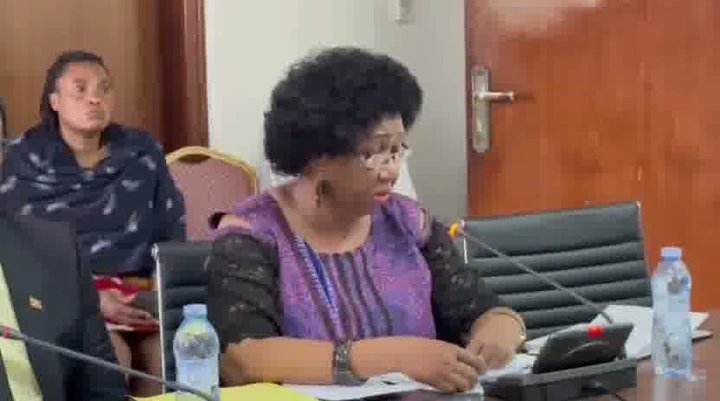

Uganda Human Rights Commission (UHRC) Chairperson Mariam Wangadya delivered an emotional and at times tearful defence of her leadership before Parliament’s Committee on Legal Affairs, apologising to President Yoweri Museveni, Parliament and Ugandans over the turmoil engulfing the constitutional body.
Appearing before MPs on legal commitee , where she was summoned to answer allegations raised by fellow commissioners, Wangadya painted a picture of a commission crippled by internal conflict, saying she had been bullied, humiliated, intimidated and psychologically tortured by some of her colleagues ever since assuming office.
She told legislators that after serving 17 years as a commissioner at the Uganda Human Rights Commission and another eight years as Deputy Inspector General of Government, she had never experienced the level of hostility she now faces.
“I could never have imagined that a head of institution could be bullied, humiliated, harassed, taunted and disrespected to this extent,†Wangadya said.
She recalled serving under the Commission’s pioneer chairperson Margaret Sekaggya and later under the late Med Kaggwa, saying such conduct would never have been tolerated.
She also reflected on her years at the Inspectorate of Government under Justice Irene Mulyagonja, saying she and fellow deputies always respected institutional leadership.
“I cannot fathom that we, her deputies, could ever have done anything near what is being done to me.â€
At one point, Wangadya struggled to hold back tears as she spoke about her personal circumstances.
She revealed that she has been a single mother since her son was only three weeks old and remains the sole breadwinner for her son, his wife and grandchild.
She told MPs that writing a resignation letter would never be an easy decision for someone carrying such family responsibilities.
Speaking on behalf of the Commission, Wangadya apologised publicly.
“On behalf of the Uganda Human Rights Commission as currently constituted, I apologise to His Excellency the President, this Parliament, all Ugandans and stakeholders. We have let you down.â€she said
Responding to accusations that she deliberately sidelined fellow commissioners from official activities, Wangadya dismissed the allegations as false.
She explained that tribunal work had been divided into two panels covering all commissioners but claimed some commissioners regularly failed to attend sessions despite receiving sitting allowances.
According to her, their absence often denied the tribunal the quorum required to hear cases, exposing Commission decisions to possible legal challenges.
One of the biggest accusations against Wangadya has been that she arbitrarily closes human rights files without allowing full hearings.
She rejected the allegations, insisting such decisions are lawful and are made by the Commission sitting as a tribunal rather than by herself alone.
She explained that hearing complaints is not itself one of the Commission’s constitutional functions but rather a judicial power granted under Article 53 of the Constitution.
Wangadya noted that Uganda and Canada are the only national human rights institutions in the world empowered to sit as courts and award compensation for human rights violations.
She argued that tribunal hearings form only a small component of the Commission’s wider mandate.
“The Commission would continue to function even if there were no tribunal decisions.â€
Why files are closed
The Chairperson outlined several reasons why some complaints are dismissed before reaching full hearings.
She said many complaints are filed outside the legal five-year limitation period provided under the Uganda Human Rights Commission Act.
Rather than spending scarce public resources hearing cases that are legally time-barred, she said such files are closed administratively and complainants informed.
She also cited cases where complaints fail to disclose a genuine human rights violation.
For example, road traffic accidents caused by negligence are sometimes wrongly filed as human rights violations even though they belong before ordinary courts.
Other complaints, she said, are filed against the wrong respondents.
She gave the example of mob justice incidents where victims are killed by angry crowds but families sue the Attorney General or Police instead of the actual perpetrators.
According to Wangadya, such matters should not consume the Commission’s limited resources.
“We won’t sanitise criminalsâ€
One of the strongest moments of her presentation came when she defended the Commission’s decision to reject some complaints brought by convicted criminals.
She said many prisoners accused of murder, rape, aggravated robbery and defilement file torture and unlawful detention complaints simply to weaken criminal cases against them.
She cited the example of a man who admitted defiling his six-year-old niece before later complaining that police kept him in custody for more than 48 hours before taking him to court.
Wangadya questioned whether a serious human rights institution should prioritise such complaints.
“What message would we be sending to victims of crime?â€
She insisted the Commission would not become a centre for protecting violent criminals from accountability.
“I will continue to resist turning the Commission into a centre for sanitisation of criminals.â€
She further alleged that many torture complaints arrive supported by forged medical reports, saying the Commission has a duty to protect both complainants and the State from fraudulent claims.
She also said employment disputes, land conflicts and other matters filed before the wrong institutions are routinely rejected because they belong before specialised courts.
Defends her legal authority
Wangadya reminded MPs that the Constitution requires the Chairperson of the Uganda Human Rights Commission to be qualified to serve as a High Court judge.
She noted she has practised as an advocate for more than 30 years and argued that determining whether a complaint is legally admissible falls squarely within her responsibilities.
“How can that be turned into a crisis?†she asked.
Foreign travel accusations
Addressing claims that she denied commissioners opportunities to travel abroad, Wangadya said the allegations were misleading.
She described herself as someone who dislikes flying and only travels when absolutely necessary.
She revealed that she had previously sent Commissioner Vasariza to Moscow on official duty, where he travelled business class and received full allowances.
By contrast, she said she herself attended a similar conference the previous year, flew economy class and claimed no allowance.
She added that many invitations addressed to the Chairperson are actually intended for technical staff rather than commissioners.
Commissioner died after replacing colleague
One of the most emotional moments came when Wangadya recounted the death of Commissioner Father Lokodo.
She said she had originally nominated another commissioner to attend a Geneva meeting, but the commissioner declined to travel.
Father Lokodo agreed to attend instead.
“I regret that decision,†Wangadya said.
She explained that she knew he had been slightly unwell but had no idea the illness was so serious.
While in Geneva, Father Lokodo collapsed and later died.
She also claimed the same commissioner later declined another official assignment to Nairobi without informing her.
Vehicle misuse allegations
Wangadya also accused some commissioners of repeatedly damaging official vehicles.
She claimed one commissioner had been allocated three vehicles, including a brand-new one, but each was damaged within weeks.
Another commissioner, she said, continues to maintain the same vehicle in excellent condition.
She further alleged that official Commission vehicles are being used to campaign for elective political offices.
Raises concerns over partisan politics
The Chairperson questioned whether some commissioners remain politically neutral as required by law.
She alleged that two commissioners openly contested parliamentary elections, wore party colours during official Commission activities and even sought leadership positions within political party structures.
According to Wangadya, such conduct undermines public confidence in the Commission’s impartiality.
She cited Section 5 of the Uganda Human Rights Commission Act, arguing commissioners should not hold executive positions in political parties.
“How can someone from another political party feel confident that their complaint will be handled with neutrality?†she asked.
“Commission meetings leave me in tearsâ€
Perhaps the most emotional testimony centred on Commission meetings.
Wangadya admitted she had not convened meetings since March this year.
She explained that while the law does not require monthly meetings, she fears the hostile environment created by some commissioners.
“They have turned those meetings into hell for me.â€
She alleged that commissioners secretly organise themselves before meetings, insult her, yell at her, point fingers, record discussions and leak confidential conversations to the media.
“Every meeting I convene leaves me in tears.â€
She said before entering meetings, she leaves her secretaries, personal assistant, drivers and bodyguards praying that she does not emotionally break down.
“I have never known peace since taking oath as Chairperson.â€
She further claimed one commissioner told her she had previously engineered the removal of former Woman MP Irene Muloni from Cabinet and warned that Wangadya herself would also be removed from office.
The committee chairperson repeatedly interrupted her, urging her to avoid personal accusations and focus on policy matters.
Claims coordinated smear campaign
Wangadya alleged that fellow commissioners compiled false dossiers accusing her of corruption and distributed them to the State House Anti-Corruption Unit, Police, Inspectorate of Government and several other government agencies.
She claimed those allegations fuelled sustained attacks against her through mainstream media, social media and bloggers, causing severe psychological distress.
According to her, the parliamentary inquiry itself was never intended to seek justice but rather to continue what she described as mental torture.
Mediation efforts failed
Despite the bitter divisions, Wangadya said she had attempted to reconcile with her colleagues.
She revealed that Commissioner Lamix Omara-Apita had initiated mediation efforts and even approached former Solicitor General Peter Atoke to serve as an independent mediator.
However, Wangadya said she has seen no willingness from the other commissioners to participate.
“Their only mantra is that we should go.â€
MPs challenge Wangadya’s human rights interpretation
After her presentation, committee members immediately began raising concerns.
One MP questioned Wangadya’s position regarding suspects detained beyond the constitutional 48-hour limit.
The legislator asked whether she believed constitutional protections should still apply regardless of the seriousness of the offences involved.
“You don’t believe that a suspect is entitled to be produced before court within 48 hours as required by the Constitution? Can we simply ignore that constitutional command because of the gravity of the allegations?†the MP asked.
The committee is expected to continue hearing evidence from commissioners as it investigates the deepening leadership crisis threatening operations at the Uganda Human Rights Commission.


 Government will not gazette Kijanangoma as King of Tooro for now - Attorney General insists
Ultimate Uganda
Government will not gazette Kijanangoma as King of Tooro for now - Attorney General insists
Ultimate Uganda
 King Oyo’s Body to Arrive Thursday
Ultimate Uganda
King Oyo’s Body to Arrive Thursday
Ultimate Uganda
 Besigye, Lukwago expected to meet Gen. Salim Saleh today at Kapeeke
Ultimate Uganda
Besigye, Lukwago expected to meet Gen. Salim Saleh today at Kapeeke
Ultimate Uganda
 Rwabwogo Advised to ‘Eat His Bishop’ As MK Prepares to Enter State H’se: PREZ MUSEVENI ON HIS WAY OUT
Ultimate Uganda
Rwabwogo Advised to ‘Eat His Bishop’ As MK Prepares to Enter State H’se: PREZ MUSEVENI ON HIS WAY OUT
Ultimate Uganda
0 Comments